Ara (constellation)
A southern constellation representing an altar, rich in star clusters.

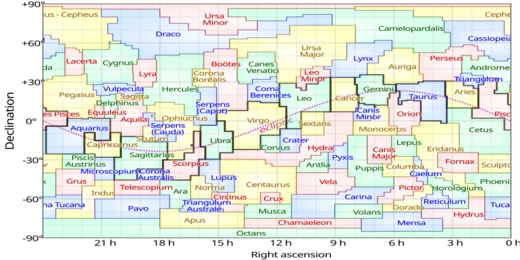
Ara, meaning "the Altar" in Latin, is a constellation in the southern sky, bordered by Scorpius, Telescopium, Triangulum Australe, and Norma. The ancient Greeks called it Βωμός (Bōmǒs), and it was one of the 48 classical constellations cataloged by the 2nd-century astronomer Ptolemy. Today, it is one of the 88 modern constellations officially recognized by the International Astronomical Union.
The brightest star in Ara is Beta Arae, an orange supergiant with an apparent magnitude of 2.85 that stays nearly constant. It is only slightly brighter than the blue-white Alpha Arae. Seven star systems within the constellation are known to have planets. Among them, the Sun-like star Mu Arae hosts four known planets, and Gliese 676, a binary red dwarf system bound by gravity, also has four known planets.
The northwestern part of Ara is crossed by the Milky Way. Inside the constellation lies Westerlund 1, a super star cluster that contains Westerlund 1-26, a red supergiant and one of the largest stars ever discovered.
In ancient Greek mythology, Ara was identified as the altar where the gods made their first offerings and formed an alliance before defeating the Titans. It was one of the southernmost constellations recorded by Ptolemy, and the poet Aratus had already noted it in 270 BC as lying close to the horizon. Ptolemy's Almagest includes stars as far south as Gamma Arae. Professor Bradley Schaefer has suggested that ancient observers must have been able to see as far south as Zeta Arae to make out a pattern resembling an altar.
Illustrations of Ara usually show it as a compact classical altar, with its smoke rising southward, though depictions have varied. In a 1482 woodcut of Gaius Julius Hyginus's *Poeticon Astronomicon*, the altar is surrounded by demons. Johann Bayer, in 1603, drew it as an altar with burning incense. Frankincense burners, known as Mabkhara, were common in the Levant, especially Yemen, and required live coals or burning embers called Jamra'. The Dutch uranographer Willem Blaeu depicted Ara as a sacrificial altar with a burning animal offering, its smoke rising northward, represented by Alpha Arae.
Quick Facts
- Ra
- 16 · 34 · 16.9497–18 · 10 · 41.3407
- Dec
- -45.4859734–-67.6905823
- Family
- Hercules
- Areatotal
- 237
- Arearank
- 63rd
- Numberbfstars
- 17
- Numberbrightstars
- 2
- Numbernearbystars
- 3
- Brighteststarname
- β Ara
Facts from the source article.
Lore & Background
In ancient Greek mythology, Ara was identified as the altar where the gods first made offerings and formed an alliance before defeating the Titans. One of the southernmost constellations depicted by Ptolemy, it had been recorded by Aratus in 270 BC as lying close to the horizon, and the Almagest portrays stars as far south as Gamma Arae. Professor Bradley Schaefer proposes such Ancients must have been able to see as far south as Zeta Arae, for a pattern that looked like an altar.
In illustrations, Ara is usually depicted as a compact classical altar with its smoke 'rising' southward, though depictions vary. In the early days of printing, a 1482 woodcut of Gaius Julius Hyginus's classic Poeticon Astronomicon depicts the altar as surrounded by demons. Johann Bayer in 1603 depicted Ara as an altar with burning incense. Willem Blaeu, a Dutch uranographer of the 16th and 17th centuries, drew Ara as an altar for sacrifices, with a burning animal offering whose smoke rises northward, represented by Alpha Arae.
The Castle of Knowledge by Robert Record of 1556 lists the constellation stating that 'Under the Scorpions tayle, standeth the Altar.' A decade later a translation of a work by Marcellus Palingenius of 1565, by Barnabe Googe states 'Here mayst thou both the Altar, and the myghty Cup beholde.'
Reader's Guide
Ara covers 237.1 square degrees, ranking 63rd of the 88 modern constellations by area. Its position in the Southern Celestial Hemisphere means the whole constellation is visible to observers south of 22°N. The Milky Way crosses the northwestern part of Ara, providing rich star fields and several open clusters, notably NGC 6200, and diffuse nebulae including the bright cluster/nebula pair NGC 6188 and NGC 6193. The brightest globular cluster in Ara is NGC 6397, one of the closest globular clusters to the Solar System at a distance of 6,500 light-years.
Within Ara lies Westerlund 1, a super star cluster that contains the red supergiant Westerlund 1-26, one of the largest stars known, with an estimated radius between 1,168 and 2,519 times that of the Sun. The constellation also hosts seven star systems with known planets, including the sunlike star Mu Arae with four planets, and the binary red dwarf system Gliese 676 with four planets. Although Ara lies close to the heart of the Milky Way, two spiral galaxies (NGC 6215 and NGC 6221) are visible near the star Eta Arae.
Did You Know?
- Beta Arae is the brightest star in Ara with an apparent magnitude of 2.85, marginally brighter than Alpha Arae.
- Seven star systems in Ara are known to host planets, including the sunlike star Mu Arae with four planets.
- NGC 6397, a globular cluster in Ara, is one of the closest globular clusters to the Solar System at 6,500 light-years away.
More in Constellations, Part 2 1-24
Spotted an error? Know more?
Reader corrections go straight into our review queue. Suggest an edit · How this site is sourced