Apus
A southern constellation named for the footless bird-of-paradise.

Apus is a small constellation in the southern sky, representing a bird-of-paradise. Its name means 'without feet' in Greek, reflecting the Western misconception that the bird-of-paradise lacked feet. The constellation is notable for its five brightest stars, all of which are reddish in hue, an unusual characteristic among constellations.
Quick Facts
- Abbreviation
- Aps
- Genitive
- Apodis
- Pronounce
- ˈ · eɪ · p · ə · s, genitive ˈ · eɪ · p · ə · ,_ · ' · æ · p · ə · ,_ · ə · ' · p · oʊ · - · d · ᵻ · s
- Symbolism
- The Bird-of-Paradise
- Ra
- 13 · 51 · 07.5441 – 18 · 27 · 27.8395
- Dec
- -67.4800797 to -83.1200714
- Family
- Bayer
- Areatotal
- 206
- Arearank
- 67th
- Numbermainstars
- 4
- Numberbfstars
- 12
- Numberbrightstars
- 0
Facts from the source article.
Lore & Background
Apus was one of twelve constellations published by Petrus Plancius from the observations of Pieter Dirkszoon Keyser and Frederick de Houtman, who sailed on the first Dutch trading expedition to the East Indies. It first appeared on a 35-cm diameter celestial globe published in 1598 in Amsterdam by Plancius with Jodocus Hondius. De Houtman included it in his southern star catalogue in 1603 under the Dutch name 'De Paradijs Voghel', and Plancius called it 'Paradysvogel Apis Indica'. The name 'Apis' (Latin for 'bee') is assumed to have been a typographical error for 'avis' ('bird'). The constellation's first known appearance in a celestial atlas was in Johann Bayer's Uranometria of 1603, where it was called 'Apis Indica'. The name 'Apus' is derived from the Greek 'apous', meaning 'without feet', referring to the Western misconception that the bird-of-paradise had no feet because specimens arrived in Europe with their feet and wings removed. The constellation later lost some of its tail when Nicolas-Louis de Lacaille used those stars to establish Octans in the 1750s.
Reader's Guide
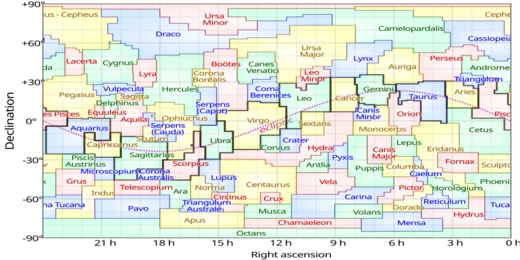
Apus covers 206.3 square degrees, ranking 67th among the 88 modern constellations. Its position in the Southern Celestial Hemisphere means it is visible to observers south of 7°N. The constellation is bordered by Ara, Triangulum Australe, Circinus, Musca, Chamaeleon, Octans, and Pavo. Its three-letter abbreviation, adopted by the International Astronomical Union in 1922, is 'Aps'. The official boundaries were set by Belgian astronomer Eugène Delporte in 1930. Lacaille gave twelve stars Bayer designations, labeling them Alpha through Kappa. The five brightest stars are all red-tinged, which is unusual. Alpha Apodis (formally named Paradys) is an orange giant with 48 times the Sun's diameter and 928 times its luminosity. Delta Apodis is a double star with components 103 arcseconds apart, visible with the naked eye. Two star systems have been found to have planets. The Milky Way covers much of the constellation's area, and it contains two prominent globular clusters: NGC 6101 and IC 4499.
Did You Know?
- The name 'Apus' means 'without feet' in Greek, based on the false belief that bird-of-paradise specimens had no feet.
- Alpha Apodis was formally named 'Paradys' on 18 May 2025.
- Delta Apodis is a double star whose two components are 103 arcseconds apart and can be resolved with the naked eye.
- Two star systems in Apus have been found to have planets, discovered by doppler spectroscopy.
More in Constellations, Part 2 1-24
Spotted an error? Know more?
Reader corrections go straight into our review queue. Suggest an edit · How this site is sourced