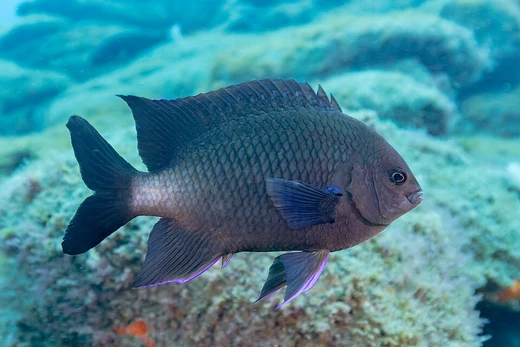
Tomato clownfish
A Western Pacific clownfish with immunity to Marine Velvet disease.

The tomato clownfish (Amphiprion frenatus) is a species of marine fish in the family Pomacentridae, native to the Western Pacific from Japan to Indonesia. It is notable for its symbiotic mutualism with sea anemones, its strong immunity to Marine Velvet disease, and its popularity in aquaria.
Quick Facts
- Taxon
- Amphiprion frenatus
Facts from the source article.
Lore & Background
The tomato clownfish is bright orange-red with a white head bar behind the eyes, joined over the head and outlined in black. Females are mainly blackish on the sides, while males are smaller and red overall. Juveniles are darker red with two or three white bars. The only color variation is sex-related, with females having darker coloration or dark spots on their sides.
In the wild, this species forms symbiotic mutualisms with sea anemones, typically the bubble-tip anemone (Entacmaea quadricolor), though some authorities also report association with the sebae anemone (Heteractis crispa). Clownfish are sequential hermaphrodites: they develop into males first, then become females. A group has a strict dominance hierarchy, with the largest and most aggressive fish being female, and only one male and one female reproduce through external fertilization.
The tomato clownfish has a strong and long-lived immunity to Marine Velvet disease (amyloodiniosis), caused by Amyloodinium ocellatum. This immunity results from several nonlethal infections and the production of specific antibodies, with an estimated weight of 816 kD.
Reader's Guide
The tomato clownfish is significant as a species with a well-documented immunity to Marine Velvet disease, a serious ectoparasitic disease affecting warmwater marine fishes. This immunity, gained through nonlethal infections and specific antibody production, distinguishes it among clownfishes. In aquaria, it is a popular pet, though it requires at least 20 US gallons of tank volume and is known to be aggressive and territorial when mature, even toward other clownfish species. It thrives without a host anemone, sometimes adopting corals, and eats dried algae, mysis shrimp, and brine shrimp. It can be bred in captivity, with fry fed baby brine shrimp and rotifers. The species is associated primarily with the bubble-tip anemone, though some sources also mention the sebae anemone. Its geographic range extends from the Ryukyu Islands of Japan to the South China Sea, Malaysia, and Indonesia. The tomato clownfish is also known by common names including blackback anemonefish, bridled anemonefish, fire clown, and red tomato clown.
Did You Know?
- It is associated with the bubble-tip anemone (Entacmaea quadricolor), and possibly the sebae anemone (Heteractis crispa).
- In aquaria, it is best kept singly or in mated pairs due to its aggression toward other clownfish species.
More in Clownfish and Damselfish 1-24
Spotted an error? Know more?
Reader corrections go straight into our review queue. Suggest an edit · How this site is sourced