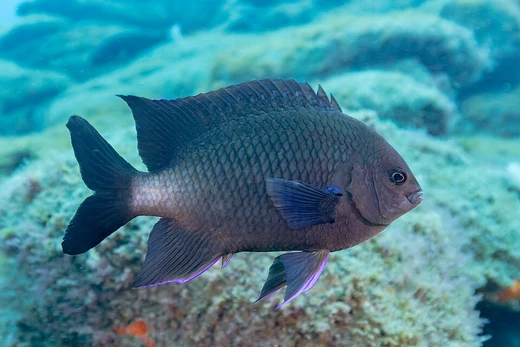
Damselfish
Damselfish are small, territorial fish found in tropical and temperate waters.

Yercaud-elango · CC BY-SA 4.0
Damselfish are fish within the subfamilies Abudefdufinae, Chrominae, Lepidozyginae, Pomacentrinae, and Stegastinae within the family Pomacentridae. Most species are relatively small, though the four largest species can reach 30 cm in length. They are found globally in tropical, subtropical, and temperate waters, primarily in marine environments, with a few inhabiting brackish or fresh water.
- Largest species
- Hypsypops rubicundus, Microspathodon bairdii, M. dorsalis, Nexilosus latifrons
- Maximum length
- 30 cm (12 in)
- Habitat types
- marine, brackish, fresh water
- Global distribution
- tropical, subtropical, temperate waters
- Example species mentioned
- Domino damselfish (D. albisella), Threespot damselfish (S. planifrons), Dusky damselfish (S. adustus), Longfin damselfish (Stegastes diencaeus), Bicolor damselfish (E. partitus), Beaugregory damselfis
Lore & Background
Many damselfish species live in tropical rocky or coral reefs and are kept as marine aquarium pets. Their diets include small crustaceans, plankton, and algae. The domino damselfish spends over 85% of its daytime foraging, with larger individuals feeding higher in the water column. Damselfish of all sizes primarily feed on caridea and copepods. Territoriality is common; for example, the threespot damselfish is extremely defensive of its territory, and the dusky damselfish spends most of its life within its territory. Longfin damselfish around Carrie Bow Cay, Belize, actively protect planktonic mysids in their reef farms, which fertilize algae that the damselfish eat, suggesting a pet-like domestication relationship. Male bicolor damselfish, E.
Reader's Guide
Damselfish are notable for their diverse behaviors and ecological roles. The article describes how the domino damselfish adjusts its foraging height based on current speeds to maximize food intake, while smaller fish forage closer to substrates likely due to predation pressure. Territoriality drives resource partitioning, as seen in the threespot damselfish. The longfin damselfish's domestication of mysid shrimps is a unique example of interspecies mutualism, where the damselfish aggressively defends the mysids, which in turn fertilize algae. Courtship behaviors vary: in S. partitus, females choose mates based on male courtship rate and signal jumps, while in the beaugregory damselfish, males court larger, more fecund females. Mating strategies include polygamy in bicolor damselfish and distance-dependent spawning visits in S. nigricans. Filial cannibalism in the cortez damselfish is an adaptive response to small or early-stage clutches. These behaviors highlight the complexity of damselfish life history and their significance in reef ecosystems.
Did You Know?
- The four largest damselfish species can reach 30 cm in length.
- Domino damselfish spend over 85% of daytime foraging.
- Longfin damselfish around Carrie Bow Cay, Belize, protect mysid shrimps in a pet-like relationship.
- Male cortez damselfish consume over 25% of their clutches in filial cannibalism.
Taxonomic Identity and Classification
Similiparma stands as a formally recognized genus within the broader world of ray-finned fishes, a grouping that encompasses the vast majority of fish species known to science. Its placement within the family Pomacentridae situates it alongside the well-known damselfish and clownfish, a family that carries considerable recognition in both scientific and popular contexts. As a genus, Similiparma represents a taxonomic unit that groups together species sharing a common lineage and a set of characteristics that distinguish them from other members of Pomacentridae. The genus name itself follows the conventions of biological nomenclature, and its classification as ray-finned places it within the dominant lineage of modern fish. This taxonomic positioning means that Similiparma shares fundamental anatomical and evolutionary traits with its family members while maintaining its own distinct identity as a separate genus. The recognition of Similiparma as a genus reflects the ongoing work of ichthyologists to parse the diversity within Pomacentridae into meaningful, manageable units of classification, each genus representing a node in the broader tree of fish evolution.
The Two Recognized Species
The genus Similiparma is defined by a modest but precise membership: exactly two species are currently recognized within its boundaries. The first is Similiparma hermani, a name that carries the taxonomic authority of Steindachner and the date 1887, marking when this species was formally described in the scientific literature. The second is Similiparma lurida, attributed to Cuvier with a date of 1830, making it the earlier of the two descriptions by nearly six decades. The fact that only two species are acknowledged in this genus speaks to a relatively narrow taxonomic scope, one that ichthyologists have delineated with care. Both species carry the binomial nomenclature that is standard in biological classification, with the genus name Similiparma paired with their respective specific epithets. The recognition of precisely these two species, and no others, reflects the current state of taxonomic understanding, though such boundaries in fish classification can shift as new research emerges. Together, hermani and lurida constitute the entire known diversity of the genus.
A Span of Discovery
The two species within Similiparma carry the names and dates of the scientists who first formally described them, creating a timeline that stretches across nearly sixty years of ichthyological work. Similiparma lurida was described by Cuvier in 1830, placing its initial scientific recognition in the early nineteenth century, a period of extraordinary expansion in biological taxonomy. More than half a century later, in 1887, Steindachner described Similiparma hermani, adding the second and final recognized species to the genus. The nearly fifty-seven-year gap between these two descriptions reflects the gradual, cumulative nature of taxonomic work in fish biology, where new species are identified and named incrementally as collections grow and comparative anatomy advances. The attribution of authority to these two naturalists, Cuvier and Steindachner, anchors the genus in the broader history of zoological science. Their names remain permanently attached to the species they described, a convention of binomial nomenclature that preserves the historical record of discovery even as the scientific understanding of these fish continues to evolve.
Life Within the Pomacentridae
Similiparma's membership in the family Pomacentridae connects it to one of the most recognizable and widely discussed families of marine fish, the damselfish and clownfish. This familial placement is significant because Pomacentridae is a group that has captured both scientific attention and public fascination, largely due to the cultural prominence of clownfish. By belonging to this family, Similiparma shares a common evolutionary heritage with these well-known relatives, implying shared characteristics at the level of family-level traits. The family name itself, Pomacentridae, is the taxonomic container that groups together damselfish, clownfish, and other related lineages into a single recognized clade. Within this broader family, Similiparma occupies its own genus-level position, distinct from other genera but united by the shared family-level characteristics that define Pomacentridae. Its place among damselfish and clownfish, even as a less widely known genus, underscores the tremendous diversity that exists within a single fish family.
Gallery
More in Clownfish and Damselfish 1-24
Spotted an error? Know more?
Reader corrections go straight into our review queue. Suggest an edit · How this site is sourced