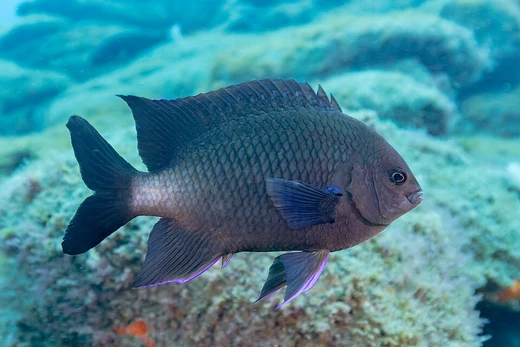
Acanthochromis
The sole damselfish species in the genus Acanthochromis.

Acanthochromis is a genus of damselfish from the western Pacific Ocean, containing only a single species: the spiny chromis (Acanthochromis polyacanthus). It is notable for being the sole member of its genus and for its direct development of larvae, lacking a pelagic larval stage, which is unusual among coral reef fishes.
Quick Facts
- Taxon
- Acanthochromis polyacanthus
Facts from the source article.
Lore & Background
The spiny chromis was first formally described in 1855 by Dutch ichthyologist Pieter Bleeker as Dascyllus polyacanthus, with the type locality given as Batman in the Moluccas. It is the only species in the genus Acanthochromis. The genus name combines acanthus ("spine"), likely referring to its 17 dorsal-fin spines, and Chromis, suggesting a relationship to that genus. The specific name polyacanthus means "many-spined".
This fish occurs in a wide range of color variations depending on geographic location, thought to result from the lack of a pelagic larval phase and sedentary adult behavior, leading to little genetic connectivity and divergent evolution. It is currently unclear whether all these variations are truly the same species or constitute a species complex. Juveniles typically display a yellow stripe along their flanks.
Unlike many coral reef fishes, the spiny chromis has direct development: parents protect their brood from the egg stage through hatching to the fully developed juvenile stage, with no pelagic larval stage. Offspring often settle near their hatching site, resulting in high local adaptation and geographic color variations.
Reader's Guide
The spiny chromis is significant as the only member of the genus Acanthochromis, making it a taxonomically isolated damselfish. Its direct development—lacking a pelagic larval stage—is a notable departure from the typical life cycle of most coral reef fishes, which rely on a planktonic larval phase for dispersal. This reproductive strategy leads to limited genetic connectivity between populations, fostering local adaptation and a wide range of geographic color variations. The article notes uncertainty about whether these variations represent a single species or a species complex, highlighting ongoing taxonomic questions. Ecologically, it is planktivorous and algivorous, and it steals algae from algae-farming damselfish. Juveniles consume mucus secreted from their parents' skin, a behavior similar to that of young discus. Its distribution spans the western Pacific, including Indonesia, Papua New Guinea, northern Australia, the Philippines (except Luzon), and Melanesia, typically inhabiting coral reefs at depths of 1 to 65 meters.
Did You Know?
- It has 17 dorsal-fin spines, which likely inspired its genus name meaning 'spine'.
- Juveniles consume mucus secreted from their parents' skin, similar to discus fish.
- It lacks a pelagic larval stage, unlike most coral reef fishes.
More in Clownfish and Damselfish 1-24
Spotted an error? Know more?
Reader corrections go straight into our review queue. Suggest an edit · How this site is sourced