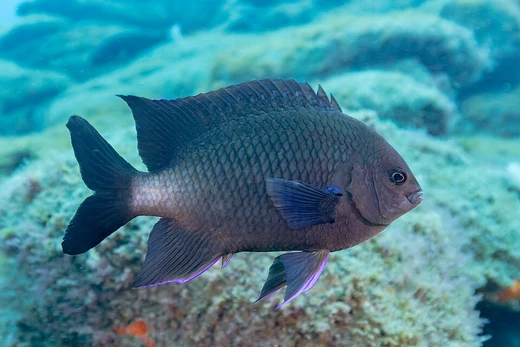
Amphiprion akindynos
Barrier Reef anemonefish: a generalist anemonefish of the Great Barrier Reef.

Amphiprion akindynos, commonly called the Barrier Reef anemonefish, lives mainly on Australia’s Great Barrier Reef, with additional populations in the western Pacific. Its Greek name, *akindynos*, means “safe” or “without danger,” a nod to the protection it finds among its host anemone’s stinging tentacles, which it is immune to. Like all anemonefish, it has a mutualistic bond with sea anemones. It is a sequential hermaphrodite with a strict pecking order based on size: the largest individual is the female, the next largest is the breeding male, and non-breeding males get progressively smaller down the hierarchy. This species is protandrous—if the sole breeding female dies, the breeding male transforms into a female, and the largest non-breeder then becomes the new breeding male. Its natural diet includes zooplankton.
Adults are orange-brown with two white bars edged in black that wrap around the body. The first bar sits behind the eyes on the head and can be thin or broken; the second runs below the dorsal fin. The caudal peduncle and tail fin are white. Juveniles are usually brown with three white stripes, while sub-adults shift to a dull yellow with two white stripes. They have 10 to 11 dorsal spines and 2 anal spines, reaching a maximum length of 12–13 cm (4.7–5.1 in).
Unlike some anemonefish, *A. akindynos* shows no color variations based on location, sex, or host anemone. Its white bars are generally narrower than those of *A. clarkii*, and it lacks the sharp transition between body color and white tail fin seen in that species; *A. clarkii* may also have a yellow tail fin. Adult *A. chrysopterus* are darker, with a broader head bar that is not constricted or broken. Historically placed in the *clarkii* complex, genetic analysis shows *A. akindynos* is quite distinct from other members of that group and instead belongs to a clade with *A. mccullochi*. Further study suggests evolutionary connectivity between samples of the two species, with historical hybridization and introgression creating a complex mitochondrial DNA structure. Two evolutionary groups were found, each containing individuals of both species, so they lack reciprocal monophyly, though no haplotypes are shared between them.
Quick Facts
- Taxon
- Amphiprion akindynos
Facts from the source article.
Lore & Background
Adults are an orange-brown colour with two white bars with black edging encircling the body. The first bar is located on the head behind the eyes and may be thin and broken. The second bar is on the body below the dorsal fin. The caudal peduncle and caudal fin are white. Juveniles are normally brown with three white stripes. In sub-adults the colouring changes to a dull yellow with two white stripes. A. akindynos does not show colour variations based on geographic location, sex or host anemone. The white bars on A. akindynos are generally narrower than those of A. clarkii and it lacks the abrupt transition between the body colour and white caudal fin. Traditionally A. akindynos was included in the clarkii complex, but genetic analysis has shown it is significantly different and instead is part of a clade with A. mccullochi. Historical hybridization and introgression resulted in a complex mitochondrial DNA structure, with two evolutionary groups detected in both species, though no shared haplotypes between species.
Reader's Guide
The Barrier Reef anemonefish is found in lagoons and outer reefs in the Great Barrier Reef, Coral Sea, northern New South Wales, New Caledonia, the Loyalty Islands and Tonga. It has been thought limited to depths of less than 25 m, but surveys using autonomous underwater vehicles observed it at depths between 50 and 65 m at Viper Reef and Hydrographers Passage. It is a generalist, hosted by six of the ten host anemones: Entacmaea quadricolor, Heteractis aurora, Heteractis crispa, Heteractis magnifica, Stichodactyla haddoni, and Stichodactyla mertensii. The fish is a nesting fish; a few days before mating, aggression from the dominant male towards the female increases and he begins clearing a nest site on a rock close to the host anemone. The male guards and aerates the eggs for 6 to 7 days until they hatch. The diet consists primarily of algae and zooplankton. The dominant pair travels farther from the host anemone to find food. The host anemone may benefit from small pieces of food dropped by the anemonefish. The species was officially named the state aquatic emblem of Queensland in March 2005.
Did You Know?
- The species name 'akindynos' is Greek for 'safe' or 'without danger'.
- It is a sequential hermaphrodite exhibiting protandry: the breeding male changes to female if the sole breeding female dies.
- Surveys using autonomous underwater vehicles observed A. akindynos at depths between 50 and 65 m, deeper than the previously thought limit of 25 m.
More in Clownfish and Damselfish 1-24
Spotted an error? Know more?
Reader corrections go straight into our review queue. Suggest an edit · How this site is sourced