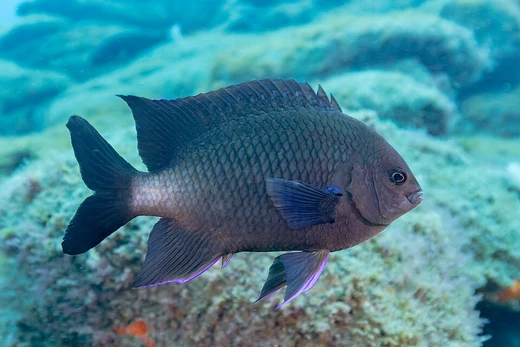
Fusilier damselfish
A color-changing damselfish found in Indo-Pacific coral reefs.

NOAA Fisheries/Jan Willem Staman · Public domain
The fusilier damselfish (Lepidozygus tapeinosoma) is the sole member of its genus, Lepidozygus, which belongs to its own subfamily, Lepidozyginae, within the Pomacentridae family. This fish is native to the Indo-Pacific region and is popular among aquarium keepers. It reaches a maximum length of 10.5 centimeters (4.1 inches).
**Distribution and habitat** This species ranges across the Indo-Pacific. In the Indian Ocean, it appears off eastern Africa, the Gulf of Aden, Oman, India, the Maldives, Sri Lanka, the Similan Islands (Andaman Sea), Indonesia, and Australia. In the Pacific, it is found in Cambodia, Indonesia, the Philippines, the Great Barrier Reef (Australia), Vietnam, Taiwan, various Pacific islands as far as Hawaii, and from the Gulf of California south to northern Peru. It lives at depths of 1 to 30 meters (3.3 to 98.4 feet), typically in coral reefs and lagoons, and prefers tropical waters.
**Description** Adults grow to a maximum of 10.5 centimeters (4.1 inches). Their fins include 12 dorsal spines, 14 to 15 dorsal soft rays, 2 anal spines, and 15 to 16 anal soft rays. Coloration varies significantly with behavior: while feeding, the fish turns silvery green; it darkens when resting. In the Maldives, adults guarding their eggs display a banded pattern.
**Ecology** The fusilier damselfish feeds on zooplankton. It changes color depending on its activity and forms aggregations.
**In the aquarium** This fish appears occasionally in the aquarium trade. It is peaceful and can be kept in groups. Its behavior resembles that of Anthias but is hardier. When feeding, it flashes red and green colors. Unlike many shoaling fish, it does not single out or target the weakest individual with aggression. A social species, it thrives when housed with others of its kind. It swims quickly and readily accepts most offered foods.
Quick Facts
- Grandparent Authority
- Allen, 1975
- Taxon
- Lepidozygus tapeinosoma
Facts from the source article.
Lore & Background
The fusilier damselfish is found in the Indo-Pacific, with populations in the Indian Ocean including eastern Africa, the Gulf of Aden, Oman, India, the Maldives, Sri Lanka, the Similan Islands, Indonesia, and Australia. In the Pacific Ocean, it occurs from Cambodia, Indonesia, the Philippines, the Great Barrier Reef, Vietnam, Taiwan, various Pacific islands to Hawaii, and from the Gulf of California south to northern Peru. It inhabits coral reefs and lagoons at depths of 1 to 30 metres, living in tropical waters.
Adults can grow up to 10.5 centimetres at maximum length. They have 12 dorsal spines, 14 to 15 dorsal soft rays, 2 anal spines, and 15 to 16 anal soft rays. Coloration changes a lot depending on behavior: when feeding, it turns silvery green; it darkens when resting; and in the Maldives, adults guarding eggs have a banded pattern. This fish feeds on zooplankton and forms aggregations.
In the aquarium trade, it is occasionally available. It can be kept in groups, is very peaceful, and behaves similarly to Anthias but is not as delicate. When feeding, it flashes red and green colors. Unlike many other shoaling fish, it does not single out and focus aggression on the weakest individual. It is a social animal that does best with others of the same species, is a fast swimmer, and readily eats most any foods offered.
Reader's Guide
The fusilier damselfish is notable as the sole species in the monotypic genus Lepidozygus and its own subfamily, Lepidozyginae, within the Pomacentridae family. Its distribution spans the Indo-Pacific, from eastern Africa and the Gulf of Aden across to Hawaii and from the Gulf of California to northern Peru, indicating a broad tropical range. The species is distinguished by its variable coloration, which shifts with behavior—silvery green when feeding, darker when resting, and banded when guarding eggs in the Maldives. It feeds on zooplankton and forms aggregations in coral reefs and lagoons at depths up to 30 metres.
In the aquarium context, the fusilier damselfish is occasionally available and valued for its peaceful nature and social behavior, thriving in groups. Its color flashes of red and green during feeding add to its appeal. Unlike many shoaling fish, it does not target the weakest individual with aggression, making it suitable for community tanks. Its fast swimming and readiness to accept various foods contribute to its manageability. The species' ecological role as a zooplankton feeder and its distinctive subfamily classification underscore its significance within damselfish diversity.
Did You Know?
- Adults can grow up to a maximum length of 10.5 centimetres (4.1 in).
- It is found at depths of 1 to 30 metres (3.3 to 98.4 ft) in coral reefs and lagoons.
One Name, Dozens of Fish
The common name yellowtail does not point to a single species but rather to a broad collection of fish whose unifying feature is a caudal fin that is partially or entirely yellow. In most casual usage, the term evokes the amberjack group, with Seriola lalandi (the yellowtail amberjack, also called the Cape, Giant, or Southern yellowtail) and Seriola quinqueradiata (the Japanese amberjack) being the most recognizable, particularly in sushi contexts. Beyond those well-known amberjacks, the name is also applied to the Atlantic bumper, the yellowtail flounder, the yellowtail snapper, the whitespotted devil, and the yellowtail horse mackerel. The full roster of species carrying yellowtail in their common name extends well past sixty entries, spanning angelfish, wrasse, tang, catfish, clownfish, mullet, and many other groupings. This sheer breadth makes yellowtail one of the most widely shared descriptive labels in the entire fish nomenclature, with no single biological lineage owning the term.
Among the Damsels
Several damselfish and damsel species occupy the yellowtail naming space. The yellowtail damselfish, identified as Microspathodon chrysurus, is one clear entry. The yellowtail damsel and the yellowtail blue damsel both correspond to Chrysiptera parasema, a single species that has accumulated at least two distinct common names. The yellowtail dascyllus (Dascyllus flavicaudus) and the yellowtail demoiselle (Neoglyphidodon polyacanthus) add further representation from the damselfish group. What connects these species to the much more widely known amberjacks is the same straightforward criterion: a tail fin bearing yellow coloration. The damselfish entries sit alongside the yellowtail clownfish (Amphiprion clarkii and Amphiprion sebae), the yellowtail chromis (Chromis enchrysura), and the yellowtail reeffish (also Chromis enchrysura), showing that even within closely related small-fish groupings, the yellowtail label appears repeatedly. The result is a naming landscape where a small damsel and a large amberjack share a common name with no implication of close relationship.
The Fusilier Entries
Fusilier species appear in the yellowtail list under three separate scientific names. The redbelly yellowtail fusilier, Caesio cuning, carries both a belly-color descriptor and the yellowtail tail-fin tag in its common name. Caesio teres and Paracaesio xanthura are the other two fusilier entries. Notably, Paracaesio xanthura also appears in the list as the yellowtail blue snapper, meaning a single species holds two different common names that emphasize different visual features. This dual labeling illustrates how common names in ichthyology are often descriptive rather than taxonomic, capturing whatever trait a local observer finds most distinctive. The fusilier entries, like the damselfish entries, are linked to the broader yellowtail group solely by the yellow tail fin, with no suggestion in the naming that they are closely related to the amberjacks, the snappers, or the flounders that share the same label. The yellowtail fusilier name is, in effect, a color note attached to a particular body form.
A Label That Spans the Fish Kingdom
The full list of yellowtail-named species reveals a striking taxonomic spread. The common name appears attached to species grouped as angelfish (Apolemichthys xanthurus, Centropyge fisheri, Chaetodontoplus meredithi, Chaetodontoplus personifer), wrasse (Anampses meleagrides, Coris gaimard), tang (Zebrasoma xanthurum, Prionurus punctatus), emperor (Lethrinus atkinsoni, Lethrinus crocineus), snapper (Ocyurus chrysurus, Paracaesio xanthura), and many others including catfish, barracuda, mullet, kingfish, hamlet, tamarin, sailfin tang, tetra, and scad. The yellowtail rainbow (Elagatis bipinnulata) and the yellowtail sardinella (Sardinella rouxi) extend the range further. What emerges from this diversity is that the yellowtail label functions as a purely descriptive tag for tail coloration, applied across dozens of unrelated lineages. A yellowtail catfish (Pangasius pangasius) and a yellowtail clownfish (Amphiprion clarkii) share a name but virtually nothing else in their biology, underscoring that the label is a visual shorthand rather than a taxonomic statement.
Gallery
More in Clownfish and Damselfish 1-24
Spotted an error? Know more?
Reader corrections go straight into our review queue. Suggest an edit · How this site is sourced