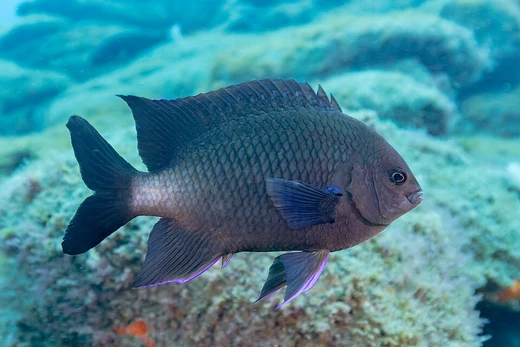
Lepidozyginae
Monotypic damselfish subfamily with one species, the fusilier damselfish.

Lepidozyginae is a subfamily of damselfish in the family Pomacentridae. It is monotypic, containing only the genus Lepidozygus and its sole species, the fusilier damselfish (Lepidozygus tapeinosoma). This subfamily is notable for being the only one in its family with a single genus and species.
Quick Facts
- Grandparent Authority
- Allen, 1975
- Taxon
- Lepidozygus tapeinosoma
Facts from the source article.
Lore & Background
The fusilier damselfish, the only member of Lepidozyginae, occurs in the Indo-Pacific, from eastern Africa and the Gulf of Aden across to Hawaii and south to northern Peru. It inhabits coral reefs and lagoons at depths of 1 to 30 meters. Adults grow up to 10.5 cm in length and have 12 dorsal spines, 14 to 15 dorsal soft rays, 2 anal spines, and 15 to 16 anal soft rays.
Coloration changes with behavior: it turns silvery green when feeding, darkens when resting, and adults guarding eggs in the Maldives display a banded pattern. The fish feeds on zooplankton and forms aggregations. It is occasionally found in the aquarium trade, where it is described as very peaceful and social, doing best in groups. Its behavior is similar to Anthias but less delicate, and it flashes red and green colors when feeding.
Reader's Guide
The subfamily Lepidozyginae is significant as a monotypic taxon within the Pomacentridae, representing a distinct evolutionary lineage. The sole species, the fusilier damselfish, is notable for its color-changing ability tied to behavior—silvery green while feeding, darker at rest, and banded when guarding eggs. Its distribution spans the Indo-Pacific, from the Indian Ocean to the Pacific, including Hawaii and the Gulf of California. In the aquarium trade, it is valued for its peaceful nature and social behavior, forming groups without singling out weak individuals. The species is also recognized for its diet of zooplankton and its habitat in coral reefs and lagoons. Its maximum length of 10.5 cm and fin ray counts provide key identification features. The subfamily's legacy is tied to its unique taxonomic position and the ecological and behavioral traits of its single species.
Did You Know?
- The fusilier damselfish is the only species in the genus Lepidozygus and the subfamily Lepidozyginae.
- Adults can grow up to a maximum length of 10.5 cm (4.1 in).
- Its coloration changes: silvery green when feeding, darker when resting, and banded when guarding eggs in the Maldives.
- It is found at depths of 1 to 30 meters in coral reefs and lagoons.
Historical Taxonomic Standing
Lepidozyginae occupied a recognized position as one of four subfamilies within Pomacentridae, the family that encompasses damselfishes and clownfishes. In the traditional classification framework, it stood alongside Amphiprioninae, Chrominae, and Pomacentrinae as a distinct taxonomic heading. This arrangement reflected the prevailing understanding of relationships among the roughly 385 species distributed across approximately 31 genera that constitute the family. The broader family had long been slotted within the order Perciformes or classified as indeterminate percomorphs, a placement that Lepidozyginae inherited as part of that organizational scheme. Members of Pomacentridae are primarily marine ray-finned fishes, with a handful of species venturing into freshwater and brackish waters. The family is characterized by hardy constitutions and pronounced territoriality, traits that would have been shared among the species grouped under the Lepidozyginae heading. Many of these fishes display vivid coloration, making them popular choices in the aquarium trade.
The Phylogenetic Restructuring
More recent phylogenetic analyses have fundamentally reorganized the subfamily-level structure of Pomacentridae, rendering the traditional four-subfamily arrangement—including Lepidozyginae—obsolete. The modern framework recognizes Chrominae, Glyphisodontinae, Microspathodontinae, and Pomacentrinae as the valid subfamilies. Under this revised scheme, the clownfishes, previously housed in their own subfamily Amphiprioninae, are now nested within Pomacentrinae. This taxonomic upheaval means that the species once catalogued under the Lepidozyginae heading have been redistributed among the newly recognized groupings based on evolutionary relationships rather than the older morphological criteria. The shift reflects a broader trend in ichthyology where molecular and phylogenetic evidence supersedes traditional classification. The family itself has also moved in its broader placement, now regarded as basal blenniiforms rather than members of Perciformes, further underscoring how dramatically our understanding of these fishes' evolutionary position has evolved.
Biological and Ecological Framework
The species that were historically grouped under Lepidozyginae belong to a family whose members are predominantly found in tropical seas, with a few extending into subtropical waters. The Indo-West Pacific region, stretching from East Africa to Polynesia, harbors the greatest concentration of pomacentrid species, with the waters between the Philippines and Australia representing the peak of diversity. Most of these fishes inhabit shallow coral reef environments, typically between 2 and 15 meters in depth, though some species venture below 100 meters. They are largely specialists, tied to particular reef microhabitats such as sandy lagoons, steep reef slopes, or wave-exposed zones. Coral serves as essential shelter for many species, and some cannot survive without it. Bottom-dwelling members are notably territorial, defending patches of reef and inadvertently promoting thick algal growth within their boundaries—a behavior that earned certain species the common name farmerfish. Their diets are generally omnivorous or herbivorous, encompassing algae, plankton, and small crustaceans.
Reproductive Biology and Lifecycle
The reproductive strategies of pomacentrids, the family to which Lepidozyginae historically belonged, involve elaborate male courtship behaviors. Before spawning, males clear a patch of substrate free of algae and invertebrates to establish a nest site. Courtship displays include rapid bursts of movement, chasing or nipping the female, stationary hovering, or dramatic fin extension. Once the female is attracted to the prepared site, she deposits a string of adhesive eggs onto the substrate while the male follows behind, fertilizing them externally. Brood sizes vary considerably across the family, ranging from 50 to 1,000 eggs. The male then guards the clutch for two to seven days until hatching. The resulting transparent larvae, measuring just 2 to 4 millimeters, enter a pelagic phase lasting anywhere from a week to over a month before settling into suitable habitat and developing their juvenile coloration. In captivity, these fishes can live up to 18 years, though wild populations likely reach only 10 to 12 years.
More in Clownfish and Damselfish 1-24
Spotted an error? Know more?
Reader corrections go straight into our review queue. Suggest an edit · How this site is sourced