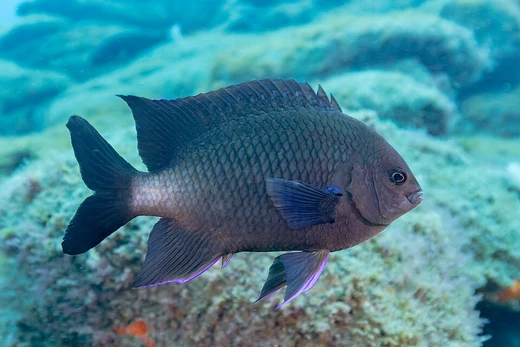
Garibaldi (fish)
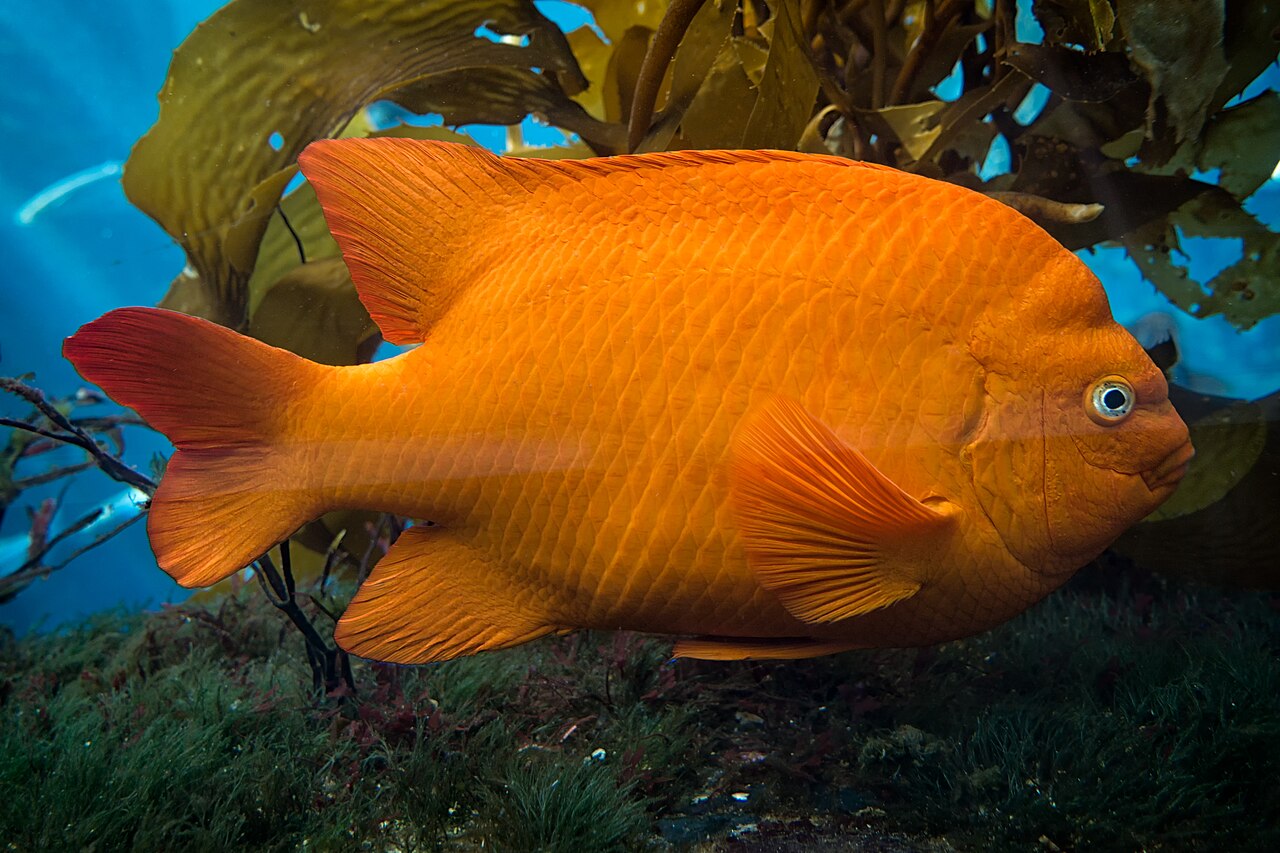
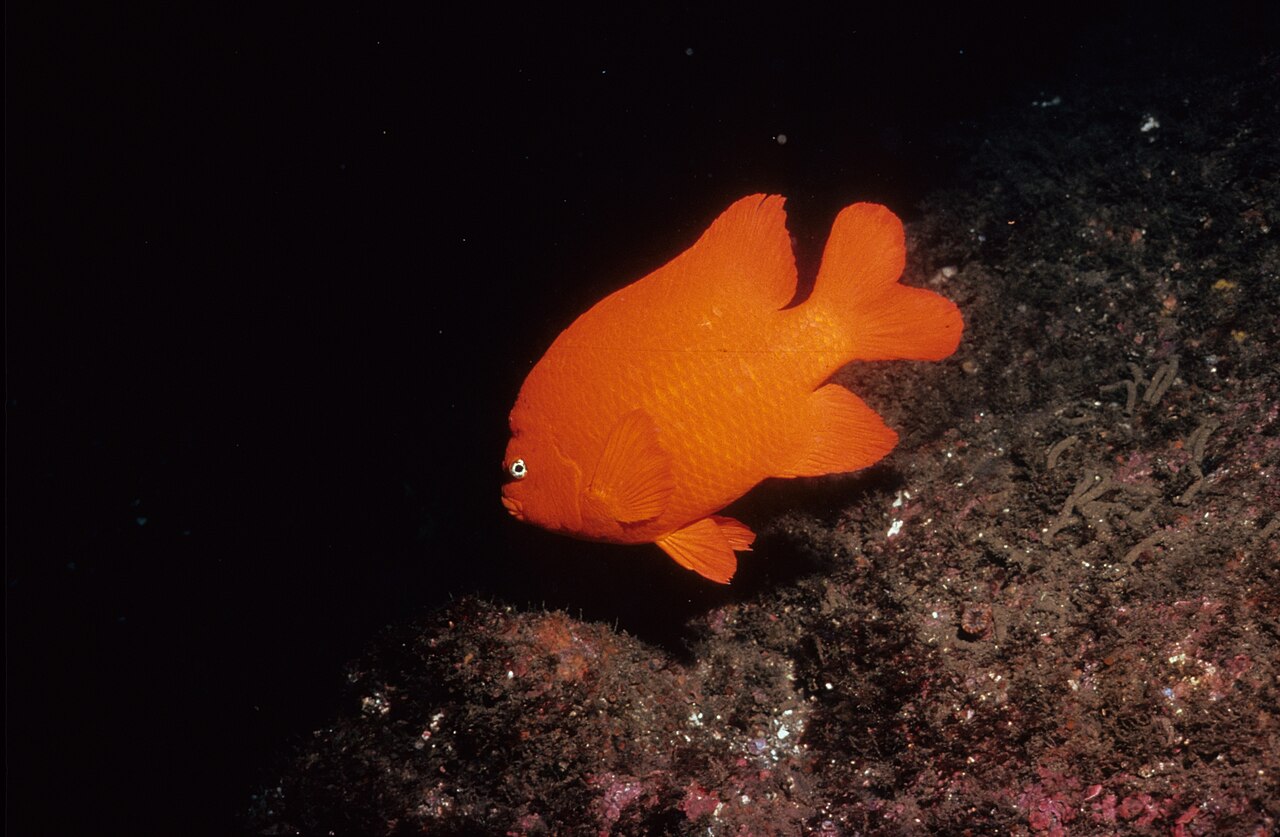
Bright orange damselfish, California's marine state fish.

M.O. Stevens · CC BY 3.0
The Garibaldi (Hypsypops rubicundus), a bright orange fish from the damselfish family, was once called the Catalina goldfish or marine goldfish but is now most often referred to as the Garibaldi damselfish. This species lives in the subtropical northeastern Pacific Ocean. In 1995, it became California’s official marine state fish, and since then, recreational and commercial fishing for it has been banned in the state’s coastal waters. It is the largest damselfish, reaching up to 35.6 cm (14 inches) in length.
The fish’s English name honors 19th-century Italian general Giuseppe Garibaldi, whose followers were known for wearing red shirts. Like other damselfish, males aggressively guard the nest after the female lays eggs.
Garibaldis live in marine waters up to 30 meters (98 feet) deep. They typically nest near rock reefs and over rocky seafloors, preferring exposed or semi-protected coasts with clear water, plenty of crevices, and small caves for cover. Juveniles can be found in tide pools up to about 12 meters (40 feet) deep. Their range extends from Monterey Bay, California, south to Guadalupe Island, Baja California.
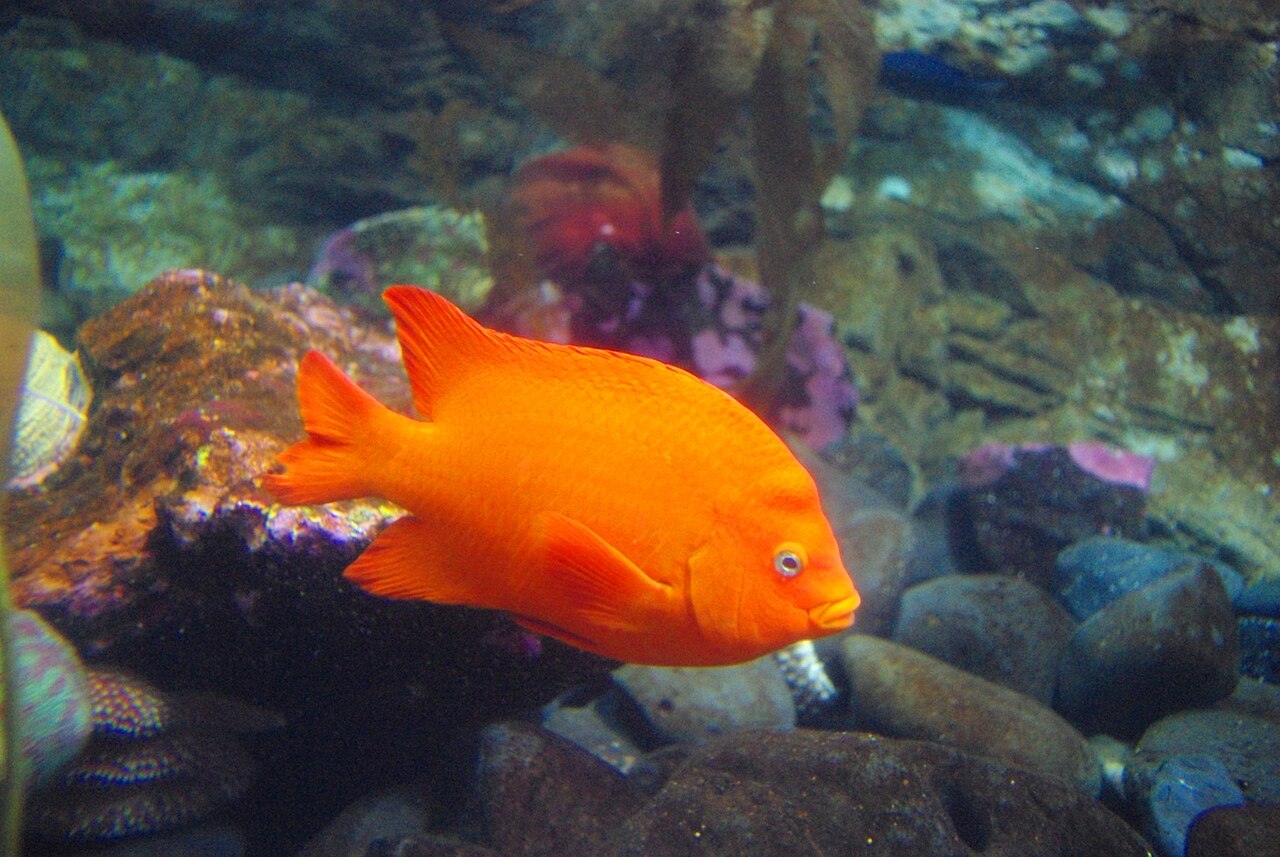
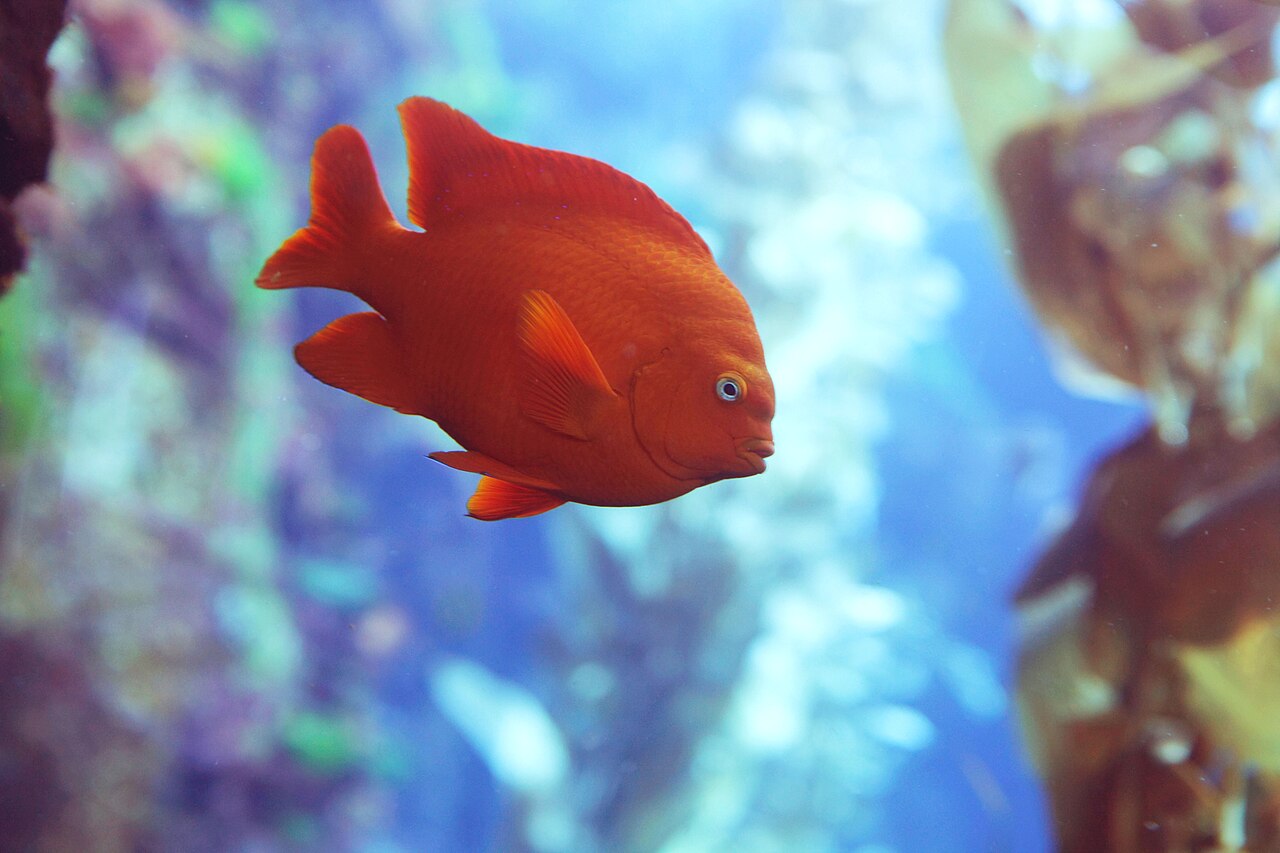
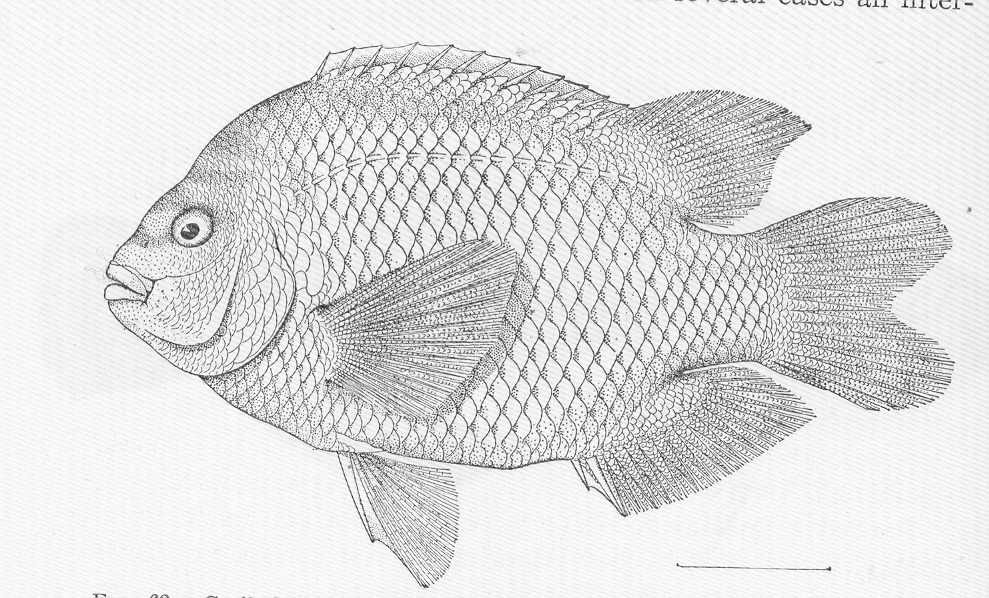
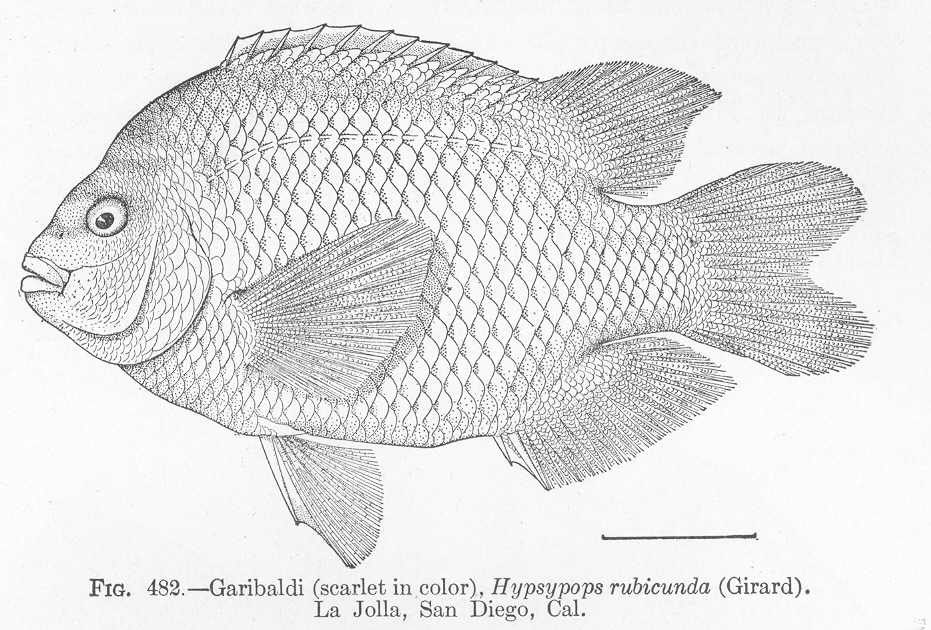
These fish have deep, laterally compressed bodies covered in coarse scales, with a single dorsal fin bearing about 12 spines and 16 rays. Adults are uniformly bright orange. There is a sexual size difference: males average about 25 mm (1 inch) larger than females, which is unusual for damselfish and other southern California marine fish, where females are typically larger. Juveniles are a deeper, redder orange than adults and are covered in many small iridescent blue stripes and spots, which they gradually lose as they mature. Their tail and dorsal fins are more translucent than those of adults.
A 1992 study by Caron and Rainboth found that bright orange coloration reduces aggressive behavior among territorial Garibaldi, especially during breeding season. They tested orange and patterned orange (along with non-orange) as stimuli and found that orange strongly triggered territorial responses, but adding disruptive patterns to orange canceled that effect. This supports the “intraspecific camouflage” theory, which suggests that juvenile coloration helps them go unrecognized as competitors by adults. However, the study used color blocks, not live fish, so it’s unclear if results would hold with real fish. A later study by Thomas J.
Quick Facts
- Genus
- Hypsypops
- Species
- rubicundus
Facts from the source article.
Lore & Background
The English name Garibaldi refers to the 19th-century Italian general and political figure Giuseppe Garibaldi, whose followers often wore a characteristic scarlet or red shirt. Adult Garibaldis are uniformly bright orange in color, while juveniles are a deeper, more reddish shade of orange with many small iridescent blue stripes and spots, which they gradually lose as they become adults. The species exhibits sexual size dimorphism, with average adult males measuring 25 mm (1 inch) larger than females, an unusual trait for damselfish and other marine fish in southern California, where typically adult females are larger.
Garibaldis are found in marine waters up to 30 meters (98 ft) in depth, usually nesting in association with rock reefs and over rocky sea-bottoms. They prefer exposed or semi-protected coasts with clear water and plenty of crevices and small caves. Juveniles can be found in tide pools up to depths of 40 feet (just over 12 m). The species is native to subtropical parts of the northeastern Pacific Ocean, ranging from Monterey Bay, California, to Guadalupe Island, Baja California.
A study by Caron & Rainboth in 1992 found that vibrant orange coloration reduces aggressive behavior among territorial Garibaldi, and that adding disruptive patterns to orange counteracted this effect, supporting an 'intraspecific camouflage' theory. However, a separate study by Thomas J. Neal found that normal-colored juveniles were attacked more than adult-colored juveniles. An alternative 'adult-habituation' hypothesis proposes that the vibrant colors of juveniles help adults get used to their presence more quickly, similar to the bright coloration of poisonous organisms.
Reader's Guide
The Garibaldi holds significance as the official marine state fish of California, designated in 1995, and is protected from recreational and commercial fishing in California coastal waters. Its territorial behavior is notable: unlike other damselfish where males guard nest sites only during mating season, both male and female adult Garibaldis defend year-round territories of about 3–10 square meters. Males are especially aggressive during breeding, attacking much larger creatures including humans. The species is the longest-lived damselfish known, with a 2022 study by Williams et al. recording a 57-year-old individual, surpassing the previous maximum of 17 years by two decades.
Garibaldis are generalist omnivores, feeding mainly on invertebrates such as polychaete worms, anemones, and sponge fragments, as well as algae and occasionally their own eggs. They engage in cleaning symbiosis with Senoritas (Oxyjulis californica) and Kelp Perch (Brachyistius frenatus), which remove external parasites. The red and white shrimp (Hippolysmata californica) has also been observed removing parasites from Garibaldi. Adult Garibaldis have very few natural predators, though kelp bass (Paralabrax clathratus) prey on young-of-the-year individuals. The species' breeding biology includes diel patterns of egg-hatching, with embryos hatching within 2 hours after sunset to minimize predation risk.
Did You Know?
- The Garibaldi was named the official marine state fish of California in 1995.
- A 2022 study found a Garibaldi aged 57 years, making it the longest-lived damselfish by two decades.
- Male Garibaldis are 25 mm (1 inch) larger on average than females, an unusual trait for damselfish.
- Juvenile Garibalds have iridescent blue stripes and spots that they gradually lose as adults.
The Naming Puzzle
Common names for fish occupy a fascinating and often confusing space in how people talk about aquatic life. A single everyday label might point to just one species, or it might sweep in an entire genus or even a whole family of related creatures. In some cases, the same name gets applied to completely unrelated groups that share no close evolutionary lineage. This is why reference materials typically flag ambiguous common names and list out every possible meaning behind them, so readers are not left guessing which creature is actually being discussed. The Garibaldi, as a common name, sits within this broader web of nomenclature where clarity depends heavily on context. When a name could refer to multiple organisms, the scientific designation presented in parentheses becomes the anchor that pins down exactly which animal is meant. This layered system of naming reflects the complexity of the natural world and the human need to simplify it into manageable, memorable labels.
Taxonomic Anchoring
Every common name in a fish reference carries a shadow twin: the formal scientific name, presented in parentheses, that removes all ambiguity. For individual species, this binomial designation is precise and universal, cutting through the regional and colloquial variations that common names accumulate over time. But the naming system does not stop at the species level. Higher taxa—genera, families, and broader groupings—also receive their own scientific identifiers, and these are included alongside the common name to give readers the full taxonomic picture. This means that when you encounter a fish listed under a familiar everyday label, the parenthetical scientific name tells you not just what species it is, but where it sits in the larger tree of aquatic life. The Garibaldi's entry, like others in such references, benefits from this dual-layered identification, ensuring that hobbyists, researchers, and casual readers all arrive at the same organism regardless of which name they started with.
The Alphabetical Archive
Fish references have long relied on the simple, democratic structure of the alphabet to organize their contents. From A to Z, each letter opens a doorway to a cluster of species, and the Garibaldi finds its place in the G section alongside dozens of other creatures. This alphabetical arrangement is not merely a filing convenience; it creates a predictable, navigable landscape that allows anyone—from a first-time aquarium shopper to a seasoned ichthyologist—to locate a specific fish without needing to understand evolutionary relationships. The X section, for instance, might yield the X-ray tetra, a name that itself hints at the transparency of the fish's body. The sheer breadth of the A-to-Z listing underscores just how vast the diversity of aquarium fish truly is, with entries spanning every letter of the alphabet and representing an enormous range of forms, sizes, and habitats across the aquatic world.
Beyond the Single Name
The Garibaldi does not exist in isolation within the broader world of aquarium fish. Reference materials that list it also point readers toward companion resources: a dedicated list of aquarium fish organized by scientific name, a separate catalog focused specifically on freshwater species, and a broader discussion of fish diversity in general. These cross-referenced lists form an ecosystem of knowledge, each one offering a different lens through which to view the same creatures. The freshwater aquarium fish list, for example, narrows the focus to a particular habitat category, while the scientific-name index serves those who prefer precision over colloquial labels. Together, these resources suggest that understanding any single fish—Garibaldi or otherwise—requires stepping outside its individual entry and exploring the wider community of species it belongs to. The diversity of fish is not just a biological fact; it is the organizing principle behind every list, every index, and every common name.
Gallery
More in Clownfish and Damselfish 1-24
Spotted an error? Know more?
Reader corrections go straight into our review queue. Suggest an edit · How this site is sourced