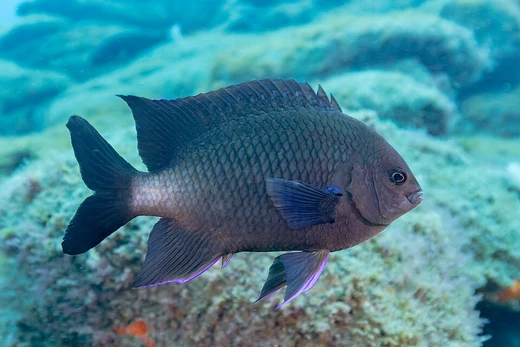
Clownfish
Clownfish are damselfishes with a symbiotic relationship with sea anemones.

Liane Thompson · CC BY 4.0
Clownfish, also known as anemonefishes, belong to the genus *Amphiprion* and live in the warm, tropical salt waters of the Indo-Pacific, primarily around coral reefs. Their most recognizable feature is their coloring, which usually includes white vertical bars set against a background that can be red, orange, yellow, brown, or black. They have a mutually beneficial partnership with sea anemones, using them for shelter and protection from predators. In exchange, clownfish guard the anemone from fish that eat it, keep it clean by fanning it, and bring in helpful microorganisms through their waste. Their bright patterns and social behavior have made them popular, especially after appearing in the 2003 Disney/Pixar film *Finding Nemo*, and they are highly desired for home aquariums.
- Genus
- Amphiprion
- Family
- Pomacentridae (damselfishes)
- Type species
- red saddleback anemonefish
- Genus coined by
- Marcus Elieser Bloch and Johann Gottlob Theaenus Schneider
- Genus coined year
- 1801
- Number of living species as of 2025
- 29
- Size range mm
- 80–160 mm
Lore & Background
Clownfish are damselfishes (family Pomacentridae) in the genus Amphiprion, coined by Marcus Elieser Bloch and Johann Gottlob Theaenus Schneider in 1801 using the red saddleback anemonefish as the type species. Georges Cuvier considered the maroon clownfish morphologically different enough to be placed in its own genus Premnas in 1816. The status of Premnas has been disputed over the years, switching between a synonym or subgenus of Amphiprion and being its own genus. In 2021, two expansive phylogenetic analyses of damselfishes found the species to be within Amphiprion, making Premnas a junior synonym. In 1975, ichthyologist Gerald R. Allen placed clownfish in their own subfamily Amphiprioninae. A 2009 genetic study suggested creating the tribe Amphiprionini for clownfish and moving them to the subfamily Pomacentrinae. Eschmeyer's Catalog of Fishes considers the genus to be part of Pomacentrinae though scientific papers still use Amphiprioninae.
Clownfish vary in size; the maroon clownfish can reach 160 mm long while the orange clownfish reaches only 80 mm. Females are larger than males and the smallest individuals in a group are only 6–15 mm. Clownfish have saw-shaped edges along the operculum and under the eyes, which is the source of their genus name. Their colour patterns consist of a red, orange, yellow, brown or black background with zero to three white vertical bars lined with black. A 2018 study found that clownfish species with only one or no vertical bars tend to be more specialised for anemone species with greater toxicity and shorter tentacles, while those with two or three bars are more likely to use more anemone species within their range. The study suggested vertical bars function in camouflage while warning colouration is more important for species that cannot hide in the tentacles of their hosts.
Reader's Guide
Clownfish are notable for their symbiotic and mutually beneficial relationship with sea anemones, on which they rely for shelter and protection from predators. In turn, clownfish protect the anemone from anemone-eating fish, clean and fan them, and attract beneficial microorganisms with their waste. They live in groups consisting of a breeding female and male, along with some non-breeding individuals, with a size-based dominance hierarchy. When the female disappears, the breeding male changes sex and takes her place. During reproduction, the female deposits eggs on a rock near their anemone, and the male fertilises them. After hatching, clownfish disperse into the open ocean as larvae, eventually settling on the bottom and searching for an anemone host as juveniles. Their recognisable colour patterns and social nature have contributed to their popularity; they are featured in the Disney/Pixar film Finding Nemo (2003) and are sought after in the aquarium trade. The ocellaris clownfish ranks among the most commonly traded marine fish. Many captive clownfish were taken from the wild and this has led to their decline. Clownfish are more numerous in marine protected areas, where collecting is forbidden. Other threats to populations include global warming, which causes ocean warming and acidification.
Did You Know?
- A 2018 study suggested that vertical bars on clownfish may function in camouflage or warning colouration related to their anemone host.
- In 2025, a new species, the Polynesian anemonefish (A. maohiensis), was classified, previously seen as a colour morph of the orange-fin anemonefish.
The Anemone Partnership
The orange clownfish forms one of marine biology's most fascinating mutualistic bonds. Rather than drifting freely through open reef waters, A. percula anchors its entire life to specific sea anemones, primarily Heteractis magnifica and Stichodactyla gigantea. Even as a tiny larva, the fish navigates by chemical signals the anemone releases into the surrounding water, honing in on the correct host species with remarkable precision. The arrangement benefits both partners in tangible ways. The anemone's venomous tentacles deter predators such as brittle stars, wrasses, and rival damselfish, creating a living fortress around the fish. In return, the clownfish feeds the anemone, boosts local oxygen levels, and clears away accumulated waste. Perhaps most intriguing is the mechanism allowing the fish to brush against stinging tentacles without harm. Research from 1958 at Marineland of the Pacific by Davenport and Noris demonstrated that a mucus coating on the fish's skin prevents the anemone from discharging its lethal nematocysts. A second line of evidence suggests the species has developed some degree of acquired immunity to the anemone's toxins, and current understanding holds that both protective strategies operate simultaneously.
A Living Hierarchy
Each clownfish group operates under a rigid, size-based social order that governs everything from reproduction to survival. A single breeding pair—always a female and a male—sits at the top, accompanied by zero to four subordinate nonbreeders. Every individual is born male, a trait called protandry, but the moment the breeding female dies, the largest male transforms into the new female, and the biggest remaining nonbreeder steps up as the new breeding male. Spawning is tied to the lunar cycle, with nighttime moonlight heightening the fish's alertness and triggering courtship displays: the male extends his fins, nips at the female, chases her, and performs rapid vertical swimming. A single clutch ranges from 400 to 1,500 eggs, and a breeding female can remain in that role for roughly twelve years. The nonbreeders, whose gonads are non-functional, do not assist at the nest nor gain occasional mating chances. Instead, they are essentially queuing for the anemone territory itself, since a resident has a better shot at eventually inheriting the host than any outsider.
Reading the Orange
At a glance, the percula clownfish is unmistakable: a vivid orange body crossed by three crisp white bands, each trimmed with black edging of varying thickness along the fins. The first bar sits just behind the eye, the second runs straight down the midline with a small anterior projecting bulge, and the third appears near the tail fin. Adults average about 8 centimeters, though some reach 11, and there is no visible color difference between the sexes. Confusing this species with its close relative A. ocellaris—sometimes called the "false percula" or "common clownfish"—is a common mistake among hobbyists, since the two share nearly identical coloration. The most dependable way to tell them apart lies in the dorsal fin: A. percula carries ten spines, occasionally nine, while A. ocellaris has eleven, rarely ten. Additionally, A. ocellaris lacks the bold black outlines around its fins that give the percula its distinctive contrast. These subtle anatomical details matter not just for identification but for conservation, since the Great Barrier Reef Marine Park Authority regulates collection permits issued to dealers seeking this and other tropical fish within the park.
Shrinking to Survive
When marine heatwaves sweep through reef waters, most vertebrate species suffer disrupted growth and elevated mortality. The orange clownfish, however, has evolved a remarkable physiological response: it can actively shrink its own body in response to thermal stress. This is not a uniform reaction. The degree of shrinkage is modulated by an individual's social rank and relative size within its group. Fish that shrink more frequently than their breeding partner appear to gain a measurable survival advantage during these extreme heat events, suggesting that the ability to downsize is not merely a passive stress response but a strategic adaptation tied to the group's competitive dynamics. This connects directly to the species' intensely competitive social structure, where the breeding female ultimately controls how many fish her anemone can support, since available space scales with her body size. Males suppress the growth of smaller males in a cascading chain of aggression, and the smallest individual is eventually expelled from the host. The result is a tightly regulated, density-dependent system in which every fish's size, rank, and even its capacity to shrink under heat stress are shaped by the social pressures of its tiny anemone household.
Gallery
More in Clownfish and Damselfish 1-24
Spotted an error? Know more?
Reader corrections go straight into our review queue. Suggest an edit · How this site is sourced