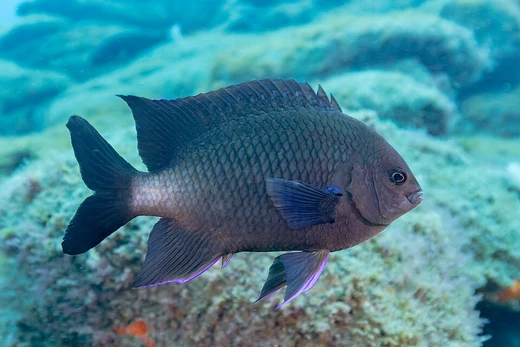
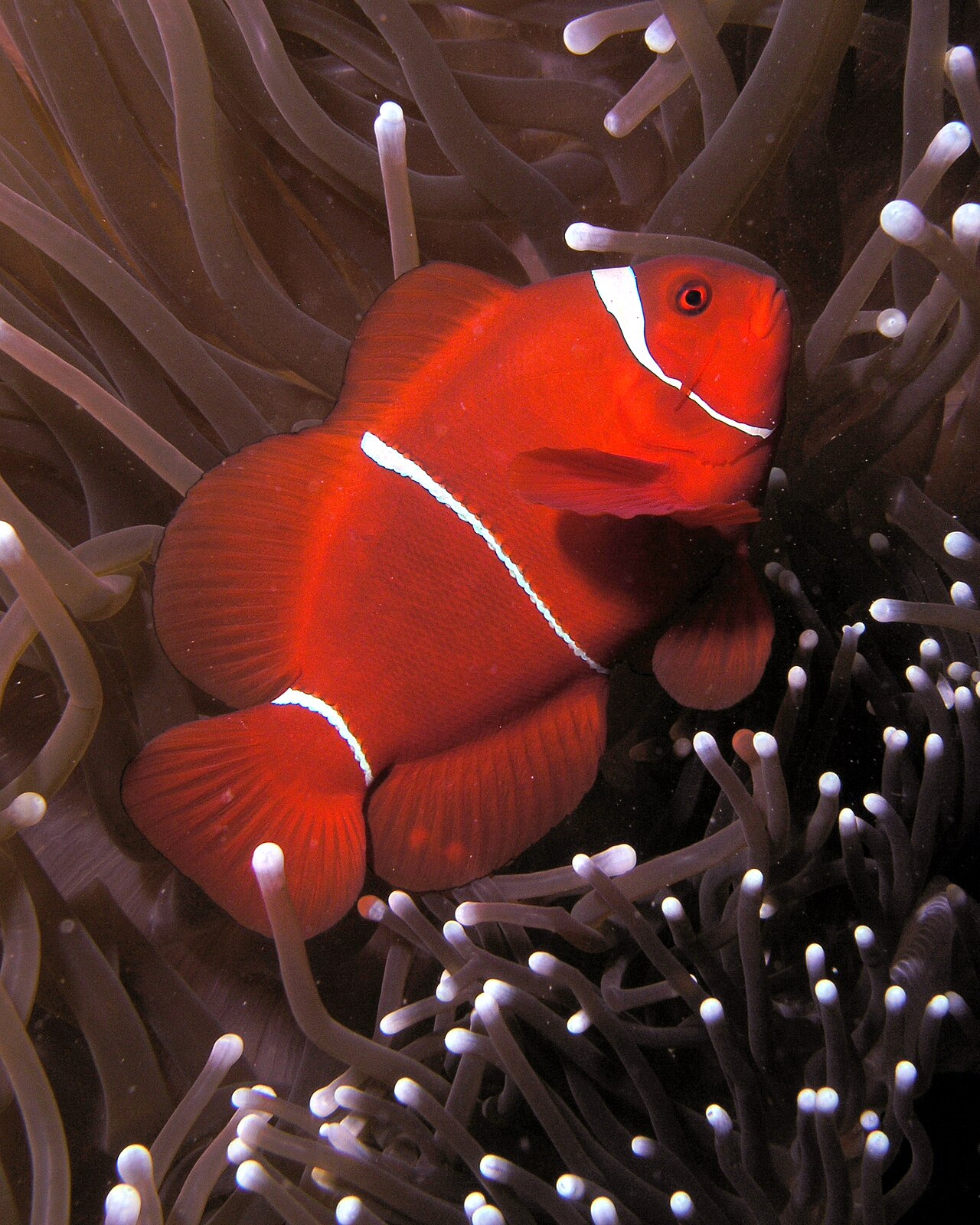
Maroon clownfish
Largest and most territorial clownfish, formerly in its own genus.

Nhobgood · CC BY-SA 3.0
The maroon clownfish (Amphiprion biaculeatus), also known as the spine-cheeked anemonefish, is a species of anemonefish found in the Indo-Pacific from western Indonesia to Taiwan and the Great Barrier Reef. It is notable for being the largest clownfish species, with females growing up to 17 cm (6.7 in), and for its highly territorial behavior. Historically classified as the only species in the genus Premnas, genetic analysis has reclassified it into the genus Amphiprion, making Premnas a junior synonym.
Quick Facts
- Genus
- Amphiprion
- Species
- biaculeatus
Facts from the source article.
Lore & Background
The maroon clownfish was once the only species of the genus Premnas, distinguished by a spine on the cheek. Genetic analysis has shown it is closely related to Amphiprion percula, A. latezonatus, and A. ocellaris, leading to its reclassification into Amphiprion in 2021. The species name remains unchanged. The taxon 'P. epigrammata' from Sumatra probably should be recognized as a distinct species, Amphiprion epigrammata, but genetic data are needed to confirm this.
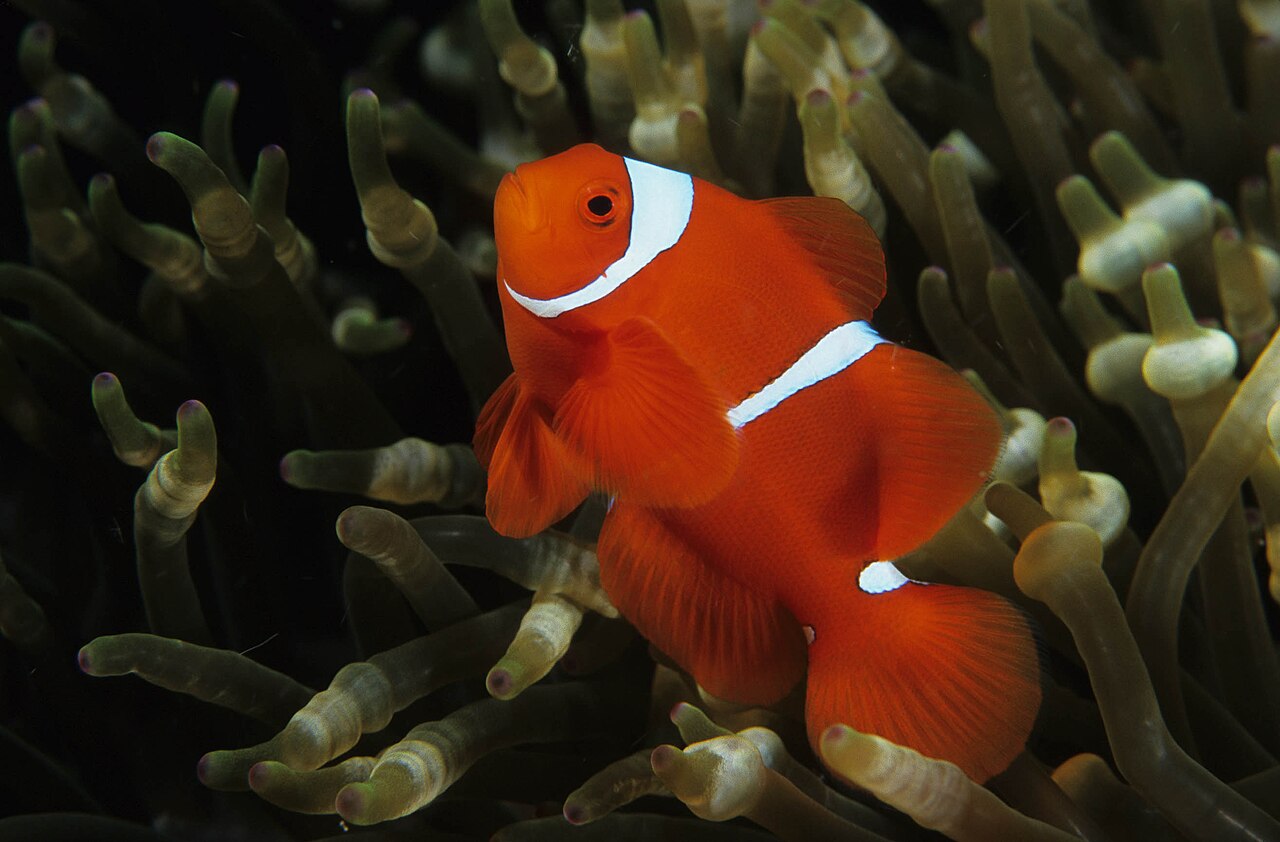
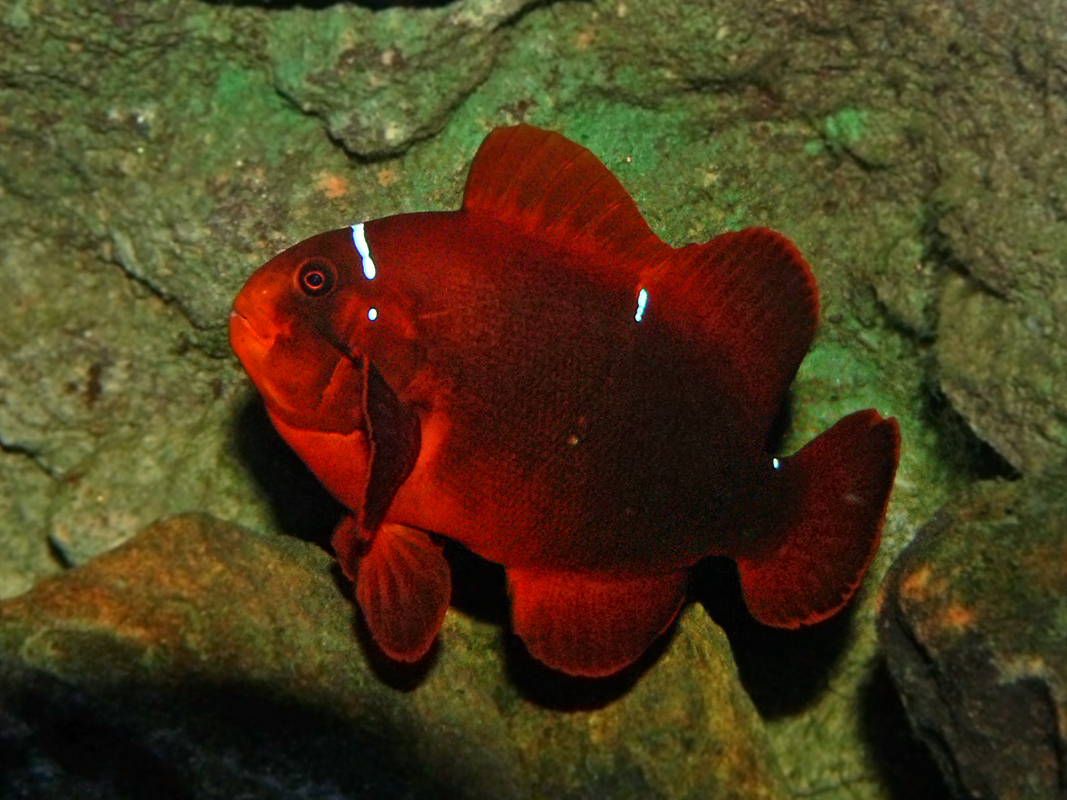
Color varies by sex and geography. Juveniles and males are bright red-orange; females range from maroon to dark brown. Body bars may be white, grey, or yellow. In the central Malay Archipelago, females have a dull-yellow head bar and grey body bars. In East Timor to Australia, females have white or grey bars. In Sumatra and the Andaman Islands, both sexes have yellow body bars, a feature unique among anemonefish.
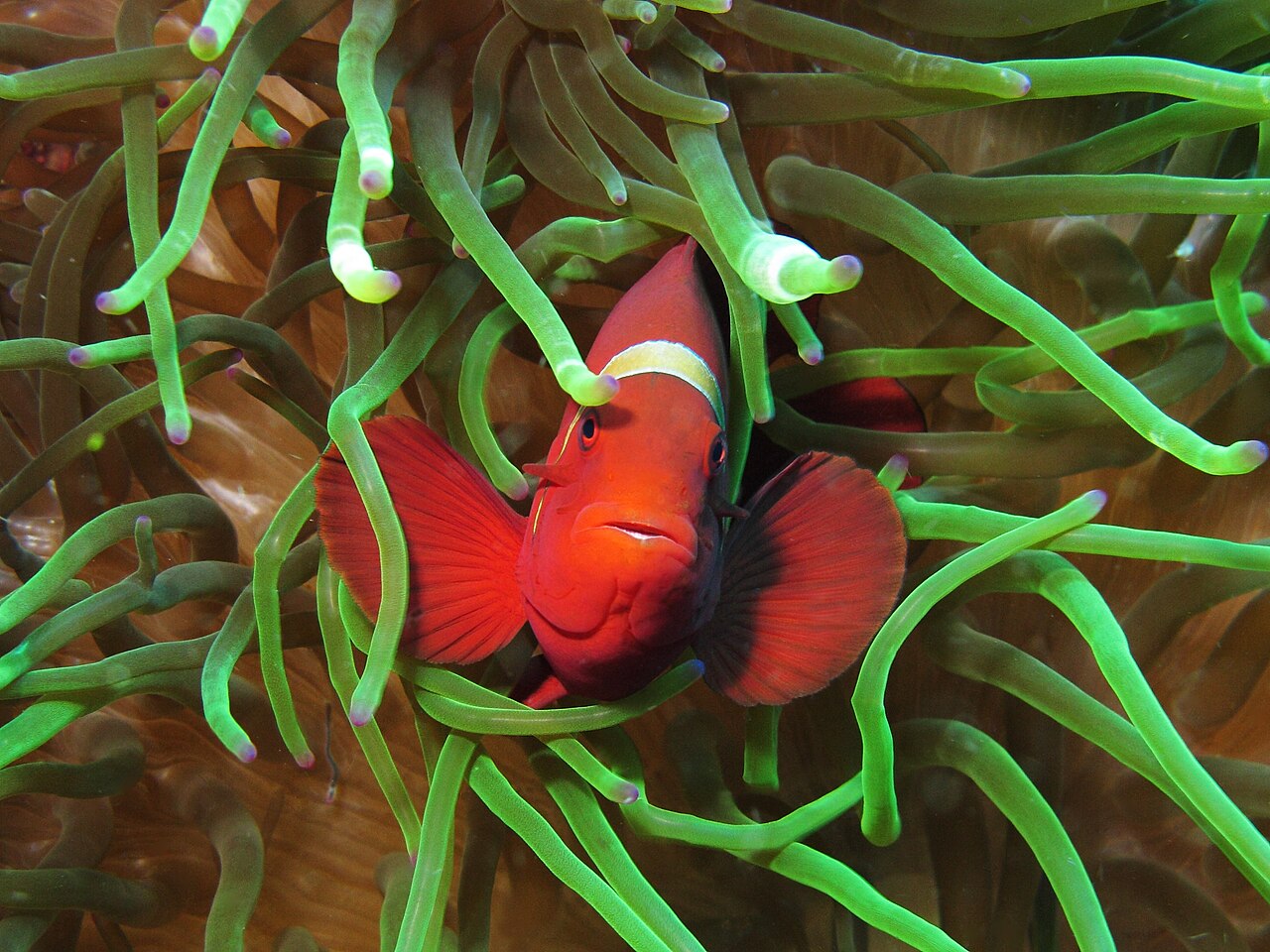
The fish is a sequential hermaphrodite with protandry: the breeding male changes to female if the sole breeding female dies, and the largest nonbreeder becomes the breeding male. It is highly specialized, almost exclusively hosting the bubble-tip anemone (Entacmaea quadricolor), and is considered the most territorial of all anemonefish. It is usually found as a single mated pair, not in a hierarchical group.
Reader's Guide
The maroon clownfish is significant as the largest and most aggressive anemonefish, traits that shape its ecological role and aquarium care. Its reclassification from the monotypic genus Premnas to Amphiprion in 2021, based on genetic analysis, resolved a long-standing taxonomic debate and highlighted the importance of molecular data in fish systematics. The species exhibits striking geographic color variations, with females in Sumatra and the Andaman Islands being the only anemonefish with yellow body bars. Its highly specialized relationship with the bubble-tip anemone, combined with its territoriality, allows it to outcompete other clownfish species for this host. In captivity, it has been successfully bred and selectively bred for traits like the 'lightning' morph with broken, jagged white bars. Hybridization with Amphiprion ocellaris has produced the 'blood orange clownfish', combining the larger size and fiery temperament of the maroon with the body shape of A. ocellaris. The species' protandrous hermaphroditism and strict size-based hierarchy are classic examples of clownfish social structure.
Did You Know?
- Females can grow up to 17 cm (6.7 in), while males are much smaller, typically 6–7 cm (2.4–2.8 in).
- It is the most territorial of all anemonefish and almost exclusively hosts the bubble-tip anemone (Entacmaea quadricolor).
- A hybrid with Amphiprion ocellaris, called the 'blood orange clownfish', has been produced in aquaculture.
A Place Among the Reef
The Maroon clownfish finds its home in the Coral reef tank, one of many carefully curated displays within the Swirls and Jewels zone at Jakarta Aquarium and Safari. In this particular tank, it shares its aquatic world with the Picturesque dragonet, the Threespot dascyllus, and the Flame angelfish—a small community of reef-dwelling species that together paint a picture of the biodiversity found in tropical coral ecosystems. The tank sits within a zone that also houses a sea urchin tank, a shrimp tank, a moray eel tank, a seadragon tank, and numerous other specialized exhibits, each dedicated to a different facet of marine life. For visitors walking through the Swirls and Jewels zone, the Maroon clownfish is one thread in a much larger tapestry of aquatic species, visible through the glass of its coral reef habitat alongside its colorful tank-mates.
The Swirls and Jewels Zone
The Swirls and Jewels zone is one of nine distinct zones that make up Jakarta Aquarium and Safari, and it is here that the Maroon clownfish is on display. This zone is a dense collection of specialized tanks, each devoted to a particular group of marine creatures. Beyond the Coral reef tank where the Maroon clownfish resides, visitors encounter a cylindrical tank housing the Indo-Pacific tarpon, a sea urchin tank with long-spined sea urchins and cardinalfish, a batfish tank with ribbon eels, a sea horse tank featuring the tiger tail seahorse, and a lionfish tank that also holds the estuarine stonefish. The zone also includes a circular tank with a hollow space in the middle that guests must crawl through a tunnel to enter, offering an immersive vantage point over spotted-gill cardinalfish, Pacific regal blue tang, and emperor angelfish. The Maroon clownfish occupies its niche within this richly varied aquatic landscape.
Institutional Roots and Collaborative Vision
Jakarta Aquarium and Safari, where the Maroon clownfish is one of many marine species on display, operates within the Neo Soho retail and leisure complex in Jakarta, Indonesia. The facility is not a standalone venture; it functions as a subsidiary of Taman Safari of Indonesia, working in collaboration with Aquaria KLCC of Malaysia. This partnership between an Indonesian safari park and a Malaysian aquarium gives the collection a cross-border dimension, drawing on expertise from both nations. The aquarium houses hundreds of species spanning mammals, reptiles, insects, and various types of Indonesian marine fish, while also incorporating animals from Africa and South America. The Maroon clownfish, displayed in the Coral reef tank, is thus part of a much larger institutional effort to present a global cross-section of animal life to visitors in the heart of Jakarta's commercial district.
Accolades and the Visitor Experience
The Maroon clownfish is one of the many species that contribute to the overall appeal of Jakarta Aquarium and Safari, a facility that has earned the Trip Advisor Certificate of Excellence Destination for 2018 as well as recognition through the Indonesia Travel Tourism Awards, known as ITTA. These accolades reflect the broader experience offered to visitors, who move through nine distinct zones encountering everything from Asian small-clawed otters and Javan binturongs to axolotls and poison dart frogs. In the Touch and Find zone, guests can physically interact with species like the whitespotted bamboo shark and bluespotted ribbontail ray, while in the Rainforest of Indonesia zone they can pet a red tegu or photograph a reticulated python. The Maroon clownfish, visible in its coral reef habitat, is one small but vivid element in this expansive, award-winning encounter with the natural world.
Gallery
More in Clownfish and Damselfish 1-24
Spotted an error? Know more?
Reader corrections go straight into our review queue. Suggest an edit · How this site is sourced