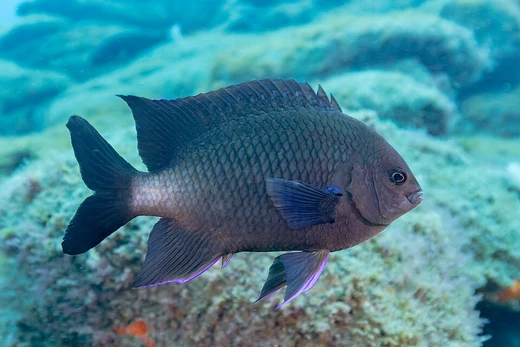
Spiny chromis
A damselfish with direct development and no pelagic larval stage.

The spiny chromis (Acanthochromis polyacanthus) is a damselfish found in the western Pacific. It is the sole species in its genus, Acanthochromis.
Dutch ichthyologist Pieter Bleeker first described it in 1855, naming it Dascyllus polyacanthus based on a specimen from Batman in the Moluccas. Its genus name combines *acanthus* ("spine"), likely referring to its 17 dorsal-fin spines, with *Chromis*, suggesting a relation to that genus. The species name *polyacanthus* means "many-spined."
This fish inhabits the western Pacific, including western and central Indonesia, Papua New Guinea, northern Australia, the Philippines (except Luzon), and Melanesia. It lives on coral reefs, typically at depths of 4 to 20 meters (13 to 66 ft), though it can range from 1 to 65 meters (3.3 to 213.3 ft).
Adults reach up to 14 centimeters (5.5 inches) in length. Their fins include 17 dorsal spines, 14 to 16 dorsal rays, 2 anal spines, and 14 to 16 anal rays. Color varies widely by location, likely because the species lacks a pelagic larval stage and adults are sedentary, leading to low genetic exchange between populations and divergent evolution. Whether all color forms belong to the same species or form a species complex is unclear. Juveniles often have a yellow stripe along their sides.
The spiny chromis eats plankton and algae, and it steals algae from algae-farming damselfish. Juveniles also consume mucus from their parents' skin, similar to young discus fish.
Unlike most coral reef fish, this species has direct larval development. Parents guard their eggs (laid on the reef) through hatching until the young are fully developed juveniles. There is no pelagic larval stage. As a result, offspring usually settle near their birthplace, leading to strong local adaptation and the development of distinct geographic color variations.
Quick Facts
- Taxon
- Acanthochromis polyacanthus
Facts from the source article.
Lore & Background
The spiny chromis was first formally described in 1855 as Dascyllus polyacanthus by the Dutch ichthyologist Pieter Bleeker, with the type locality given as Batman in the Moluccas. Its genus name is a compound of acanthus meaning 'spine', probably a reference to the 17 dorsal-fin spines, and Chromis, presumably referring to a relationship to that genus. The specific name polyacanthus means 'many-spined'.
This fish occurs in a wide range of colour variations depending on geographic location. It is thought this is due to the lack of a pelagic larval phase and sedentary behaviour of adults, resulting in little genetic connectivity between populations and thus divergent evolution. It is currently unclear whether all these variations are truly the same species, or whether they constitute a species complex. Juveniles typically display a yellow stripe along their flanks.
The spiny chromis is planktivorous and algivorous, and steals algae from algae-farming species of damselfish. Juveniles consume mucus secreted from their parent's skin, similar to the behaviour of young discus. Unlike many other coral reef fishes, it has direct development of their larvae, meaning parents protect their brood from the egg stage through hatching to the fully developed juvenile stage, with no pelagic larval stage.
Reader's Guide
The spiny chromis is significant as the sole member of the genus Acanthochromis, a distinction that underscores its unique evolutionary path among damselfishes. Its most notable legacy is its direct development, which contrasts with the vast majority of coral reef fishes that have a pelagic larval stage. This reproductive strategy means offspring often take up residence on the reef not far from where they were hatched, leading to high levels of local adaptation and the emergence of multiple geographic colour variations. The article notes that it is currently unclear whether these variations represent a single species or a species complex, leaving an open question for future research. Its diet includes stealing algae from algae-farming damselfish, and juveniles feed on parental mucus, behaviors that highlight its ecological interactions. Found in the western Pacific, it inhabits coral reefs at depths usually between 4 and 20 metres, and its description by Pieter Bleeker in 1855 places it within the early history of ichthyological taxonomy.
Did You Know?
- The spiny chromis is the only species in the genus Acanthochromis.
- It has 17 dorsal spines, which likely inspired its genus name meaning 'spine'.
- It has direct development with no pelagic larval stage, unlike most coral reef fishes.
More in Clownfish and Damselfish 1-24
Spotted an error? Know more?
Reader corrections go straight into our review queue. Suggest an edit · How this site is sourced