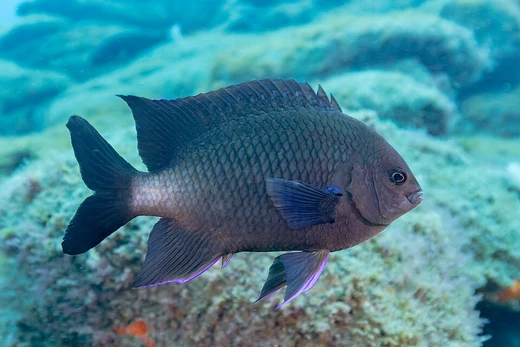
Sebae clownfish
An anemonefish of the northern Indian Ocean with a symbiotic host relationship.

The sebae clownfish (Amphiprion sebae) is an anemonefish found in the northern Indian Ocean, from Java to the Arabian Peninsula. It is notable for its symbiotic relationship with sea anemones, primarily the saddle anemone (Stichodactyla haddoni), and for its distinctive blackish or dark brown body with yellow snout, breast, and belly, along with two broad white bars.
Quick Facts
- Taxon
- Amphiprion sebae
Facts from the source article.
Lore & Background
Amphiprion sebae, described by Bleeker in 1853, is a sequential hermaphrodite with a strict dominance hierarchy where only the largest fish is female. In a group, only two clownfish—a male and a female—reproduce through external fertilization. The species is associated with the host anemone Stichodactyla haddoni, despite the common name of Heteractis crispa (sebae anemone) suggesting otherwise.
A melanistic variation exists where the fish lacks the yellow snout, breast, and belly, though it is not known whether this variation is linked to a specific anemone species. The similar species A. polymnus can be distinguished by a black or dark wedge shape on the tail, while A. clarkii lacks the characteristic sloping mid-band of A. sebae.
In captivity, a study using estuarine water examined breeding and larval rearing. The male courts the female about a week before spawning, and the male initiates site maintenance. The female lays 300 to 600 eggs, which the male guards. Eggs hatch after six to eight days, and larvae undergo metamorphosis between days fifteen and eighteen.
Reader's Guide
The sebae clownfish is significant as a representative of anemonefish symbiosis, living with Stichodactyla haddoni in the northern Indian Ocean. Its reproductive biology—sequential hermaphroditism with a strict dominance hierarchy and external fertilization—illustrates a common pattern among clownfish. The species is also notable for its color variations, including a melanistic form, and for being sometimes mislabeled in the aquarium trade as A. clarkii, though the two differ in the shape of the mid-body bar. The eggs, initially transparent with oil droplets, mature to bright yellow or orange, with sizes ranging from 1.7 to 2.6 mm in length. The species' distribution spans from Java to the Arabian Peninsula, including India, Sri Lanka, the Maldives, Sumatra, and the Andaman Islands. Its legacy lies in its role as a model for studying anemonefish ecology, captive breeding, and larval development, as documented in research using estuarine water.
Did You Know?
- Only two clownfish in a group—a male and a female—reproduce through external fertilization.
- The sebae clownfish is normally found with the saddle anemone (Stichodactyla haddoni), not the sebae anemone (Heteractis crispa).
- Eggs of A. sebae are initially transparent with oil droplets and become bright yellow to orange as they mature.
- A melanistic variation of A. sebae lacks the yellow snout, breast, and belly, but it is not known if this is linked to a specific anemone.
More in Clownfish and Damselfish 1-24
Spotted an error? Know more?
Reader corrections go straight into our review queue. Suggest an edit · How this site is sourced