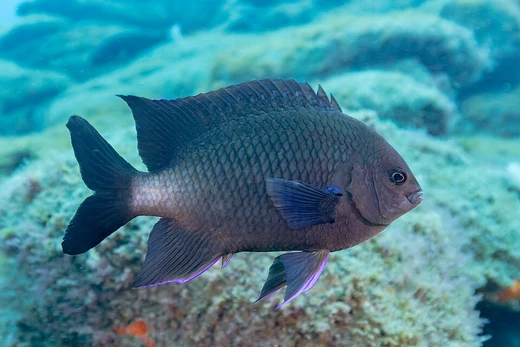
Saddleback clownfish
A black and white anemonefish with a distinctive saddle-shaped bar.

The saddleback clownfish (Amphiprion polymnus), also known as the yellowfin anemonefish, is a black and white species of anemonefish distinguished by a large white saddle-shaped bar across the middle of its body. It forms a symbiotic mutualism with sea anemones and is notable for its strict size-based dominance hierarchy and protandrous hermaphroditism, where the breeding male changes to female if the sole breeding female dies.
Quick Facts
- Taxon
- Amphiprion polymnus
Facts from the source article.
Lore & Background
Amphiprion polymnus is a small, stocky fish with an oval, laterally compressed body and a round profile. Its body color ranges from dark brown to yellow orange, and it typically has two or three white bars: a thick head bar behind the eyes, a large white saddle or slanted bar across the middle, and sometimes a third bar on the caudal peduncle. The snout and pectoral fin are orange yellow to brownish orange. Melanistic variation correlates partially with the host anemone: specimens associated with Heteractis crispa tend to be darker than those with Stichodactyla haddoni, and aquarium specimens have been observed changing color after accepting a new host.
Historically, anemonefish were identified by morphological features and color pattern. A. polymnus is part of the saddleback complex with A. sebae and A. latezonatus, though genetic analysis showed A. latezonatus is a monospecific lineage. The yellow tail of A. sebae distinguishes it from A. polymnus. The species inhabits silty lagoons and harbour areas from 2 to 30 metres depth, found across the Coral Triangle, northern Australia, Melanesia, and the Ryukyu Islands.
Like all anemonefish, A. polymnus is a sequential hermaphrodite with a strict size-based dominance hierarchy: the female is largest, the breeding male second largest, and non-breeding males progressively smaller. It exhibits protandry—if the sole breeding female dies, the breeding male changes to female, and the largest non-breeder becomes the breeding male. The male is almost equal in size to the female, an adaptation suggested to help elude predators by erratic swimming or covering distance to shelter.
Reader's Guide
The saddleback clownfish is significant as a specialist anemonefish hosted by only two of the ten host anemone species: Heteractis crispa (rarely) and Stichodactyla haddoni. Its relationship with host anemones is highly nested, not random. The fish is aggressively territorial and diurnal, using the anemone as shelter for the group and nest, and defending it from butterflyfishes that eat tentacles. Both host anemones can bury themselves in sand under stress, leaving the fish vulnerable to predation.
Conservation concerns include environmental threats to coral reefs: anemones contain zooxanthellae and can bleach due to increased water temperature or acidification. Additionally, collection for the marine aquarium trade—where anemonefish make up 43% of the global marine ornamental trade—poses a threat, with 25% of trade from captive-bred fish and the majority wild-caught, leading to decreased densities in exploited areas. Bleaching is a significant threat, and collection compounds localised impacts. This species was not evaluated in the 2012 IUCN Red List.
In aquariums, A. polymnus has been bred in captivity. However, keeping its host anemones is not recommended even for experienced aquarists due to poor survival rates of wild-collected specimens and shortened lifespans in captivity.
More in Clownfish and Damselfish 1-24
Spotted an error? Know more?
Reader corrections go straight into our review queue. Suggest an edit · How this site is sourced