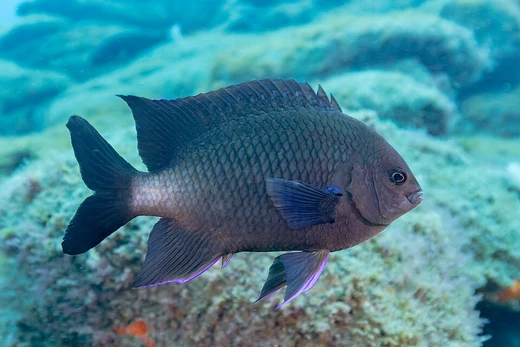
Red Sea clownfish
A two-banded anemonefish found in the Red Sea and western Indian Ocean.

The Red Sea Clownfish (Amphiprion bicinctus, meaning "both sawlike with two stripes"), commonly known as the Red Sea or two-banded anemonefish, is a marine fish belonging to the family Pomacentridae, the clownfishes and damselfishes. Like other species of the genus, the fish feeds on algae and zooplankton in the wild. It is notable for forming symbiotic mutualisms with sea anemones, being unaffected by their stinging tentacles, and for its distinctive two white bands.
Quick Facts
- Taxon
- Amphiprion bicinctus
Facts from the source article.
Lore & Background
The Red Sea Clownfish has a body that is yellow-orange to dark brown, with two white bands or bars edged in black, the head-bar being considerably wider. Males grow to 10 cm, females to 14 cm. Like all clownfish, it is a sequential hermaphrodite: individuals develop into males first and, upon maturing, become females. In a group, a strict dominance hierarchy exists, with the largest and most aggressive fish being female and the only two fish (a male and a female) reproducing through external fertilization.
The species is found in the Western Indian Ocean, the Red Sea, Socotra, and the Chagos Archipelago. It is a generalist in its choice of host sea anemones, being hosted by five species: Entacmaea quadricolor (bubble-tip anemone), Heteractis aurora (white beaded anemone), Heteractis crispa (Sebae anemone), Heteractis magnifica (magnificent sea anemone), and Stichodactyla gigantea (giant carpet anemone). Studies in the northern Red Sea have shown a preference for E. quadricolor over H. crispa, with sexually mature fish rarely hosted by H. crispa. One study theorized that H. crispa might serve as a nursery anemone, as clusters of juveniles were found only at low-density sites, while a later study concluded it was a less-preferred host due to body size, morphology, and behavior of the host.
Reader's Guide
The Red Sea Clownfish is significant as a representative of the clownfish and damselfish family, demonstrating the classic symbiotic mutualism with sea anemones: the anemone protects the fish from predators and provides food scraps, while the clownfish defends the anemone from predators and parasites. Its two white bars place it within the clarkii complex subgenus, and its yellow caudal fin distinguishes it from similar species such as A. latifasciatus (which has a wider mid-body bar and forked tail) and A. allardi or A. chagosensis (which have white or whitish tails). The species' host relationships are not random but highly nested; studies have revealed a preference for the bubble-tip anemone over the Sebae anemone, with the latter possibly acting as a nursery for juveniles. This research highlights the ecological complexity of anemonefish-anemone associations. The fish's color variation—from yellow-orange to dark brown—can occur within the species based on distribution, sex, age, and host anemone. Its presence across the Red Sea and western Indian Ocean underscores its adaptability to sheltered reefs and shallow lagoons.
Did You Know?
- The Red Sea Clownfish has two white bands or bars with black edges, and the head-bar is considerably wider than the body bar.
- Males grow to 10 cm, while females reach 14 cm in length.
- It is a generalist host, associating with five species of sea anemones, including the bubble-tip anemone and the Sebae anemone.
- Studies in the northern Red Sea suggest that Heteractis crispa may serve as a nursery anemone for juvenile fish.
More in Clownfish and Damselfish 1-24
Spotted an error? Know more?
Reader corrections go straight into our review queue. Suggest an edit · How this site is sourced