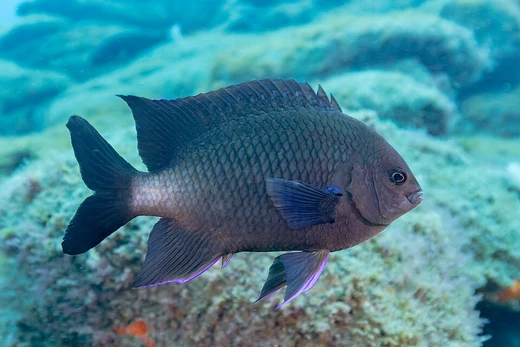
Red saddleback anemonefish
A reddish-orange clownfish with a black saddle, lacking white bars as an adult.

The red saddleback anemonefish, *Amphiprion ephippium* (also called the saddle anemonefish), is a marine species in the clownfish and damselfish family, Pomacentridae. Like other clownfish, it lives in a mutualistic partnership with sea anemones in the wild—the fish is immune to the anemone’s stinging tentacles. The anemone shelters the fish from predators and provides food from leftover scraps and dead tentacles; in exchange, the fish defends the anemone from predators and parasites. Clownfish are small, typically 10–18 cm long, and can be yellow, orange, reddish, or blackish, often with white bars or patches. Color may vary by location, sex, age, or host anemone. They inhabit warm waters of the Indian and Pacific Oceans and the Red Sea, in sheltered reefs and shallow lagoons. Within a group, a strict hierarchy exists: the largest, most aggressive fish is the dominant female. Only one breeding pair (a male and female) reproduces via external fertilization. Clownfish are sequential hermaphrodites—they mature as males first, then become females. Adults of this species have a reddish-orange body with a black saddle or spot on each side. Juveniles may have two or three white bars, but these disappear in mature fish. They have 10–11 dorsal spines, 2 anal spines, 16–18 dorsal soft rays, and 13–14 anal soft rays, reaching a maximum length of 12 cm. None known. Adults lack a white bar on the head, which distinguishes them from similar species like *A. frenatus*, *A. melanopus*, and *A. rubrocinctus*. This fish is found in the Andaman and Nicobar Islands, Thailand, Malaysia, Sumatra, and Java. The original collection site, Tranquebar, is likely a mistake, as it lies outside the known range. It associates with two host anemones: the bubble-tip anemone (*Entacmaea quadricolor*) and the sebae anemone (*Heteractis crispa*).
Quick Facts
- Taxon
- Amphiprion ephippium
Facts from the source article.
Lore & Background
Adults of the red saddleback anemonefish have a reddish-orange body and a black saddle or spot on the sides. While small juveniles may have 2 or 3 white bars, these are not present in mature fish. They have 10-11 dorsal spines, 2 anal spines, 16-18 dorsal soft rays and 13-14 anal soft rays, reaching a maximum length of 12 cm. Like other clownfish, this species forms a strict dominance hierarchy in groups, with the largest and most aggressive fish being female. Only two fish, a male and a female, reproduce through external fertilization. Clownfish are sequential hermaphrodites, developing into males first and becoming females when they mature. The lack of a white head bar on adults distinguishes A. ephippium from the somewhat similar A. frenatus, A. melanopus, and A. rubrocinctus. None known.
Reader's Guide
The red saddleback anemonefish is significant as a member of the clownfish and damselfish family, known for its symbiotic mutualism with sea anemones. In the wild, the sea anemone protects the clownfish from predators and provides food through scraps and dead tentacles, while the clownfish defends the anemone from predators and parasites. This species is found in warmer waters of the Indian and Pacific oceans and the Red Sea, specifically in the Andaman and Nicobar Islands, Thailand, Malaysia, Sumatra, and Java, inhabiting sheltered reefs or shallow lagoons. The original collection locality, Tranquebar, is believed to be erroneous as it is outside the known range. A. ephippium is associated with two host anemone species: Entacmaea quadricolor (bubble-tip anemone) and Heteractis crispa (Sebae anemone). Its legacy lies in its distinct adult coloration—reddish-orange with a black saddle and no white bars—which sets it apart from similar species. The species exemplifies the typical clownfish life history, including a strict dominance hierarchy and sequential hermaphroditism, contributing to the broader understanding of anemonefish ecology and behavior.
More in Clownfish and Damselfish 1-24
Spotted an error? Know more?
Reader corrections go straight into our review queue. Suggest an edit · How this site is sourced