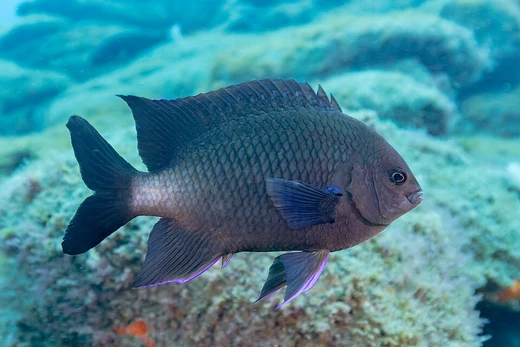
Pink skunk clownfish
A small, algae-eating anemonefish with a pink body and white stripes.

The pink skunk clownfish (Amphiprion perideraion), also known as the pink anemonefish, is a species of anemonefish widespread from northern Australia through the Malay Archipelago and Melanesia. It forms a symbiotic mutualism with sea anemones and is unaffected by the host's stinging tentacles. Notable for being one of the smallest anemonefish species, it exhibits protandry and a strict size-based dominance hierarchy.
Quick Facts
- Taxon
- Amphiprion perideraion
Facts from the source article.
Lore & Background
The body of A. perideraion is pink to peach, with a white stripe along the dorsal ridge common to all members of the skunk complex and a white head bar running vertically just behind the eye. It is one of the smallest anemonefish species, with females growing to a length of 10 cm. Unlike some other anemonefish, it does not show color variations based on geographic location, sex, or host anemone.
A. perideraion is a sequential hermaphrodite with a strict size-based dominance hierarchy: the female is largest, the breeding male is second largest, and male nonbreeders get progressively smaller. It exhibits protandry, meaning the breeding male changes to female if the sole breeding female dies, with the largest nonbreeder becoming the breeding male.
The species is found throughout the Malay Archipelago and Melanesia, in the west Pacific Ocean from the Great Barrier Reef and Tonga north to the Ryukyu Islands, and in the eastern Indian Ocean from Ningaloo Reef through the Rowley Shoals to Sumatra. It inhabits reef lagoons and outer reef slopes. Genetic analysis has shown a genetic break between the Java Sea population and all other locations.
Reader's Guide
The pink skunk clownfish is significant as a generalist anemonefish, hosted by four of the ten host anemone species: Heteractis crispa, Heteractis magnifica, Macrodactyla doreensis, and Stichodactyla gigantea. Unusually for anemonefish, it has been observed sharing a host with other species, including A. clarkii and A. akallopisos. Its natural diet includes zooplankton, benthic worms, tunicates, and algae, but it is the only species of anemonefish to primarily feed on algae. The species has been successfully bred in an aquarium, where hobbyists feed it brine shrimp, mysis shrimp, chopped shellfish, and dried algae. Conservation concerns include vulnerability to bleaching due to increased water temperature or acidification, and exploitation by the global ornamental fish trade. It was not evaluated in the 2012 release of the IUCN Red List. A. perideraion and A. clarkii are the only anemonefish found on both the east and west coasts of Australia.
Did You Know?
- A. perideraion is one of the smallest anemonefish species, with females reaching only 10 cm in length.
- It is the only anemonefish species that primarily feeds on algae.
- Surveys using autonomous underwater vehicles found A. perideraion at depths between 50 and 65 m, deeper than its typical range of 3–20 m.
More in Clownfish and Damselfish 1-24
Spotted an error? Know more?
Reader corrections go straight into our review queue. Suggest an edit · How this site is sourced