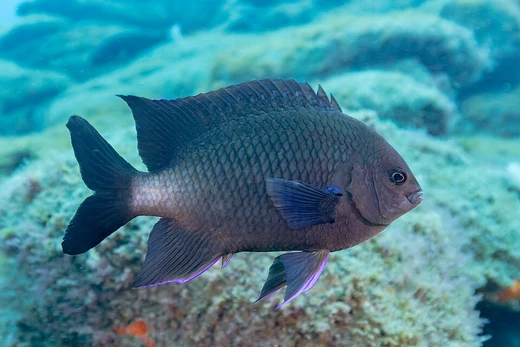
Orange-fin anemonefish
A Western Pacific clownfish with white bars and variable tail color.

The orange-fin anemonefish (Amphiprion chrysopterus) is a marine fish belonging to the family Pomacentridae, the clownfishes and damselfishes. It is found in the Western Pacific north of the Great Barrier Reef from the surface to 20 m, including the Pacific Ocean between Queensland, Australia, and New Guinea to the Marshall and Tuamotus Islands. It can grow to 17 cm in length.
Quick Facts
- Genus
- Amphiprion
- Species
- chrysopterus
Facts from the source article.
Lore & Background
The orange-fin anemonefish has a short, deep body and a small head. It is generally yellow on the body edges, yellow-brown to dark brown in the middle sides, with two white vertical stripes—the first behind the eye and the second before the anus. The fins are yellow to orange, and juveniles are a dull orange. Tail fins are generally white or yellow, varying by area of origin: fish from the Fiji and Tonga area have yellow tails, while those from the Marshall and Solomon Islands have white tails.
Like other clownfish, it forms symbiotic mutualisms with sea anemones and is unaffected by their stinging tentacles. The sea anemone protects the clownfish from predators and provides food from scraps and dead tentacles; in return, the clownfish defends the anemone from predators and parasites. Within a group, a strict dominance hierarchy exists, with the largest and most aggressive fish being female. Only two fish, a male and a female, reproduce through external fertilization. Clownfish are sequential hermaphrodites, developing into males first and later becoming females.
Adults generally inhabit reef passages and slopes. They feed mainly on planktonic copepods, algae, echiuroid and sipunculoid worms, and pelagic tunicates. They are oviparous with distinct pairing during breeding; eggs are demersal and adhere to the substrate, and males guard and aerate the eggs. Color variations occur, with blackish fish associated with the host anemone Stichodactyla mertensii, and brown males and juveniles associated with Heteractis crispa. Only orange or brown juveniles are associated with Heteractis aurora.
Reader's Guide
The orange-fin anemonefish is notable for its association with multiple species of host anemones, including Entacmaea quadricolor, Heteractis aurora, Heteractis crispa, Heteractis magnifica, Macrodactyla doreensis, Stichodactyla haddoni, and Stichodactyla mertensii. This broad host range reflects its adaptability within Western Pacific reef systems. The species can be confused with three other clownfish with overlapping distribution—Amphiprion akindynos, Amphiprion clarkii, and Amphiprion tricinctus—but can be distinguished by its darker coloration, black pelvic and anal fins (which eliminate A. akindynos), and the absence of a wide midbar or tail bar (which would indicate A. clarkii). A. tricinctus also has a tail bar unless it is solid black. The orange-fin anemonefish's tail color varies geographically, with yellow tails in the Fiji and Tonga region and white tails in the Marshall and Solomon Islands, illustrating local variation within the species. Its maximum recorded length of 17 cm places it within the typical size range for clownfish, which are generally 10–18 cm. The species is found from the surface to 20 m depth, inhabiting sheltered reefs and shallow lagoons in warmer waters of the Western Pacific.
Did You Know?
- The orange-fin anemonefish can grow to 17 cm in length.
- Its tail fin color varies by region: yellow near Fiji and Tonga, white near the Marshall and Solomon Islands.
- It is associated with at least seven species of host anemones, including the bubble-tip anemone and Mertens' carpet sea anemone.
- It may be confused with Amphiprion akindynos, A. clarkii, and A. tricinctus, but can be distinguished by fin color and bar patterns.
More in Clownfish and Damselfish 1-24
Spotted an error? Know more?
Reader corrections go straight into our review queue. Suggest an edit · How this site is sourced