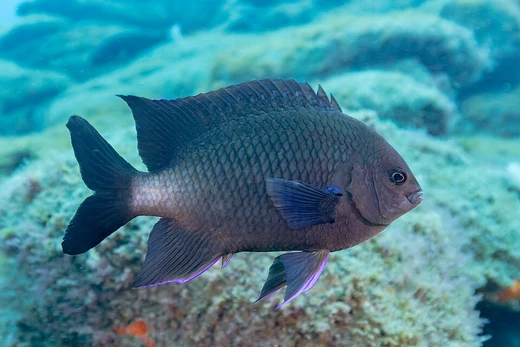
Orange clownfish
A popular aquarium fish that lives in symbiosis with sea anemones.

The orange clownfish (*Amphiprion percula*), also called the percula clownfish or clown anemonefish, is a well-known aquarium species. Like other anemonefishes, it typically lives alongside sea anemones. It specifically associates with *Heteractis magnifica* and *Stichodactyla gigantea*, and as larvae, it uses chemical signals released by these anemones to find and choose the right host for shelter and protection, leading to a strong preference for those species.
Keeping this fish in captivity is tricky, despite its popularity. The Great Barrier Reef Marine Park Authority controls how many collection permits are given to aquarium fish dealers who want to catch this and other tropical fish within the park.
The partnership between anemonefish and anemones works because the fish attracts other fish to the anemone, where they get stung by its venomous tentacles. The anemone shields the fish from predators like brittle stars, wrasses, and other damselfish, while the fish helps the anemone by feeding it, boosting oxygen levels, and removing waste. Exactly how the fish avoids being harmed by the anemone is still debated. A 1958 study at Marineland of the Pacific by Dr. Demorest Davenport and Dr. Kenneth Noris found that the fish’s mucus stops the anemone from firing its stinging nematocysts. Another idea is that the fish has developed immunity to the anemone’s toxins. Evidence suggests both mechanisms are at work. The fish eats algae, zooplankton, worms, and small crustaceans.
**Description**
*Amphiprion percula* reaches up to 11 cm (4.3 in) long, averaging about 8 cm (3.1 in). It has three white stripes across a bright orange body, with no color difference between males and females. The front stripe sits just behind the eye, the middle stripe runs straight across the middle, and the rear stripe is near the tail fin. The middle stripe has a forward-pointing bulge. Each fin has a black edge of varying thickness. This species is easily confused with the similar *A. ocellaris*, sometimes called the false percula or common clownfish. The most reliable way to tell them apart is fin spine count: *A. percula* has 10 spines in its first dorsal fin (rarely 9), while *A. ocellaris* has 11 (rarely 10). *A. ocellaris* also lacks the thick black fin edging. Marine heatwaves harm the growth of many vertebrates.
Quick Facts
- Taxon
- Amphiprion percula
Facts from the source article.
Lore & Background
Amphiprion percula can be recognized by three white lines across its bright orange body, with no distinction in color between sexes. The anterior white bar is placed just behind the eye, the middle bar goes straight down the middle of the fish, and the posterior bar occurs near the caudal fin, with an anterior projecting bulge on the middle bar. Black edging outlines each fin with varying thickness. This species can be mistaken for A. ocellaris, but A. percula has 10 spines in the first dorsal fin (rarely 9) while A. ocellaris has 11 (rarely 10), and A. ocellaris does not have thick black edging outlining the fins.
The symbiosis between anemonefish and anemones depends on the presence of the fish drawing other fish to the anemone, where they are stung by its venomous tentacles. The anemone gives the fish protection from predators including brittle stars, wrasses, and other damselfish, while the fish feeds the anemone, increases oxygenation, and removes waste material. Various hypotheses exist about the fish's ability to live within the anemone without being harmed; a study revealed that mucus secreted by the anemone fish prevented the anemone from discharging its nematocysts, and a second hypothesis is that A. percula has acquired immunity, with a combination of the two shown to be the case. Marine heatwaves negatively affect growth patterns, and orange clownfish can shrink their bodies to combat heat stress, with the amount of shrinkage modulated by social rank and size.
Reader's Guide
The orange clownfish is notable for its complex social structure and reproductive biology. Each group consists of a breeding pair and none to four nonbreeders, with a size-based hierarchy: the female is largest, the breeding male second largest, and male non-breeders progressively smaller. They exhibit protandry, meaning each fish is born male but changes to female if the sole breeding female dies. Spawning is correlated with the lunar cycle, and the male attracts the female through courting behaviors including extending fins, biting, chasing, and rapid swimming. The female spawns 400–1500 eggs per cycle, and the expected tenure of breeding females is roughly 12 years. Nonbreeders associate with groups not for breeding opportunities or as helpers, but as a queue for the territory occupied by the breeders, as nonbreeders living with breeders have a better chance of eventually securing a territory. Aggression exists between males, with the largest male suppressing the development of the next smallest, and the female ultimately controls the size of other fish in the anemone. In captivity, the fish is peaceful. The larvae hatch after 6–8 days, swim to the open ocean to eat plankton for about a week, then return to the reef to find an anemone. Recruitment is influenced by food supplies, predator threats, and availability of nearby anemones. Most anemonefish are site-attached and do not move between anemones more than a few meters due to the danger of being outside their safe haven.
Did You Know?
- The orange clownfish can grow to 11 cm in length, but averages 8 cm.
- It has 10 spines in the first dorsal fin, while the similar A. ocellaris has 11.
- Nonbreeders in a group queue for the territory of the anemone, not for breeding opportunities.
- The fish can shrink its body during marine heatwaves to combat heat stress.
More in Clownfish and Damselfish 1-24
Spotted an error? Know more?
Reader corrections go straight into our review queue. Suggest an edit · How this site is sourced