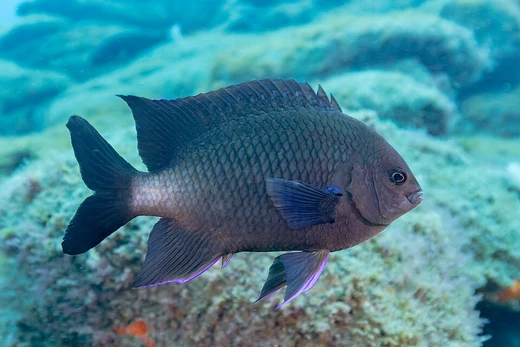
Ocellaris clownfish
A small, colorful fish symbiotic with sea anemones.

The ocellaris clownfish, also called the false percula or common clownfish, is a saltwater fish in the Pomacentridae family, which also includes damselfish. Its color varies by location: some are black with white bands, found near northern Hawaii, Australia, Southeast Asia, and Japan, while others are orange or red-brown with three white bands on the body and head. It can be told apart from other clownfish species by counting its pectoral rays and dorsal spines. Adults reach about 11 cm (4.3 inches) long, with females larger than males. Newly hatched ocellaris clownfish live near the ocean surface, but as juveniles they swim down to the seafloor to find a host anemone, forming a symbiotic partnership.
In terms of classification, this fish is a ray-finned bony fish in the family Pomacentridae. Its closest relative is the orange clownfish, *Amphiprion percula*. Evidence suggests that ancestral clownfish could only tolerate the stings of a single anemone species; over time, the 28 clownfish species, including the ocellaris, evolved to resist the venom of many different anemones.
The ocellaris clownfish has a small, stocky, oval body that is flattened from side to side, with a round outline. Its color ranges from orange to reddish-brown, though it can be black in places like Australia’s Northern Territory. Three vertical white stripes, each edged with a fine black line, mark the body: one behind the eye, one in the middle that widens toward the head, and one around the tail base. All fins also have a thin black border. It is often mistaken for *Amphiprion percula*, which looks nearly identical but has thicker black outlines, a shorter dorsal fin, and typically 10 dorsal-fin spines instead of 11.
This species lives in the eastern Indian Ocean and western Pacific Ocean, as well as near Hawaii, North America, northern Australia, Southeast Asia, and Japan. It usually stays in small groups on outer reef slopes or in sheltered lagoons, no deeper than 15 meters. It inhabits three anemone species: *Heteractis magnifica*, *Stichodactyla gigantea*, and *Stichodactyla mertensii*, with which it has a symbiotic relationship.
The ocellaris clownfish is active during the day. It is a protandrous hermaphrodite—males can change into females—and lives in a harem with a strict dominance hierarchy.
Quick Facts
- Taxon
- Amphiprion ocellaris
Facts from the source article.
Lore & Background
The ocellaris clownfish is a ray-finned bony fish in the family Pomacentridae, sister to Amphiprion percula. Evidence indicates that ancestrally, Amphiprion clownfish could withstand the stings of only one type of anemone; after further speciation, the 28 different species of clownfish, including A. ocellaris, have specialized to resist the poisonous stings of many different anemone species. Its body has a stocky appearance and oval shape, compressed laterally with a round profile. Coloration varies from orange to reddish-brown, but can be black in some areas such as the Northern Territory in Australia. It has three vertical white stripes outlined with a fine black line, and all fins are outlined with a fine black line. A. ocellaris is often confused with Amphiprion percula but can be distinguished by the thickness of black outlines, a taller dorsal fin, and typically 11 dorsal-fin spines versus 10 in A. percula.
Reader's Guide
The ocellaris clownfish is significant for its complex social system and symbiotic relationship with sea anemones. It is a protandrous hermaphrodite, meaning the male can change sex to female, and lives in a harem with an established dominance hierarchy. It is aggressively territorial and completely dependent on its sea anemone for shelter, as it faces higher predation risk in open waters. The anemone provides protection with its tentacles, while the fish's mucus prevents stinging; the fish may also defend the anemone from reef fishes that eat tentacles. Social hierarchies are formed by outliving more dominant members, with the dominant pair reproducing more than subordinates. Juveniles face difficulty finding an anemone and often begin at the bottom of the social ladder, subject to aggression. Group size correlates with patch size, but this does not imply fewer resources for subordinates; rather, the dominant member's length limits group size. Feeding is affected by hierarchy, with smaller fish eating less due to aggression and danger. The species feeds on algae, copepods, and zooplankton. Reproduction involves monogamous mating, with males becoming more aggressive during spawning and caring for the eggs after external fertilization.
Did You Know?
- A. ocellaris can be black with white bands in areas such as northern Hawaii, Australia, Southeast Asia, and Japan.
- It has 11 dorsal-fin spines, while its sister species Amphiprion percula has 10.
- Juveniles travel down from the surface to find shelter in a host anemone.
- The eggs take approximately six to eight days to hatch, depending on water temperature.
More in Clownfish and Damselfish 1-24
Spotted an error? Know more?
Reader corrections go straight into our review queue. Suggest an edit · How this site is sourced