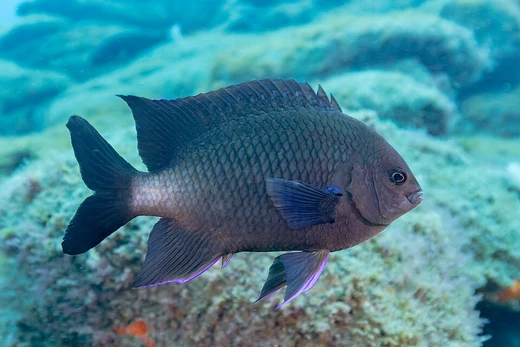
Allard's clownfish
A dark-brown clownfish with white bars from the western Indian Ocean.

Allard's clownfish or Allard's anemonefish (Amphiprion allardi) is a marine fish belonging to the family Pomacentridae, the clownfishes and damselfishes. It is found in the western Indian Ocean off the coast of East Africa and the Mascarenes, and like other clownfish, it forms symbiotic mutualisms with sea anemones.
Quick Facts
- Taxon
- Amphiprion allardi
Facts from the source article.
Lore & Background
Adults are a dark-brown to black color with two white bars with black edging encircling the body. The caudal fin is white with other fins orange. They have 10-11 dorsal spines, two anal spines, 15-17 dorsal soft rays, and 15-17 anal soft rays. They reach a maximum length of 14 cm (5+1⁄2 in).
Allard's anemonefish is almost identical to A. chrysopterus (orange-fin anemonefish) and are distinguished by their geographic location. It is similar to the nearby A. latifasciatus (Madagascar anemonefish), but A. latifasciatus has a forked, yellow caudal fin.
The specific name and the common name honour the aquarist and marine collector Jacques Allard, who gave support to the author Wolfgang Klausewitz's visit to East Africa and who supplied him with many specimens.
Reader's Guide
Allard's clownfish is notable as a member of the Pomacentridae family, forming symbiotic mutualisms with sea anemones in the wild. It is associated with three species of host anemones: Entacmaea quadricolor (bubble-tip anemone), Heteractis aurora (beaded sea anemone), and Stichodactyla mertensii (Mertens' carpet sea anemone). The fish is found in east Africa between Kenya and Durban, and east to the Seychelles and Mascarene Islands, usually near or within the tentacles of its host anemones. Its similarity to other species, such as A. chrysopterus and A. latifasciatus, means that geographic location is key to identification. The species was named after Jacques Allard, who supported the author Wolfgang Klausewitz's research in East Africa. As a clownfish, it exhibits a strict dominance hierarchy, with the largest and most aggressive fish being female, and only two fish in a group reproduce through external fertilization. Clownfish are sequential hermaphrodites, developing into males first and then becoming females when they mature.
Did You Know?
- It is almost identical to the orange-fin anemonefish (A. chrysopterus) and is distinguished by geographic location.
- The species is named after aquarist and marine collector Jacques Allard.
- It is associated with three host anemone species: bubble-tip, beaded sea, and Mertens' carpet anemones.
More in Clownfish and Damselfish 1-24
Spotted an error? Know more?
Reader corrections go straight into our review queue. Suggest an edit · How this site is sourced