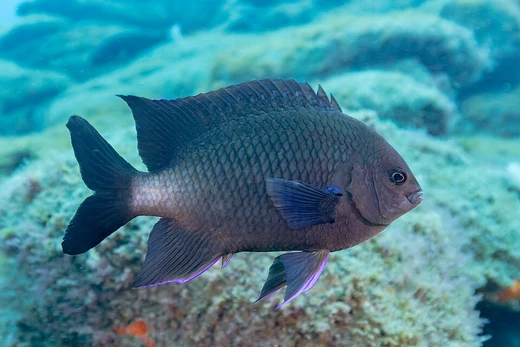
Lagoon damselfish
A large damselfish of sheltered Indo-Pacific reefs.

The lagoon damselfish (Hemiglyphidodon plagiometopon), also called the sweetlip damsel, is a ray-finned fish belonging to the damselfish family Pomacentridae. It is a relatively large damselfish, inhabiting the Indo-Pacific region, where it lives near branching corals in protected reef areas.
Adults are mostly brown, with a pale russet head that darkens toward the tail, and pinkish marks on the gill cover. Juveniles are dark blue to brown on the head and front body, turning yellow toward the tail and underside, and have a large iridescent blue eyespot on the dorsal fin, plus blue bands and spots near the head. They reach a maximum length of 18 cm (7.1 in). Sometimes the only noticeable feature is a yellow ring around the eye.
This species occurs in the eastern Indian Ocean from Thailand through Indonesia, the Philippines, and the Timor Sea, and into the western Pacific as far south as Australia, north to China, and east to the Solomon Islands.
It lives in sheltered reefs and lagoons, often in murky water with silty bottoms near the base of branching corals, at depths of 1–20 m (3–66 ft). Lagoon damselfish are detritivores, having up to three times more gill rakers than other damselfish, an adaptation for feeding on fine detritus. They are territorial, defending a patch of algae-covered reef. While feeding on detritus, they also consume small amounts of algae and invertebrates. They form breeding pairs, clearing a nest site and performing a mating dance with fast swimming and fin movements. Males often darken and may develop white blotches during mating. Eggs are laid at dawn, are demersal, and stick to the substrate, where the male guards and aerates them.
The lagoon damselfish is listed as Least Concern on the IUCN Red List, though it may be threatened by habitat degradation and human exploitation.
Quick Facts
- Taxon
- Hemiglyphidodon plagiometopon
Facts from the source article.
Lore & Background
The lagoon damselfish is a large brown species; adults often have a pale russet head with the colour gradually darkening toward the tail, and pinkish markings on the operculum. Juveniles are dark blue to brownish on the head and near body, yellow toward the tail and on the underside, with a large iridescent blue eyespot on the dorsal fin and blue bands and spots near the head. Sometimes the only distinctive marking is a yellow eyering.
It is found in the eastern Indian Ocean from Thailand through Indonesia, the Philippines and the Timor Sea into the western Pacific, south to Australia, north to China, and east to the Solomon Islands. It inhabits sheltered reefs and lagoons, often in areas of high turbidity and a silty substrate at the base of branching corals, at depths of 1–20 metres.
The species is a detritivore, with up to three times the number of gill rakers as other damselfish for feeding on fine detritus. It is territorial and defends a patch of algal-covered reef. While feeding on detritus, it consumes small amounts of algae and invertebrates. It forms pairs for breeding, clearing an area to create a nest, then engaging in a mating dance involving fast swimming and fin movements. Males frequently darken and may develop white blotches during mating. Eggs are laid at dawn, are demersal, and adhere to the substrate, where the male guards and aerates them.
Reader's Guide
The lagoon damselfish is notable as a larger species of damselfish, reaching up to 18 centimetres, and is distinguished by its detritivorous feeding strategy, having up to three times the number of gill rakers compared to other damselfish. This adaptation allows it to exploit fine detritus in sheltered, turbid reef environments. Its territorial behavior, involving defense of algal-covered patches, and its pair-bonding reproductive strategy—including a mating dance, male color changes, and male egg guarding—are characteristic of the family Pomacentridae. The species has been evaluated as Least Concern by the IUCN, though it may be threatened by habitat degradation and human exploitation. Its distribution spans the eastern Indian Ocean to the western Pacific, including regions such as Thailand, Indonesia, the Philippines, Australia, China, and the Solomon Islands. The distinct juvenile coloration, with a blue eyespot and yellow tail, contrasts with the adult's brown and russet tones, sometimes marked only by a yellow eyering.
Did You Know?
- The lagoon damselfish has up to three times the number of gill rakers as other damselfish, adapted for feeding on fine detritus.
- Adults often have a pale russet head that darkens toward the tail, with pinkish markings on the operculum.
More in Clownfish and Damselfish 1-24
Spotted an error? Know more?
Reader corrections go straight into our review queue. Suggest an edit · How this site is sourced