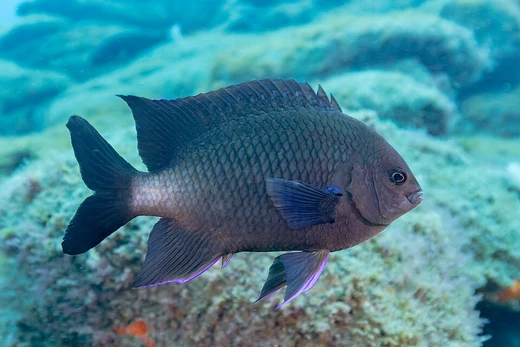
Galapagos damsel
A possibly extinct damselfish endemic to the Galápagos and Cocos Island.

The Galápagos damsel (Azurina eupalama), sometimes called the blackspot chromis, is a member of the Pomacentridae family that may now be extinct. This fish lives only in the waters around the Galápagos Islands and Cocos Island.
Growing up to 15 centimeters long, the damsel has an olive-gray body with a blue tint and silvery sides. A black spot marks the base of each pectoral fin, and its lateral line is prominent.
The species has been observed at numerous Galápagos sites, including Floreana, Gardiner Bay, Española, Tagus Cove, Isabela, Marchena, James Bay, Sullivan Bay, Santiago, Wreck Bay, San Cristóbal, Academy Bay, Santa Cruz, and Santa Fe. One old specimen in the American Museum of Natural History came from near Cocos Island. It feeds on plankton. Some scientists think climate change may be making extreme El Niño–Southern Oscillation events more frequent, which could have harmed this fish.
The 1982–1983 El Niño raised water temperatures around the Galápagos, cutting plankton production for at least a year. This caused populations of many plankton-eating fish, including the Galápagos damsel, to crash. Despite thorough searches in the following decade, none were seen again. The International Union for Conservation of Nature lists it as critically endangered and possibly extinct, noting speculation that it might survive on warm temperate islands off Peru, such as the Lobos Islands, but no evidence has turned up in untargeted surveys.
Quick Facts
- Taxon
- Azurina eupalama
Facts from the source article.
Lore & Background
The Galápagos damsel reaches a length of 15 centimeters. It is olive-gray with a blue tinge, and silvery along the sides. There is a black spot at the base of each pectoral fin, and it has a prominent lateral line. It is a plankton feeder. The species has been recorded from numerous locations in the Galápagos Islands, including Floreana, Gardiner Bay, Española, Tagus Cove, Isabela, Marchena, James Bay, Sullivan Bay, Santiago, Wreck Bay, San Cristóbal, Academy Bay, Santa Cruz, and Santa Fe. One specimen, collected many years ago, is held in the fish collection at the American Museum of Natural History and was found near Cocos Island.
Reader's Guide
The Galápagos damsel is significant primarily due to its possible extinction, which is linked to the El Niño–Southern Oscillation of 1982 and 1983. That event caused an increase in water temperature near the Galápagos Islands, reducing plankton production for at least one year. This led to population declines in many planktivorous fish, including the Galápagos damsel. Despite intensive searches during the following decade, the species was not seen again. The International Union for Conservation of Nature lists it as critically endangered and possibly extinct. The article notes speculation that the fish may still exist on islands off Peru that have warm temperate conditions, such as the Lobos Islands, but no evidence has been found in untargeted survey data to date. It has also been suggested that global climate change may be influencing the rate of extreme El Niño–Southern Oscillation events, such as the one that severely impacted this damselfish.
Did You Know?
- The Galápagos damsel is also known as the blackspot chromis.
- The species was severely impacted by the El Niño–Southern Oscillation of 1982 and 1983.
- One specimen in the American Museum of Natural History was collected near Cocos Island.
More in Clownfish and Damselfish 1-24
Spotted an error? Know more?
Reader corrections go straight into our review queue. Suggest an edit · How this site is sourced