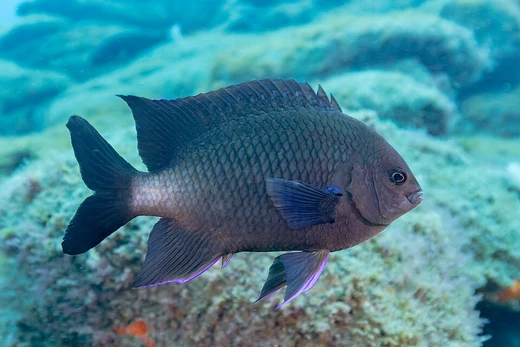
Dascyllus
Genus of damselfish commensal with corals, found in Indo-West Pacific.

Dascyllus is a genus of fish belonging to the damselfish family, Pomacentridae. These fish typically live in a commensal relationship with corals. They inhabit the Indo-West Pacific region and feed mainly on plankton.
Within the genus, three species groups have been proposed: the *D. aruanus* complex, the *D. trimaculatus* complex, and the *D. reticulatus* complex. However, only the first two groups are monophyletic, with the *D. aruanus* complex being the most ancient lineage in the genus. Members of the *D. trimaculatus* complex are the largest, growing to 90–110 mm in standard length, while most other species are smaller, reaching 50–65 mm. An exception is *D. flavicaudus*, which can reach 90 mm.
Juveniles of the *D. trimaculatus* complex are strongly associated with sea anemones. Some, and possibly all, species in this group are gonochoristic (having separate sexes from birth). In contrast, all other *Dascyllus* species are protogynous, meaning females can change sex to become males as they age or grow larger. This ability likely evolved once in the common ancestor of the genus and was later lost in the ancestor of the *D. trimaculatus* complex. All *Dascyllus* species are demersal spawners: females lay eggs in nests prepared by males, and the males guard the eggs until they hatch.
The genus currently includes 11 recognized species. Notably, the character Deb from the animated film *Finding Nemo* is a damselfish of this genus.
Quick Facts
- Taxon
- Dascyllus
- Type Species
- Chaetodon aruanus
- Type Species Authority
- Linnaeus, 1758
Facts from the source article.
Lore & Background
Three species complexes have been proposed: the D. aruanus complex (D. aruanus, D. abudafur, D. melanurus), the D. trimaculatus complex (D. trimaculatus, D. albisella, D. auripinnis, D. strasburgi), and the D. reticulatus complex (D. reticulatus, D. carneus, D. marginatus, D. flavicaudus). However, only the D. aruanus complex and the D. trimaculatus complex are monophyletic. The species of the D. aruanus complex are the most basal in the genus Dascyllus.
The D. trimaculatus complex is strongly associated with sea anemones as juveniles. Some and potentially all species in the D. trimaculatus group are gonochoristic, but all other species are protogynous (females can change sex and become males as they grow older or larger). It is likely that protogyny arose once in the common ancestor of the genus Dascyllus, which was then lost in the ancestor of the D. trimaculatus complex. All Dascyllus species are demersal spawners, and in all species, the female lays her eggs in nests prepared by a male, and the eggs are tended by the male until hatching.
Reader's Guide
Dascyllus is notable as a genus of damselfish that are usually commensal with corals, and its species are found across the Indo-West Pacific. The genus is divided into three proposed species complexes, though only two are confirmed monophyletic. The D. aruanus complex is the most basal lineage. Size varies significantly: the D. trimaculatus complex includes the largest species (up to 90–110 mm SL), while most others reach 50–65 mm SL, except D. flavicaudus which reaches 90 mm SL. A key biological feature is the reproductive system: most Dascyllus species are protogynous (females can change to males), but the D. trimaculatus complex is gonochoristic, likely representing a loss of protogyny. All species are demersal spawners with male parental care. The genus also appears in popular culture: Deb, a character in the animated film Finding Nemo, is a damselfish of genus Dascyllus.
Did You Know?
- Dascyllus species are usually commensals with corals.
- Most Dascyllus species are protogynous, but the D. trimaculatus complex is gonochoristic.
More in Clownfish and Damselfish 1-24
Spotted an error? Know more?
Reader corrections go straight into our review queue. Suggest an edit · How this site is sourced