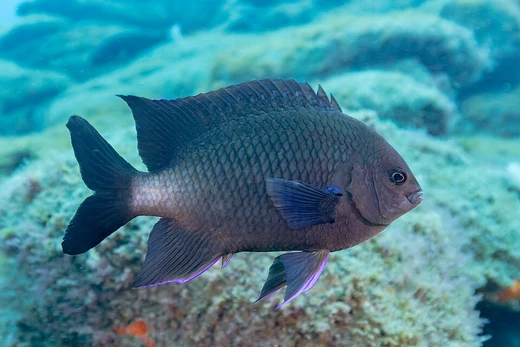
Clark's anemonefish
The most widely distributed and color-variable anemonefish.

Clark's anemonefish, also called the yellowtail clownfish, is a marine species in the Pomacentridae family, which includes all 28 species of clownfishes and damselfishes. It stands out as the most widespread anemonefish and displays the widest range of color variations among them, with differences tied to where it lives, its sex, its age, and the type of sea anemone it inhabits.
Like all clownfish, it forms a symbiotic mutualism with sea anemones in the wild, living unharmed among their stinging tentacles. The anemone provides protection from predators and food from leftover scraps and dead tentacles, while the clownfish defends the anemone from its own predators and parasites. These fish are small, reaching 10 to 18 centimeters in length, and come in yellow, orange, reddish, or blackish tones, often with white bars or patches. Color can shift within a species based on distribution, sex, age, and host anemone. They live in warmer waters of the Indian and Pacific Oceans and the Red Sea, in sheltered reefs or shallow lagoons. In a group, a strict hierarchy exists: the largest, most aggressive fish is the dominant female, and only one male and one female reproduce through external fertilization. Clownfish are sequential hermaphrodites, starting life as males and later becoming females. They are not aggressive. Observations of eight breeding pairs off the Philippines showed they preferred breeding in colder months, with a peak season from November to May; egg production rose toward the new moon and fell after the full moon, a pattern similar to other temperate clownfish species.
Clark's anemonefish is small, with males growing up to 10 centimeters and females up to 15 centimeters. It has a stocky, laterally compressed, oval to rounded body. Its vivid black, white, and yellow stripes vary greatly by location. Typically, it is black on top and orange-yellow underneath, with the black areas widening with age. Two vertical white bands mark the body—one behind the eye and one above the anus—and the caudal peduncle is white. The snout is orange or pinkish, the dorsal and caudal fins are orange-yellow, and the caudal fin is usually lighter than the rest of the body, sometimes whitish.
Quick Facts
- Genus
- Amphiprion
- Species
- clarkii
Facts from the source article.
Lore & Background
Clark's anemonefish is a small-sized fish, growing up to 10 cm as a male and 15 cm as a female. It is stocky, laterally compressed, and oval to rounded. It is colorful, with vivid black, white, and yellow stripes, though the exact pattern shows considerable geographical variation. Usually it is black dorsally and orange-yellow ventrally, the black areas becoming wider with age. There are two vertical white bands, one behind the eye and one above the anus, and the caudal peduncle is white. The snout is orange or pinkish. The dorsal and caudal fins are orange-yellow, and the caudal fin is generally lighter in tone than the rest of the body, sometimes becoming whitish.
Clark's anemonefish shows the greatest color variations of any anemonefish, with variations based on location, sex, age and host anemone. Adults in Vanuatu and New Caledonia are orange-yellow with two vertical white bands. Sex related color differences may be present, such as the female having a white caudal fin and the male having a yellow caudal fin. Juveniles are orange-yellow with vertical white bands. Fish living with the host anemone Stichodactyla mertensii are frequently black except for the snout bars and tail.
Clark's anemonefish is the least host specific anemonefish, living in association with all ten species of sea anemones that host anemonefish. It is found in tropical waters from the Indian Ocean to the Western Pacific, most commonly occupying reef biomes at 1 to 60 meters in areas with host anemones.
Reader's Guide
Clark's anemonefish is the most widely distributed anemonefish, being found in tropical waters from the Indian Ocean to the Western Pacific. It is also the least host specific anemonefish, living in association with all ten species of sea anemones that host anemonefish. This broad distribution and host tolerance make it a significant species for understanding the mutualistic symbiosis between clownfish and sea anemones. The species shows the greatest color variations of any anemonefish, with variations based on location, sex, age and host anemone, which provides insight into the adaptive plasticity of anemonefish. The specific name and common name honour the Scottish engraver John Heaviside Clark, who provided illustrations for Bennett's work on fishes from the coast of Ceylon. As a member of the Pomacentridae family, which includes 28 species of anemonefish, Clark's anemonefish exemplifies the typical clownfish traits: forming symbiotic mutualisms with sea anemones, having a strict dominance hierarchy with sequential hermaphroditism, and breeding through external fertilization with seasonal spawning patterns.
Did You Know?
- It shows the greatest color variations of any anemonefish, varying by location, sex, age, and host anemone.
- The species is named after Scottish engraver John Heaviside Clark, who illustrated fishes from the coast of Ceylon.
More in Clownfish and Damselfish 1-24
Spotted an error? Know more?
Reader corrections go straight into our review queue. Suggest an edit · How this site is sourced