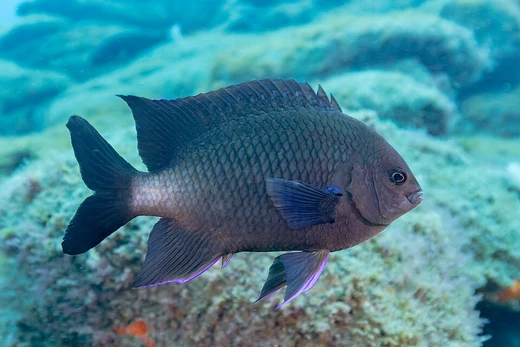
Cinnamon clownfish
A widely distributed Pacific anemonefish with a strict dominance hierarchy.

The cinnamon clownfish (Amphiprion melanopus), also known as the fire clownfish, red and black anemonefish, black-backed anemonefish, or dusky anemonefish, is a widely distributed anemonefish chiefly found in the western and southern parts of the Pacific Ocean. It is notable for its symbiotic mutualism with sea anemones and its strict size-based dominance hierarchy, exhibiting protandry where the breeding male changes to female if the sole breeding female dies.
Quick Facts
- Taxon
- Amphiprion melanopus
Facts from the source article.
Lore & Background
The species name 'melanopus' is Greek, meaning black feet, in reference to its black pelvic fins. Adults can grow to 12 cm, with a dark red to orange body and mahogany sides, a white head band that starts behind the eye and may have a blue tint, lighter dorsal and caudal fins sometimes cinnamon-colored, and black pelvic and anal fins. Historically, anemonefish were identified by morphological features and color patterns; A. melanopus belongs to the tomato complex. It is similar to A. rubrocinctus but geographically distinct, and was previously thought to include A. barberi, which has significant color-pattern differences and fewer spines in the upper-opercular series (11–19 vs. 19–26).
Reader's Guide
Amphiprion melanopus is a generalist host, usually hosted by the bubble-tip anemone (Entacmaea quadricolor) and occasionally by Heteractis crispa and rarely by Heteractis magnifica. Like all anemonefish, it is a sequential hermaphrodite with a strict size-based dominance hierarchy: the female is largest, the breeding male second largest, and non-breeding males progressively smaller. It exhibits protandry, meaning the breeding male changes to female if the sole breeding female dies, with the largest non-breeder becoming the breeding male. Its diet is omnivorous, based on zooplankton, small benthic crustaceans, and algae. The species faces threats from coral reef environmental issues, including anemone bleaching due to increased water temperature or acidification, and collection for the marine aquarium trade, where anemonefish make up 43% of the global marine ornamental trade. While bleaching is a significant threat, collection compounds the localized impact of bleaching. The species has been successfully bred in aquaria, where it may become territorial and aggressive, and accepts a variety of foods.
Did You Know?
- The scientific name 'melanopus' is Greek for 'black feet', referring to its black pelvic fins.
- It is hosted by three of the ten host anemones, usually the bubble-tip anemone (Entacmaea quadricolor).
- It was previously thought to occur in Fiji, Tonga, and the Samoan Islands, but that fish is now described as a separate species, A. barberi.
More in Clownfish and Damselfish 1-24
Spotted an error? Know more?
Reader corrections go straight into our review queue. Suggest an edit · How this site is sourced