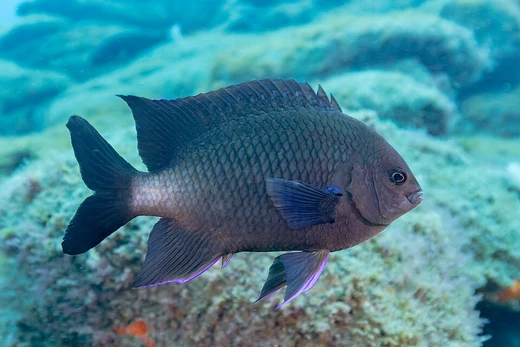
Chromis limbata
A damselfish of the Macaronesian Islands and western Africa.

Chromis limbata, commonly known as the Azores chromis or Atlantic chromis, is a species of damselfish in the family Pomacentridae. It is found in the Macaronesian Islands of the temperate eastern Atlantic Ocean and has been reported from coastal regions of western Africa.
Quick Facts
- Taxon
- Chromis limbata
Facts from the source article.
Lore & Background
Chromis limbata is greyish-brown with a dark dorsal fin, anal fin, and distal margin of the caudal fin, the proximate part of which is whitish. During spawning, the male develops a slightly purple hue as courtship colours. It has a large eye and a strongly protractile mouth reaching the vertical from the eye, with three rows of small canine-like teeth on the jaws. The dorsal fin has 14 spines and 11-12 soft rays, while the anal fin has 2 spines and 10-12 soft rays. It grows to 12 cm standard length.
It occurs in the Azores and Madeira (Portugal) and in the Canary Islands (Spain), and has been reported off the coast of western Africa from Senegal to Pointe Noire, Congo. In the Cape Verde Islands it is apparently replaced by the endemic Lubbock's chromis (Chromis lubbocki). Small numbers have been recorded off islands in Santa Catarina, southern Brazil, possibly as vagrants or introduced through discharge of ships' ballast water.
Adults inhabit rocky reefs and sandy-weedy areas at depths of 5–45 metres. They are oviparous, forming pairs to breed; the male clears a space on the substrate for the female to lay eggs, which adhere to the substrate, and the male guards and aerates them. It is commonest between 5 and 50 m, and can be found close to the sea bed or in pelagic schools. It feeds on small benthic or planktonic invertebrates. It was formerly considered conspecific with Chromis chromis, but in some areas the two species are sympatric.
Reader's Guide
Chromis limbata is notable as a valued food fish in Madeira, where it supports a small-scale artisanal fishery, especially off the south and east of the island. Its distribution across the Macaronesian Islands and reports from western Africa highlight its role in temperate eastern Atlantic reef ecosystems. The species' ability to form pelagic schools and its oviparous breeding behavior, with male parental care, are characteristic of many damselfish. The uncertainty regarding its occurrence in southern Brazil—whether as vagrants or via ballast water introduction—adds to its biogeographic interest. Its former taxonomic confusion with Chromis chromis, despite sympatry in some areas, underscores the complexity of damselfish systematics. The species' depth range of 5–45 metres and its diet of small invertebrates place it as a mid-level consumer in reef food webs.
Did You Know?
- Chromis limbata grows to a maximum standard length of 12 cm.
- Small numbers have been recorded off islands in Santa Catarina, Brazil, possibly introduced via ships' ballast water.
More in Clownfish and Damselfish 1-24
Spotted an error? Know more?
Reader corrections go straight into our review queue. Suggest an edit · How this site is sourced