Chromis gunting
A damselfish species described in 2019 from the Philippines.

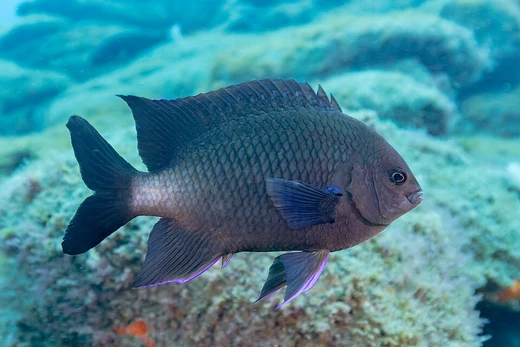
Chromis gunting is a marine damselfish in the family Pomacentridae. It was one of three species first described in 2019, alongside Chromis bowesi and Chromis hangganan, all discovered in the Philippines' Verde Island Passage, specifically around Puerto Galera and Batangas. The fish is named for its tail: *gunting* means "scissors" in Tagalog, referencing the bilateral black margins on the outer edges of its caudal fin, which give it a scissorlike appearance.
The species is characterized by 11 dorsal fin rays, 11–12 anal fin rays, 16–17 pectoral fin rays, 3 procurrent caudal fin rays, 14–16 tubed lateral-line scales, and 19–20 gill rakers. Its body length ranges from 2.1 to 2.2 times the standard length. When fresh, the body is light brown with a silver area on the anterior end and a black margin on each side of the tail.
**Distribution and habitat** Chromis gunting is found in the Philippines, particularly in Batangas and Oriental Mindoro. All three related species—C. bowesi, C. gunting, and C. hangganan—were collected at depths of 75–150 meters, with C. gunting specifically at 90–130 meters.
**Description** The largest specimen used to describe the species measured about 7.7 cm. In mature individuals, the upper body is brown, gradually turning pink in the middle and silvery gray below. There is a black fringe along the dorsal-fin spine, and black markings appear on both lobes of the caudal fin and on the caudal peduncle. The soft dorsal fin has black rays. The front two-thirds of the anal fin is black, with the rear portion transparent and yellow. The pectoral fins are transparent with a gray base, while the pelvic fins are light brown, nearly transparent, with yellowish fins and gray rays.
Quick Facts
- Taxon
- Chromis gunting
Facts from the source article.
Lore & Background
Chromis gunting was first described in 2019, alongside Chromis bowesi and Chromis hangganan, all discovered in the Verde Island Passage of the Philippines. The species was collected at depths of 90–130 meters. Its body is light brown when fresh, with a silver area on the anterior end and a bilateral black margin on the exterior side of the tail. The largest specimen used to describe the species is about 7.7 cm. Mature individuals have a brown upper body, gradually turning pink in the middle and silvery gray on the lower body. The dorsal-fin spine has a black fringe, and the caudal fin and caudal peduncle also bear black markings. The soft dorsal fin has black rays, the front two-thirds of the anal fin is black with a transparent yellow rear, the pectoral fin is transparent with a gray base, and the pelvic fins are light brown, almost transparent, with yellowish fins and gray rays.
Reader's Guide
Chromis gunting is notable as one of three damselfish species described in 2019 from the Verde Island Passage in the Philippines, a region known for high marine biodiversity. Its discovery adds to the known diversity of the genus Chromis in the family Pomacentridae. The species is characterized by specific fin ray counts and scale patterns, including 11 dorsal fin rays, 11–12 anal fin rays, and 16–17 pectoral fin rays. Its depth range of 90–130 meters places it in deeper reef habitats. The species' common name derives from the Tagalog word 'gunting' meaning scissors, referring to the scissorlike appearance of the bilateral black margins on its tail. The species is known only from the Philippines, with records from Batangas and Oriental Mindoro, and has not been reported elsewhere. Its description in 2019 highlights ongoing taxonomic work in the region.
Did You Know?
- Chromis gunting was first described in 2019 along with Chromis bowesi and Chromis hangganan.
- The species is known only from the Verde Island Passage in the Philippines, at depths of 90–130 meters.
- Its specific epithet 'gunting' means scissors in Tagalog, referring to the scissorlike black margins on its tail.
More in Clownfish and Damselfish 1-24
Spotted an error? Know more?
Reader corrections go straight into our review queue. Suggest an edit · How this site is sourced