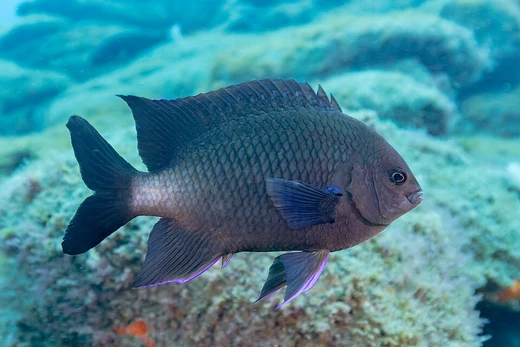
Chromis bowesi
A damselfish discovered in 2019 in Philippine waters.

Chromis bowesi, called the rhomboid chromis, belongs to the damselfish family Pomacentridae. Luiz A. Rocha and his team first described it in 2019, together with two other species—Chromis hangganan and Chromis gunting—all found in the Philippines. This fish lives at mesophotic depths.
The name bowesi honors William K. Bowes Jr. (1926–2016), the main backer of the Hope for Reefs project at the California Academy of Sciences.
The largest specimen used to describe the species measured about 8.2 cm. In the wild, C. bowesi has a bluish purple body with light blue stripes just behind the pectoral fins. The spines on the dorsal and pelvic fins are light blue to nearly white, while the soft dorsal fin is transparent. The upper body is darker than the sides and belly. The area under the eye is silvery white, and dark spots appear at the base of the pectoral fins. Freshly dead specimens show a dark gray brown upper body that fades to gray elsewhere. Adult color when fresh is brownish-grey on the dorsal side, whitish on the ventral side, with alternating dark and light stripes along the sides. The species is distinguished from related fish by having 11–12 dorsal fin rays, 11–13 anal fin rays, 17–19 pectoral fin rays, 3 procurrent caudal fin rays, 13–15 tubed lateral line scales, 25–27 gill rakers, and a body depth 1.5–1.6 times in standard length.
C. bowesi was found specifically at Verde Island in the Verde Island Passage, in Batangas Bay, and in Puerto Galera Bay. All three species—C. bowesi, C. gunting, and C. hangganan—come from the Philippines and were collected at depths of about 75–150 m, with C. bowesi at 80–120 m.
Quick Facts
- Genus
- Chromis
- Species
- bowesi
Facts from the source article.
Lore & Background
The specific name bowesi honors the late William K. Bowes Jr. (1926–2016), the main sponsor of the Hope for Reefs initiative from the California Academy of Sciences. The largest specimen used to describe the species is about 8.2 cm. In its natural habitat, C. bowesi has a bluish purple body with light blue stripes just behind the pectoral fins. Spines on dorsal and pelvic fins are light blue to almost white, with the soft dorsal fin transparent. The upper body is darker than the sides and under the abdomen, and the under-eye area is silvery white. Dark spots appear on the base of the pectoral fins. Photographs of newly dead specimens show a dark gray brown upper body, turning gray in the remaining body area. The adult fish's color when fresh is brownish-grey on the dorsal side to whitish on the ventral side, with alternating dark and light stripes on the sides of the body. The species is characterized by 11-12 dorsal fin rays, 11-13 anal fin rays, 17-19 pectoral fin rays, 3 procurrent caudal fin rays, 13-15 tubed lateral line scales, 25-27 gill rakers, and a body depth of 1.5-1.6 in standard length, which differs from other congeners.
Reader's Guide
Chromis bowesi is significant as one of three damselfish species described together in 2019 from the Philippines, highlighting the biodiversity of the Verde Island Passage region. Its discovery at depths of 80–120 meters underscores the importance of exploring mesophotic coral ecosystems, which are often overlooked. The species' etymology ties it directly to the Hope for Reefs initiative, a conservation effort sponsored by William K. Bowes Jr., linking taxonomic discovery to broader marine conservation goals. The detailed morphological description—including fin ray counts, scale counts, and body depth ratios—provides a clear basis for distinguishing C. bowesi from its congeners, contributing to the systematic understanding of the genus Chromis. Its restricted known distribution to three Philippine bays emphasizes the need for habitat protection in these areas.
Did You Know?
- Chromis bowesi was first described in 2019 along with two other species: Chromis hangganan and Chromis gunting.
- The species is named after William K. Bowes Jr., the main sponsor of the Hope for Reefs initiative.
- The largest specimen used to describe C. bowesi is about 8.2 cm in length.
- C. bowesi is found at depths of 80–120 meters in the Philippines.
More in Clownfish and Damselfish 1-24
Spotted an error? Know more?
Reader corrections go straight into our review queue. Suggest an edit · How this site is sourced