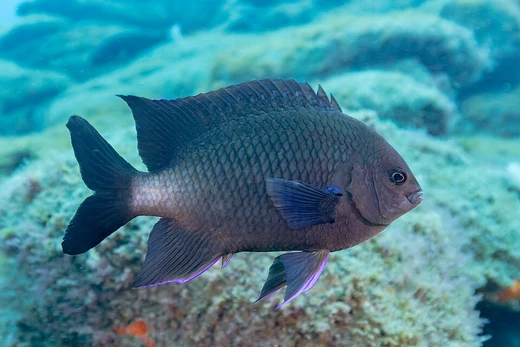
Amphiprion omanensis
Oman anemonefish with a distinctive white forked caudal fin.

Amphiprion omanensis, commonly called the Oman anemonefish, is a marine species in the clownfish and damselfish family Pomacentridae. Its body is dark brown with two narrow white bars, and it has a distinctive forked tail fin that is blackish in juveniles but becomes white in adults. The midbody bar does not reach the dorsal fin, and the headbar is usually pinched across the nape. It has 10 dorsal spines, 2 anal spines, 10–17 dorsal soft rays, and 14–15 anal soft rays, reaching a maximum length of 14 cm (5½ in). No color variations are known. The white forked tail sets it apart from similar species; the only other clownfish with a forked tail is *Amphiprion latifasciatus*, but that species has a much wider midbody bar and yellow fins, whereas *A. omanensis* has a narrow midbody bar, white tail, and black pelvic and anal fins. This fish is found only in Oman on the Arabian Peninsula. Because it is confined to a small range, scientists have used it to study long-distance dispersal between sites 400 km (250 mi) apart at either end of its range. Adults provide high levels of parental care, and the young hatch with well-developed swimming and sensory abilities before entering a pelagic larval phase lasting less than three weeks, during which they may travel far. Research showed an asymmetrical dispersal pattern favoring southward movement, matching the prevailing currents, with immigration rates of 5.4% in the south and 0.7% in the north. *A. omanensis* associates with two host anemones: *Entacmaea quadricolor* (bubble-tip anemone) and *Heteractis crispa* (Sebae anemone).
Quick Facts
- Genus
- Amphiprion
- Species
- omanensis
Facts from the source article.
Lore & Background
The body of A. omanensis is dark brown with two white bars and a distinctive forked caudal fin, which is blackish in juveniles fading to white in adults. The midbody bar is narrow and does not extend onto the dorsal fin, while the headbar is also narrow and usually constricted across the nape. They have 10 dorsal spines, 2 anal spines, 10-17 dorsal soft rays, and 14-15 anal soft rays, reaching a maximum length of 14 cm. No color variations are known.
A. omanensis is found in Oman in the Arabian Peninsula. Anemone fish are sedentary and depend on ocean currents for dispersal. As A. omanensis is confined within a small range, it was used to study long-distance dispersal from sites 400 kilometers apart at either end of its range. Adults provide high levels of parental care to their young, which hatch with well-developed swimming and sensory capabilities before embarking on a less than three-week pelagic larval phase, during which they may disperse over long distances. The study found an asymmetrical dispersal pattern between the two regions, with a higher occurrence of southward dispersal consistent with the prevailing currents, with immigration rates of 5.4% in the south and 0.7% in the north.
A. omanensis is associated with two species of anemone: Entacmaea quadricolor (bubble-tip anemone) and Heteractis crispa (sebae anemone). The white forked caudal fin is distinctive, with only A. latifasciatus having a forked caudal fin; however, A. omanensis has a narrow midbody bar, white caudal fin, and black pelvic and anal fins, while A. latifasciatus has a much wider midbody bar and yellow fins.
Reader's Guide
The significance of Amphiprion omanensis lies in its use as a model for studying long-distance dispersal in sedentary marine fish. Because it is confined within a small range in Oman, researchers were able to examine dispersal patterns between sites 400 kilometers apart at either end of its range. The study revealed an asymmetrical dispersal pattern, with a higher occurrence of southward dispersal consistent with prevailing currents, and immigration rates of 5.4% in the south and 0.7% in the north. This work highlights how ocean currents influence population connectivity in species with a pelagic larval phase of less than three weeks. The species also contributes to the understanding of anemonefish ecology, being associated with two host anemone species: Entacmaea quadricolor and Heteractis crispa. Its distinctive white forked caudal fin, narrow midbody bar, and black pelvic and anal fins help distinguish it from the similar A. latifasciatus, which has a wider midbody bar and yellow fins. No color variations are known for A. omanensis.
Did You Know?
- The caudal fin of A. omanensis is blackish in juveniles and fades to white in adults.
- A. omanensis has a narrow midbody bar that does not extend onto the dorsal fin.
- The species is confined to a small range in Oman and was used to study long-distance dispersal.
- Immigration rates were 5.4% in the south and 0.7% in the north, consistent with prevailing currents.
More in Clownfish and Damselfish 1-24
Spotted an error? Know more?
Reader corrections go straight into our review queue. Suggest an edit · How this site is sourced