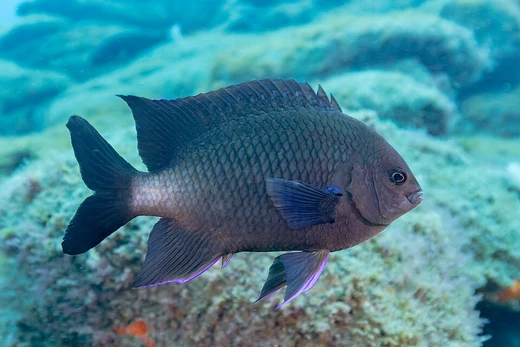
Amphiprion nigripes
A clownfish with black fins, found in the Maldive and Laccadive Islands.

Amphiprion nigripes, also called the Maldive anemonefish or blackfinned anemonefish, is a saltwater fish in the Pomacentridae family, which includes clownfishes and damselfishes. Females reach up to 11 cm in length, while males max out at about 8 cm. The body is oval and flattened from side to side. This clownfish stands out for its rusty orange coloring and a single vertical white stripe just behind the eye. Its pelvic and anal fins are black—hence the common name—and the belly often has a variable black patch. In some locations, individuals may appear orangeish-yellow, with an anal fin matching the body color rather than being black.
The species lives in the western Indian Ocean, specifically around the Maldive and Laccadive Islands. It typically occupies small groups on outer reef slopes, at depths between 2 and 25 meters, and is closely tied to the magnificent sea anemone. An omnivore, it feeds on zooplankton, small bottom-dwelling crustaceans, and algae.
Active during the day, *Amphiprion nigripes* is a protandrous hermaphrodite: all hatch as males and can later change into females. Males form harems with a strict dominance hierarchy that maintains social rank. The fish aggressively defends its territory and depends entirely on its host anemone, which serves as a safe shelter for the group and its nest. This relationship is mutualistic: the fish lives among the anemone’s stinging tentacles, protected by a special mucus coating, while its presence may lure prey closer to the anemone. The clownfish also defends the anemone from predators like butterflyfish that eat tentacles.
In captivity, this species eats brine shrimp, mysis shrimp, and chopped shellfish. Tank-raised individuals accept high-protein flakes and granular foods. It is mostly peaceful in an aquarium, though it may show some aggression when defending its host anemone. It has been bred successfully in captivity.
Quick Facts
- Taxon
- Amphiprion nigripes
Facts from the source article.
Lore & Background
The Maldive anemonefish is a small, oval-bodied, laterally compressed fish. It is characterized by its rusty orange color with a single white stripe running vertically just behind the eye. Its pelvic and anal fins are black, and a variable area on its belly can be more or less black. However, depending on geographic location, some fishes can be orangeish-yellow with an anal fin that is not black but the same color as the body.
This species is found in the western Indian Ocean in the Maldive Islands and Laccadive Islands. It typically lives in small groups on outer reef slopes at depths of 2–25 m and is particularly associated with the magnificent sea anemone. The fish is active during the day and is a protandrous hermaphrodite: all fish are hatched as males and later can change sex to female. Males live in harems with an established dominance hierarchy that manages the group and keeps individuals at a specific social rank.
The relationship between the clownfish and the sea anemone is mutualism. The fish lives within the anemone's tentacles and uses it as a shelter, protected by a thin layer of mucus that prevents stinging. The clownfish may act as a lure to attract prey to the anemone and can defend the anemone against reef fishes such as butterflyfish that might eat its tentacles.
Reader's Guide
The Maldive anemonefish is significant as a member of the Pomacentridae family, illustrating the mutualistic relationship between clownfishes and sea anemones. The article describes this mutualism in detail: the fish gains shelter from the anemone's stinging tentacles, protected by its own mucus layer, while the anemone may benefit from the fish acting as a lure for prey and defending it from predators like butterflyfish. This species also demonstrates protandrous hermaphroditism, where all individuals hatch as males and can later become female, with a dominance hierarchy governing social groups. In captivity, the species is considered mostly peaceful, with some aggression when defending its host. It can eat brine shrimp, mysis shrimp, chopped shellfish, and has accepted high-protein flakes and granular foods. It has successfully been raised in captivity. The species' distribution is limited to the western Indian Ocean, specifically the Maldive and Laccadive Islands, and it inhabits outer reef slopes at depths of 2–25 m, associated with the magnificent sea anemone. Its diet is omnivorous, based on zooplankton, small benthic crustaceans, and algae.
Did You Know?
- The Maldive anemonefish grows up to 11 cm as a female and 8 cm as a male.
- It is a protandrous hermaphrodite: all fish hatch as males and can later change sex to female.
- Its relationship with the sea anemone is mutualism, where the fish is protected by a mucus layer and may defend the anemone from butterflyfish.
- Some individuals can be orangeish-yellow with an anal fin the same color as the body, depending on geographic location.
More in Clownfish and Damselfish 1-24
Spotted an error? Know more?
Reader corrections go straight into our review queue. Suggest an edit · How this site is sourced