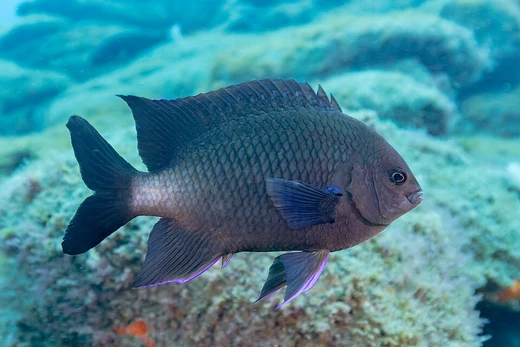
Amphiprion mccullochi
A dark brown anemonefish with a pale snout and white head bars.

Amphiprion mccullochi, commonly called the whitesnout anemonefish or McCulloch's anemonefish, lives in the subtropical waters around Lord Howe Island and Norfolk Island. Its name honors Allan McCulloch, who once served as Curator of Fishes at the Australian Museum in Sydney. Like all anemonefish, it has a symbiotic mutualism with sea anemones and is unharmed by their stinging tentacles. The species is a sequential hermaphrodite with a strict size-based dominance hierarchy: the largest individual is female, the next largest is the breeding male, and the remaining males get progressively smaller as the hierarchy descends. It shows protandry, meaning if the sole breeding female dies, the breeding male changes sex to become female, and the largest non-breeding male then becomes the breeding male.
This fish is dark brown with a pale snout, a white bar on each side of the head (these bars do not connect across the top), and a pale tail. Juveniles have two white bars and yellow edges on their pectoral fins. It has 10 dorsal spines, 2 anal spines, 15 to 17 dorsal soft rays, and 13 to 14 anal soft rays. Adults reach a maximum length of 12 centimeters (about 4¾ inches). Unlike some other anemonefish, A. mccullochi shows no color variations based on location, sex, or host anemone.
In appearance, it resembles A. melanopus, but that species has a reddish chest, belly, and dorsal fin, a yellowish to slightly red tail, and white bars that connect over the top of the head. Genetic analysis has found evolutionary links between samples of A. mccullochi and A. akindynos, with historical hybridization and introgression creating a complex mitochondrial DNA structure. Two evolutionary groups exist, with individuals of both species found in each, so the species lack reciprocal monophyly. However, no shared haplotypes occur between them.
A. mccullochi is endemic to the southwestern Pacific Ocean, found only at Lord Howe Island, Middleton Reef, Elizabeth Reef, and Norfolk Island. Its relationship with host sea anemones is highly specialized and nested: it associates with just one species, the bubble-tip anemone (Entacmaea quadricolor).
Anemonefish and their host anemones face similar environmental pressures as coral reefs. Anemones contain intracellular zooxanthellae and can bleach due to triggers like higher water temperature or acidification. A.
Quick Facts
- Genus
- Amphiprion
- Species
- mccullochi
Facts from the source article.
Lore & Background
Amphiprion mccullochi is dark brown with a pale snout, a white bar on each side of the head (but not connected on top of the head) and a pale tail. Juveniles have two white bars and the edge of the pectoral fins is yellow. They have 10 dorsal spines, 2 anal spines, 15-17 dorsal soft rays and 13-14 anal soft rays. They reach a maximum length of 12 cm (4+3⁄4 in). Some anemonefish species have color variations based on geographic location, sex and host anemone, but A. mccullochi does not show any of these variations.
A. mccullochi is similar in appearance to A. melanopus which is distinguished by its reddish chest, belly and dorsal fin, with a yellowish to slightly red tail. The white bars are also connected over the top of the head. Genetic analysis suggested evolutionary connectivity among samples of A. mccullochi and A. akindynos. Historical hybridization and introgression in the evolutionary past resulted in a complex mitochondrial DNA structure. There were two evolutionary groups with individuals of both species detected in both, thus the species lacked reciprocal monophyly. There were no shared haplotypes between species.
The specific name honours Whitley's colleague, the Australian ichthyologist Allan Riverstone McCulloch (1885-1925) who collected the type specimen. This species has bred in captivity.
Reader's Guide
Amphiprion mccullochi is of particular conservation concern due to its small geographic range, small local population, and extreme habitat specialisation—it only associates with the bubble-tip anemone Entacmaea quadricolor. As of 2022, it was categorised as Vulnerable on the IUCN Red List, and as of 2024 it was listed as Critically Endangered under the Australian EPBC Act. Anemonefish and their host anemones are found on coral reefs and face similar environmental issues. Like corals, anemones contain intracellular endosymbionts, zooxanthellae, and can suffer from bleaching due to triggers such as increased water temperature or acidification. The species is endemic to the south western Pacific Ocean at Lord Howe Island, Middleton Reef, Elizabeth Reef and Norfolk Island. Its relationship with its host anemone is highly specialised and nested in structure. The species has bred in captivity, which may offer some conservation potential, but its restricted distribution and specific host dependency make it vulnerable to environmental changes.
Did You Know?
- A. mccullochi is named after Allan McCulloch, a former Curator of Fishes at the Australian Museum, Sydney.
- It is hosted by only one species of anemone: Entacmaea quadricolor (bubble-tip anemone).
- The species lacks reciprocal monophyly with A. akindynos due to historical hybridization and introgression.
- As of 2024, it is listed as Critically Endangered under the Australian EPBC Act.
More in Clownfish and Damselfish 1-24
Spotted an error? Know more?
Reader corrections go straight into our review queue. Suggest an edit · How this site is sourced