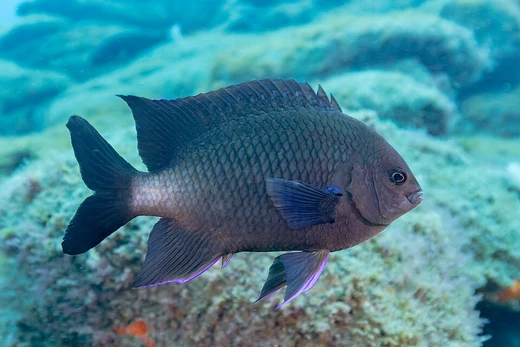
Amphiprion leucokranos
A confirmed hybrid anemonefish with a distinctive white head mark.

Amphiprion leucokranos, called the white bonnet anemonefish, is a hybrid that occurs naturally in the western central Pacific. It lives in a mutualistic partnership with sea anemones, immune to their stings. Like other anemonefish, it is a sequential hermaphrodite with a strict size-based hierarchy, which controls how genes flow.
Its body is orange or light brown, with a white bar on the head and a white patch on top—hence the name "white bonnet." The head band may be broken or solid. It has 9 dorsal spines, 2 anal spines, 18–19 dorsal soft rays, and 13–14 anal soft rays, reaching up to 11 cm long.
For a long time, scientists suspected A. leucokranos was a hybrid of A. chrysopterus and A. sandaracinos, and captive breeding confirmed it. In 2015, consistent ecological, morphological, and genetic evidence proved its hybrid origin. In any anemonefish group, the female is largest, the breeding male second largest, and non-breeders get smaller down the line. Protandry means a breeding male becomes female if the sole female dies, and the largest non-breeder then becomes the breeding male. This size hierarchy makes the relative size of parent species key to hybridization. A. chrysopterus is one of the largest anemonefish, growing to 17 cm, while A. sandaracinos is much smaller—females up to 11 cm, males only 3 to 6.5 cm. Evidence shows the larger A. chrysopterus is always the mother, with its mitochondrial DNA flowing into A. sandaracinos through hybrid backcrosses.
As a hybrid, A. leucokranos shows varied colors and patterns. Typical first-generation hybrids have intermediate features, while backcrosses lean more toward A. sandaracinos. Unlike some anemonefish (e.g., A. clarkii), it does not turn black when hosted by Stichodactyla mertensii.
The white mark on top of the head sets it apart. Its parent A. sandaracinos has a similar body color but a white stripe along the back from the upper lip to the tail fin, and lacks the white head bar.
Hybridization also depends on overlapping ranges, depths, and host anemones. A. leucokranos lives in the western central Pacific, along the north coast of New Guinea (including Manus Island, D'Entrecasteaux Islands, and New Britain) and the Solomon Islands—where A. chrysopterus and A. sandaracinos overlap. All three fish occur at depths of 1–10 m.
Quick Facts
- Genus
- Amphiprion
- Species
- leucokranos
Facts from the source article.
Lore & Background
The white bonnet anemonefish has a body that is orange or light brown, with a white head bar and a white mark on the top of its head, which gives it its common name. The head band may be continuous or not. As a hybrid, it shows a variety of colors and patterns, with the typical F1 hybrid having intermediate morphology, while backcrosses tend more towards the features of A. sandaracinos. It does not show melanism when hosted by Stichodactyla mertensii, unlike some other anemonefish such as A. clarkii.
There has been a long-standing theory that A. leucokranos was a naturally occurring hybrid between A. chrysopterus and A. sandaracinos, with the fish being experimentally created in captivity. Its hybrid status was confirmed in 2015 with consistent ecological, morphological, and genetic evidence. The strict size-based dominance hierarchy of anemonefish makes the relative size of the parent species critical in shaping the outcome of hybridization. A. chrysopterus is one of the largest anemonefish, growing to 17 cm, while A. sandaracinos is significantly smaller, growing up to 11 cm as a female and just 3 to 6.5 cm as a male. There is strong evidence that the larger A. chrysopterus is always the mother, with unidirectional introgression of A. chrysopterus mitochondrial DNA into A. sandaracinos via hybrid backcrosses.
A. leucokranos is found in the Western Central Pacific, on the north coast of New Guinea, including Manus Island, D'Entrecasteaux Islands, New Britain, and the Solomon Islands—the area where the distributions of A. chrysopterus and A. sandaracinos overlap. All three fish are found in the depth range of 1–10 m. The hybrid is hosted by Heteractis crispa, Heteractis magnifica, and Stichodactyla mertensii; at Kimbe Bay, it and its parents were primarily found in Stichodactyla mertensii, otherwise Heteractis crispa.
Reader's Guide
The significance of Amphiprion leucokranos lies in its confirmed hybrid status, which provides insight into the role of size-based dominance hierarchy in shaping gene flow among anemonefish. The strict hierarchy—where the female is largest, the breeding male second largest, and non-breeders progressively smaller—makes the relative size of parent species critical. Because A. chrysopterus is much larger than A. sandaracinos, the larger species is always the mother, leading to unidirectional introgression of A. chrysopterus mitochondrial DNA into A. sandaracinos via hybrid backcrosses. This demonstrates how social structure can direct genetic exchange in a sequential hermaphrodite with protandry. The hybrid's distribution is limited to areas where its parent species overlap, specifically the Western Central Pacific from northern New Guinea to the Solomon Islands, and all three share a depth range of 1–10 m. The hybrid's variety of colors and patterns, with intermediate morphology in F1 hybrids and backcrosses tending toward A. sandaracinos, further illustrates the genetic mixing. Its legacy is as a natural experiment in hybridization, confirmed by ecological, morphological, and genetic evidence, and it underscores the importance of host anemone availability and size hierarchy in the evolution of anemonefish.
Did You Know?
- Amphiprion leucokranos is a naturally occurring hybrid between A. chrysopterus and A. sandaracinos, confirmed in 2015.
- The larger parent species, A. chrysopterus, is always the mother, with unidirectional introgression of its mitochondrial DNA.
- It has a distinctive white mark on the top of its head, giving it the common name white bonnet anemonefish.
More in Clownfish and Damselfish 1-24
Spotted an error? Know more?
Reader corrections go straight into our review queue. Suggest an edit · How this site is sourced