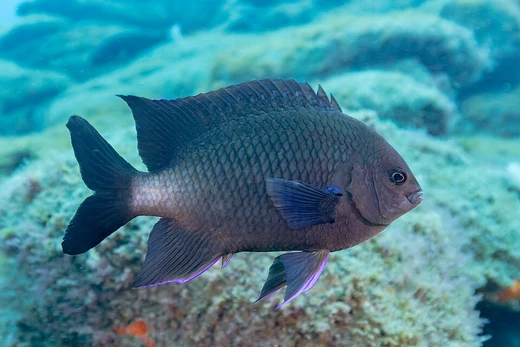
Amphiprion latifasciatus
A blackish anemonefish with yellow snout and two white bars.

Amphiprion latifasciatus, commonly called the Madagascar anemonefish, is a species of clownfish in the family Pomacentridae. Like other clownfish, it lives in a symbiotic relationship with sea anemones: the anemone’s stinging tentacles protect the fish from predators and provide food scraps, while the fish defends the anemone from parasites and predators. Clownfish are small, typically 10–18 cm long, and can be yellow, orange, reddish, or blackish, often with white bars or patches. They have a strict social hierarchy, with the largest and most aggressive individual being female, and only one breeding pair per group. They are sequential hermaphrodites, starting life as males and later becoming female.
The body of A. latifasciatus is blackish, with a yellow snout, belly, and all fins, plus two white bars. The mid-body bar is noticeably wider than in similar species. Its caudal fin is slightly forked. It has 10–11 dorsal spines, 2 anal spines, 15–16 dorsal soft rays, and 12–14 anal soft rays, and reaches a maximum length of 13 cm. No color variations are known.
This species can be confused with A. omanensis, which also has a forked tail but has black pelvic and anal fins and a narrower mid-bar. The forked tail distinguishes A. latifasciatus from A. allardi, A. bicinctus, A. chrysopterus, and A. clarkii, as does its wide mid-body bar. A. allardi, A. bicinctus, and A. chrysopterus also have white caudal fins. A. clarkii is highly variable in color, but a white tail or white bar at the tail base indicates it is not A. latifasciatus.
A. latifasciatus is found only in Madagascar and the Comoro Islands in the western Indian Ocean. It associates with two host anemones: Stichodactyla mertensii (Mertens’ carpet sea anemone) and Entacmaea quadricolor (bubble-tip anemone).
The species was first bred in captivity at the University of Illinois Urbana-Champaign by researcher Ross DeAngelis. In August 2014, one juvenile survived from a spawn collected on July 14, 2014. It is extremely rare in the aquarium trade, largely because its habitat is restricted to a small area of the western Indian Ocean.
Quick Facts
- Genus
- Amphiprion
- Species
- latifasciatus
Facts from the source article.
Lore & Background
The body of A. latifasciatus is blackish, with yellow snout, belly and all fins and two white bars. The mid-body bar is generally wider than similar species. The caudal fin is slightly forked. They have 10-11 dorsal spines, 2 anal spines, 15-16 dorsal soft rays and 12-14 anal soft rays. They reach a maximum length of 13 cm (5 in). No color variations are known.
A. latifasciatus is associated with two species of host anemone: Stichodactyla mertensii (Mertens' carpet sea anemone) and Entacmaea quadricolor (Bubble-tip anemone). It is found only in Madagascar and the Comoro Islands in the western Indian Ocean, in warmer waters of sheltered reefs or shallow lagoons, as typical for clownfish.
Like other clownfish, A. latifasciatus forms symbiotic mutualisms with sea anemones, being unaffected by their stinging tentacles. In a group, there is a strict dominance hierarchy with the largest and most aggressive fish being female; only two fish, a male and a female, reproduce through external fertilization. Clownfish are sequential hermaphrodites, developing into males first and then becoming females when they mature.
Reader's Guide
A. latifasciatus is significant as a rare clownfish species with a very restricted distribution, found only in Madagascar and the Comoro Islands. Its rarity in the aquarium trade is attributed to this limited habitat. The species was first bred in captivity at the University of Illinois Urbana-Champaign by researcher Ross DeAngelis within the Clownfish Research Laboratory; in August 2014, one individual survived and was reared to the juvenile phase from spawn dated July 14, 2014. This captive breeding achievement is notable given the species' scarcity.
Its distinguishing features include a blackish body with yellow snout, belly and fins, two white bars with a wide mid-body bar, and a slightly forked caudal fin. The forked caudal fin helps distinguish it from similar species such as A. allardi, A. bicinctus, A. chrysopterus, and A. clarkii, while the wide mid-body bar further aids identification. A. omanensis also has a forked caudal fin but differs in having black pelvic and anal fins and a narrower mid bar. The wide color variation of A. clarkii makes it harder to distinguish by color alone, though a white caudal fin or white bar at the caudal fin base indicates the fish is not A. latifasciatus.
As a clownfish, it participates in mutualistic symbiosis with sea anemones, receiving protection and food scraps while defending the anemone from predators and parasites. Its ecological role and limited range make it a species of interest for conservation and aquarium husbandry.
Did You Know?
- The species has no known color variations.
- It is associated with two host anemones: Stichodactyla mertensii and Entacmaea quadricolor.
More in Clownfish and Damselfish 1-24
Spotted an error? Know more?
Reader corrections go straight into our review queue. Suggest an edit · How this site is sourced