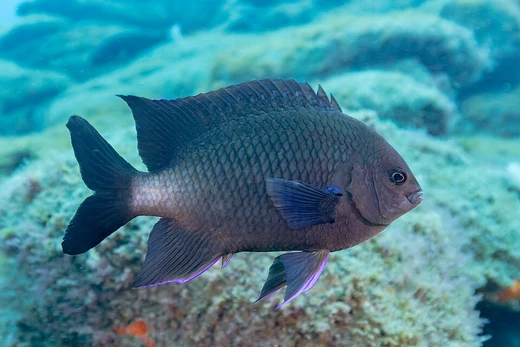
Amphiprion latezonatus
A subtropical anemonefish with a distinctive broad white midbody bar.

Amphiprion latezonatus, called the wide-band anemonefish, lives in subtropical waters along Australia’s east coast. It shares the classic anemonefish trait of a symbiotic partnership with sea anemones, immune to their stinging tentacles. The species is a sequential hermaphrodite with a strict size-based hierarchy: the largest individual is female, the next largest is the breeding male, and nonbreeding males get smaller down the line. If the sole breeding female dies, the breeding male changes sex to become female, and the largest nonbreeder takes over as the breeding male.
This fish grows up to 14 cm long and is dark brown, marked by three white bars and a broad white edge on the tail fin. Its middle bar is especially wide—about double the average width seen in other anemonefishes—and shaped like a flat-topped pyramid. It has 10 dorsal spines, 2 anal spines, 15–16 dorsal soft rays, and 13–14 anal soft rays. Bright blue markings often appear on its upper lip and along the edges of the bars, and the dorsal fin can be orange or yellow.
The broad midbody bar makes A. latezonatus easy to tell apart from other anemonefish. The closest look-alikes are A. polymnus (saddleback anemonefish) and A. sebae (sebae anemonefish), but A. latezonatus has a wider midband and lacks their characteristic sloping shape. Historically, anemonefish were grouped by field features like color and body shape, or lab traits like head scales and tooth shape. This placed A. latezonatus in the saddleback complex with A. polymnus and A. sebae. However, genetic analysis shows that complex is not a natural group; A. latezonatus forms its own distinct lineage and is more closely related to A. percula and Premnas biaculeatus than to the saddleback species.
The species is found in subtropical Australian waters, ranging from southern Queensland to northern New South Wales, as well as Norfolk Island and Lord Howe Island. Anemonefish and their host anemones have a highly structured, nonrandom relationship. A. latezonatus is very specialized, relying mainly on one host: Heteractis crispa (the sebae anemone). It has also been found living with two other sea anemone species.
Anemonefish and their hosts face similar threats to coral reefs. Anemones contain zooxanthellae (internal algae) and can bleach from warmer water or acidification.
Quick Facts
- Taxon
- Amphiprion latezonatus
Facts from the source article.
Lore & Background
Amphiprion latezonatus grows to 14 cm and is dark brown with three white bars and a broad white margin on the caudal fin. As its common name suggests, the middle bar is very wide, about twice the average width of other anemonefishes and shaped like a flat-topped pyramid. It often has bright blue markings on the upper lip and the edges of the bars, and its dorsal fin may be orange or yellow. The broad midbody bar is distinctive, and A. latezonatus is unlikely to be confused with any other anemonefish. The closest in appearance are A. polymnus (saddleback anemonefish) and A. sebae (sebae anemonefish), but A. latezonatus has a broader midband and lacks the characteristic slope of those species. Historically, anemonefish have been identified by morphological features and color pattern in the field, while in a laboratory, other features such as scalation of the head, tooth shape, and body proportions are used. These features have been used to group species into complexes, and A. latezonatus was considered part of the saddleback complex with A. polymnus and A. sebae. Genetic analysis has shown that the saddleback complex is not a monophyletic group and that A. latezonatus has a monospecific lineage, and is more closely related to A. percula and Premnas biaculeatus than to the saddleback group.
Reader's Guide
Amphiprion latezonatus is a sequential hermaphrodite with a strict size-based dominance hierarchy: the female is largest, the breeding male is second largest, and the male nonbreeders get progressively smaller as the hierarchy descends. It exhibits protandry, meaning the breeding male changes to female if the sole breeding female dies, with the largest nonbreeder becoming the breeding male. The relationship between anemonefish and their host sea anemones is not random and instead is highly nested in structure. A. latezonatus is highly specialised with only one species anemone host, Heteractis crispa (sebae anemone), though it has been found in two additional host sea anemone species. Anemonefish and their host anemones are found on coral reefs and face similar environmental issues. Like corals, anemones contain intracellular endosymbionts, zooxanthellae, and can suffer from bleaching due to triggers such as increased water temperature or acidification. Characteristics known to elevate the risk of extinction are small geographic range, small local population, and extreme habitat specialisation. A. latezonatus is an endemic species, confined to the subtropical east coast of Australia. The finding of A. latezonatus being hosted by two additional sea anemone species may reduce the risk of extinction associated with specialisation. This species was not evaluated in the 2012 release of the IUCN Red List. A. latezonatus has been bred in captivity.
More in Clownfish and Damselfish 1-24
Spotted an error? Know more?
Reader corrections go straight into our review queue. Suggest an edit · How this site is sourced