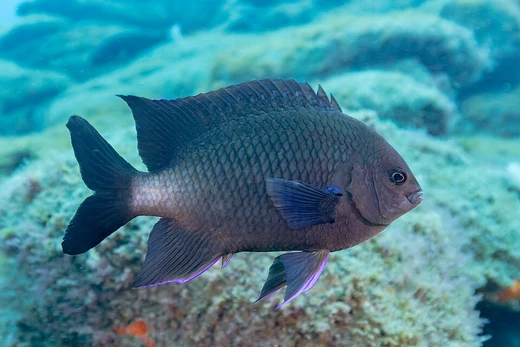
Amphiprion chrysogaster
A dark-bodied anemonefish endemic to Mauritius and probably Réunion.

Amphiprion chrysogaster, commonly known as the Mauritian anemonefish, is a type of marine fish in the Pomacentridae family, which includes clownfishes and damselfishes. This species is native to Mauritius and likely also Réunion.
Like other clownfish, it lives in a mutualistic relationship with sea anemones, immune to their stings. The anemone provides shelter and leftover food, while the clownfish drives away predators and parasites. These fish are small, reaching up to 14 cm (5½ in) long. In the wild, they form strict social groups with a dominant female at the top; all are born male and can later become female. Only one breeding pair exists per group, reproducing through external fertilization.
Adults are very dark brown, almost black, with three white bars. Their snout and breast are orange. The tail is blackish or dark brown, and the anal fin may be blackish or orange-yellow. They have 10 dorsal spines, 2 anal spines, 16–17 dorsal soft rays, and 13–14 anal soft rays.
Fish that are mostly black with three white bars are typically found with the host anemone *Stichodactyla mertensii* (Mertens' carpet sea anemone).
The Seychelles anemonefish (*A. fuscocaudatus*) differs by location, number of dorsal spines, and its solid dark tail versus dark streaks on the tail. The three-band anemonefish (*A. tricinctus*) is only found in the Marshall Islands and has a narrower bar across the tail base.
The Mauritian anemonefish is hosted by three anemone species: *Heteractis magnifica* (magnificent sea anemone), *Stichodactyla haddoni*, and *Stichodactyla mertensii*.
Quick Facts
- Taxon
- Amphiprion chrysogaster
Facts from the source article.
Lore & Background
Adults of Amphiprion chrysogaster are very dark brown, nearly black, with three white bars. The snout and breast are orange. The caudal fin is blackish or dark brown, and the anal fin may be blackish or orange-yellow. They reach a maximum length of 14 cm. Fish that are generally blackish except for the three white bars are associated with the host anemone Stichodactyla mertensii, Mertens' carpet sea anemone.
Clownfish form symbiotic mutualisms with sea anemones and are unaffected by the stinging tentacles of the host anemone. The sea anemone protects the clownfish from predators and provides food through scraps and dead tentacles; in return, the clownfish defends the anemone from its predators and parasites. Within a group of clownfish, there is a strict dominance hierarchy: the largest and most aggressive fish is female, and only two fish, a male and a female, reproduce through external fertilization. Clownfish are sequential hermaphrodites, developing into males first and then becoming females when they mature.
The Mauritian anemonefish is hosted by the following anemone species: Heteractis magnifica (magnificent sea anemone), Stichodactyla haddoni, and Stichodactyla mertensii (Mertens' carpet sea anemone).
Reader's Guide
Amphiprion chrysogaster is notable as a member of the clownfish and damselfish family Pomacentridae, with a restricted distribution limited to Mauritius and probably Réunion. Its dark, nearly black coloration with three white bars distinguishes it from similar species. The Seychelles anemonefish, A. fuscocaudatus, is distinguished by location, number of dorsal spines, and the solid dark tail of A. chrysogaster compared with dark streaks on the tail of A. fuscocaudatus. The three-band anemonefish, A. tricinctus, is distinguished by location (Marshall Islands) and a narrower bar across the tail base. The species participates in the classic clownfish-anemone mutualism, hosting three anemone species: Heteractis magnifica, Stichodactyla haddoni, and Stichodactyla mertensii. Its life history follows the typical clownfish pattern of sequential hermaphroditism and a strict dominance hierarchy, with the largest female at the top. The species reaches a maximum length of 14 cm and has 10 dorsal spines, 2 anal spines, 16-17 dorsal soft rays, and 13-14 anal soft rays. Its color variations, particularly the blackish form associated with Stichodactyla mertensii, highlight the influence of host anemone on appearance.
Did You Know?
- Adults are very dark brown, nearly black, with three white bars and an orange snout and breast.
- It is endemic to Mauritius and probably Réunion.
More in Clownfish and Damselfish 1-24
Spotted an error? Know more?
Reader corrections go straight into our review queue. Suggest an edit · How this site is sourced