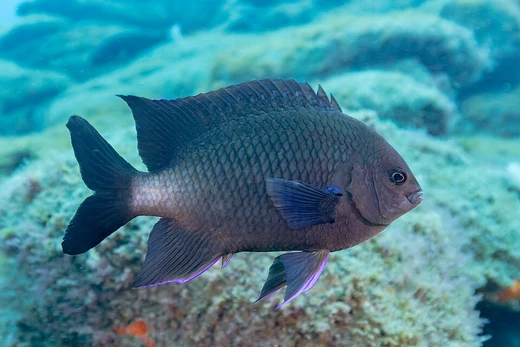
Amphiprion chagosensis
Endemic clownfish of the Chagos Archipelago.

The Chagos anemonefish, *Amphiprion chagosensis*, is a species of clownfish in the damselfish family, Pomacentridae. Its name comes from the Chagos Archipelago in the Indian Ocean, where it is found nowhere else. The first specimens were taken from Diego Garcia Atoll in that archipelago. Like other clownfish, it lives in a mutualistic partnership with sea anemones, safely dwelling among their stinging tentacles. The anemone provides shelter and food scraps, while the fish defends its host from predators and parasites. Clownfish are small, typically 10–18 cm long, and can be yellow, orange, reddish, or blackish, often with white bars or patches. They live in warm Indian and Pacific Ocean waters, including the Red Sea, in sheltered reefs and shallow lagoons. Within a group, a strict hierarchy exists: the largest, most aggressive fish is the dominant female. Only one breeding pair—a male and a female—reproduce via external fertilization. Clownfish are sequential hermaphrodites, starting life as males and later becoming females. Adults of this species are light brown with two dark-edged white bars around the body. All fins are dusky brown. They have 10–11 dorsal spines, 2 anal spines, 15–17 dorsal soft rays, and 13–14 anal soft rays. Maximum length is 10 cm (4 in). No color variations are known. The Chagos anemonefish is mainly identified by its location. Similar species are usually separated geographically: *A. akindynos* lives on the Great Barrier Reef and Coral Sea, *A. allardi* in East Africa, and *A. bicinctus* is found in the Red Sea but has an overlapping distribution at Chagos. *A. chagosensis* has a narrower headbar, a whitish caudal fin, and differences in predorsal scalation. It is found only in the Chagos Archipelago. Little is known about its specific host anemones, but it has been photographed with the bubble-tip anemone (*Entacmaea quadricolor*), magnificent sea anemone (*Heteractis magnifica*), long tentacle anemone (*Macrodactyla doreensis*), and Mertens' carpet sea anemone (*Stichodactyla mertensii*).
Quick Facts
- Taxon
- Amphiprion chagosensis
Facts from the source article.
Lore & Background
The Chagos anemonefish is a small clownfish, reaching a maximum length of 10 cm. Adults are light brown with two white bars with dark edging encircling the body, and all fins are dusky brown. No color variations are known. It is distinguished from similar species mainly by location, with A. akindynos found on the Great Barrier Reef and Coral Sea, and A. allardi in East Africa. A. bicinctus is found in the Red Sea but has an overlapping distribution at Chagos. A. chagosensis has a narrower headbar and a whitish caudal fin, and specimens can also be distinguished by differences in predorsal scalation. Little is known about its specific host anemone species, but it has been photographed in association with Entacmaea quadricolor (bubble-tip anemone), Heteractis magnifica (magnificent sea anemone), Macrodactyla doreensis (long tentacle anemone), and Stichodactyla mertensii (Mertens' carpet sea anemone).
Reader's Guide
Amphiprion chagosensis is notable as a clownfish endemic to the Chagos Archipelago in the Indian Ocean, with its original specimens collected at Diego Garcia Atoll. As a member of the family Pomacentridae, it shares the general characteristics of clownfishes: it forms symbiotic mutualisms with sea anemones in the wild, being unaffected by their stinging tentacles. The sea anemone protects the clownfish from predators and provides food from scraps and dead tentacles, while the clownfish defends the anemone from predators and parasites. Like other clownfish, A. chagosensis is small (10–18 cm, though this species reaches 10 cm) and exhibits a strict dominance hierarchy, with the largest and most aggressive fish being female. Only two fish in a group, a male and a female, reproduce through external fertilization, and clownfish are sequential hermaphrodites, developing into males first and then becoming females. The species is distinguished from similar ones by its narrower headbar, whitish caudal fin, and differences in predorsal scalation, as well as by its geographic isolation in the Chagos Archipelago.
Did You Know?
- The Chagos anemonefish is named for the Chagos Archipelago in the Indian Ocean and is endemic to that archipelago.
- Original specimens were collected at Diego Garcia Atoll, Chagos Archipelago.
- It has been photographed in association with four host anemone species, including the bubble-tip anemone and magnificent sea anemone.
More in Clownfish and Damselfish 1-24
Spotted an error? Know more?
Reader corrections go straight into our review queue. Suggest an edit · How this site is sourced