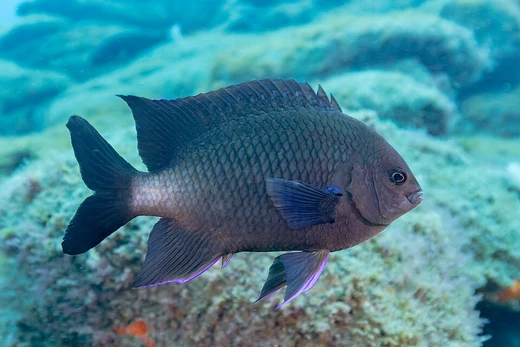
Amphiprion barberi
Anemonefish described as a new species in 2008.

Amphiprion barberi is an anemonefish native to the western Pacific. For decades, it was mistaken for a regional color variant of other species—first grouped with *Amphiprion rubrocinctus* in 1972, then with *Amphiprion melanopus* in 1980—until genetic analysis and further study led to its official recognition as a distinct species in 2008. Like all anemonefish, it lives in a symbiotic mutualism with sea anemones, immune to their stinging tentacles. It is a sequential hermaphrodite with a strict size-based hierarchy: the largest individual is the female, the next largest is the breeding male, and smaller non-breeding males rank below. This species exhibits protandry: if the sole breeding female dies, the breeding male changes sex to become the new female, and the largest non-breeder becomes the breeding male. Its natural diet consists of zooplankton.
Adults are generally red-orange with a single white bar. The snout and breast are orange, and the caudal, dorsal, and anal fins are also orange. They have 10 dorsal spines, 2 anal spines, 16–18 dorsal soft rays, and 14 anal soft rays. Maximum length is 8.5 cm (3¼ inches).
Unlike some anemonefish, *A. barberi* shows no color variations based on geography, sex, or host anemone.
Similar species include *A. rubrocinctus* and *A. melanopus*, which are geographically distinct. *A. rubrocinctus* is limited to northwestern Australia, while *A. melanopus* ranges widely across the western Pacific, from the Great Barrier Reef north to the Marshall Islands and Guam, New Guinea, and from Vanuatu and New Caledonia to eastern Indonesia. Color-pattern differences are clear: *A. melanopus* has a dark brown or blackish body, whereas *A. barberi* is red-orange. *A. melanopus* also has 19–26 spines in the upper-opercular series, compared to *A. barberi*’s 11–19.
*Amphiprion barberi* is reliably known only from the western Pacific in Fiji, Tonga, and the Samoan Islands—a regional hotspot of endemism.
The relationship between anemonefish and their host sea anemones is highly nested, not random. *A. barberi* is specialized, hosted by only two of the six anemone species found in its region: *Entacmaea quadricolor* (bubble-tip anemone) and *Heteractis crispa* (Sebae anemone).
Anemonefish and their host anemones live on coral reefs and face similar environmental threats.
Quick Facts
- Genus
- Amphiprion
- Species
- barberi
Facts from the source article.
Lore & Background
Amphiprion barberi was initially mistaken for a color variation of other anemonefish, first linked to Amphiprion rubrocinctus in 1972 and then to Amphiprion melanopus in 1980. However, DNA sequencing led to its recognition as a distinct species in 2008. Like all anemonefishes, it forms a symbiotic mutualism with sea anemones and is unaffected by their stinging tentacles. It is a sequential hermaphrodite with a strict size-based dominance hierarchy: the female is largest, the breeding male is second largest, and non-breeding males get progressively smaller. It exhibits protandry, meaning the breeding male changes to female if the sole breeding female dies, with the largest non-breeder becoming the breeding male. Its natural diet includes zooplankton.
The body of adults is generally red-orange with a single white bar; the snout and breast are orange, and the caudal, dorsal, and anal fins are orange. Unlike some anemonefish, A. barberi does not show color variations based on geographic location, sex, or host anemone. It is reliably known only in the western Pacific in Fiji, Tonga, and the Samoan Islands, a regional hotspot of endemism. It is hosted by only two of the six host anemones found in the region: Entacmaea quadricolor and Heteractis crispa.
Reader's Guide
Amphiprion barberi is notable for its recent recognition as a distinct species through DNA sequencing, resolving earlier confusion with Amphiprion rubrocinctus and Amphiprion melanopus. Its small geographic range—restricted to Fiji, Tonga, and the Samoan Islands—marks it as a regional endemic. While this limited distribution could elevate extinction risk, the species is said to be common in Fiji and frequently encountered in Samoa. Its ability to use two different anemone hosts may reduce the risk associated with extreme habitat specialisation. The species was not evaluated in the 2012 IUCN Red List. The specific name honors Paul Barber of Boston University for his contributions to the study of genetic relationships of Indo-Pacific coral reef organisms. Its conservation context is tied to coral reef health, as anemones contain zooxanthellae and can suffer bleaching from increased water temperature or acidification.
Did You Know?
- Amphiprion barberi was described as a new species in 2008 after DNA sequencing.
- It is reliably known only in Fiji, Tonga, and the Samoan Islands.
- It is hosted by only two anemone species: Entacmaea quadricolor and Heteractis crispa.
More in Clownfish and Damselfish 1-24
Spotted an error? Know more?
Reader corrections go straight into our review queue. Suggest an edit · How this site is sourced