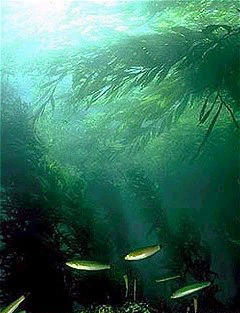
Wakame
A kelp native to East Asia, now a globally invasive species.

Wakame (Undaria pinnatifida) is a type of kelp that naturally grows along the cold, temperate shores of the northwest Pacific Ocean. This edible seaweed has a mildly sweet, strong, and distinctive taste, along with a smooth, satiny feel. It is commonly used in soups and salads.
People in East Asia have harvested wakame for food for a very long time. In Japan, sea farmers have been cultivating it since the Nara period, which began in the eighth century. While it originally comes from the cold coastal waters of Japan, Korea, China, and Russia, it has spread to temperate areas worldwide, including New Zealand, the United States, Belgium, France, Great Britain, Spain, Italy, Argentina, Australia, and Mexico. As of 2018, the Invasive Species Specialist Group placed it on its list of the 100 worst invasive species globally.
Like all kelp and brown algae, wakame looks plant-like but is not related to true plants. Instead, it is a photosynthetic, multicellular stramenopile protist belonging to the SAR supergroup.
The main common name comes from the Japanese word *wakame* (ワカメ, わかめ, 若布, 和布). In English, it is sometimes called sea mustard. In Chinese, it is known as *qúndài cài* (裙带菜) or *hǎidài yá* (海帶芽). In French, it is *wakamé* or *fougère des mers* (sea fern). In Korean, it is called *miyeok* (미역).
In Old Japanese, *me* referred to edible seaweeds in general, while *mo* meant algae. Various kanji, such as 海藻, 軍布, and 和布, were used to write the word. Since wakame was likely the most commonly eaten seaweed, *me* came to specifically mean wakame, later expanding to include other seaweeds like *kajime*, *hirome* (kombu), and *arame*. The name *wakame* comes from *waka* + *me* (若布, meaning "young seaweed"). If *waka* is a eulogistic prefix, similar to the *tama* in *tamagushi*, then *wakame* may have referred to seaweeds broadly in ancient times. In the *Man'yōshū*, both 和可米 and 稚海藻 (both read as *wakame*) appear, along with *nigime* (和海藻, soft wakame). The word *tamamo* (玉藻, meaning "beautiful algae"), which also appears often in the *Man'yōshū*, might refer to wakame in some poems.
The earliest mention of wakame in Western documents is likely in the Portuguese *Nippo Jisho* (1603), where it appears as *Vacame*. In 1867, the word *wakame* appeared in an English-language publication, *A Japanese and English Dictionary* by James C. Hepburn.
Quick Facts
- Genus
- Undaria
- Species
- pinnatifida
Facts from the source article.
Lore & Background
Wakame has long been collected for food in East Asia, with sea farmers in Japan cultivating it since the eighth century (Nara period). Its primary common name derives from the Japanese wakame (ワカメ, わかめ, 若布, 和布). In Old Japanese, 'me' stood for edible seaweeds in general, and wakame was likely most often eaten, so 'me' especially meant wakame. The word wakame is derived from waka + me (若布, lit. 'young seaweed'). In the Man'yōshū, it appears as 和可米 and 稚海藻, and also as nigime (和海藻, soft wakame).
In the West, the earliest appearance is probably in the Portuguese Nippo Jisho (1603) as Vacame. In 1867, the word appeared in an English-language publication by James C. Hepburn. Starting in the 1960s, the word wakame began to be used widely in the United States, with dried imports becoming available at natural food stores and Asian-American grocery stores due to the macrobiotic movement, and in the 1970s with the growth of Japanese restaurants and sushi bars.
Wakame is a photosynthetic, multicellular stramenopile protist of the SAR supergroup, plant-like in appearance but unrelated to true plants. It has established itself in temperate regions around the world, including New Zealand, the United States, Belgium, France, Great Britain, Spain, Italy, Argentina, Australia and Mexico. As of 2018, the Invasive Species Specialist Group listed it among the 100 worst globally invasive species.
Reader's Guide
Wakame's significance spans cuisine, health, and ecology. In cuisine, it is used in Japan and Europe dried or salted in soups (especially miso soup) and salads (tofu salad), often dressed with soya sauce and vinegar. Goma wakame, or seaweed salad, is a popular side dish at American and European sushi restaurants. In Korea, it is used to make miyeok-guk, a seaweed soup stir-fried in sesame oil and boiled with meat broth. Health effects noted in the article include a study at Hokkaido University finding that the compound fucoxanthin may help burn fatty tissue in mice and rats by inducing expression of the fat-burning protein UCP1. Wakame is a rich source of eicosapentaenoic acid (omega-3), with over 400 mg per 100 kcal, and is low in calories. It also has high levels of sodium, calcium, iodine, thiamine and niacin. In Oriental medicine it has been used for blood purification, intestinal strength, skin, hair, reproductive organs and menstrual regularity. In Korea, miyeok-guk is popularly consumed by women after giving birth for its calcium and iodine content, and traditionally on birthdays.
Ecologically, wakame is a serious invasive species. It is commonly introduced on artificial structures, where its r-selected growth strategy facilitates spread to natural reefs. It can reduce the abundance and diversity of understory algae, out-compete native macroalgae, and affect associated epibionts and macrofauna. Its dense congregations clog underwater equipment and foul boat hulls, damaging aquaculture and fishing industries. Eradication typically involves manual removal of reproductive parts by divers and regular cleaning of underwater apparatus. In New Zealand, it was declared an unwanted organism in 2000, first discovered in Wellington Harbour in 1987, and has since spread from Stewart Island to the Karikari Peninsula. Despite its invasive status, farming is permitted in heavily infested areas of New Zealand as part of a control program established since 2010, with permission from Biosecurity New Zealand.
Did You Know?
- Wakame has been cultivated in Japan since the eighth century (Nara period).
- It is listed among the 100 worst globally invasive species as of 2018.
- In Korea, miyeok-guk soup is traditionally eaten by women after giving birth and on birthdays.
Frequently Asked Questions
What is Wakame?
Wakame is the common name for Undaria pinnatifida, a species of edible brown kelp. It is prized for its smooth, satiny texture and a mildly sweet yet bold, distinctive flavor that makes it a staple in soups and salads.
Where is Wakame originally from?
It naturally thrives along the cold, temperate coastlines of the northwest Pacific, specifically the shores of Japan, Korea, China, and Russia. Over time it has been carried to temperate regions around the globe.
How long has Wakame been farmed?
Japanese sea farmers have been cultivating it since the Nara period, which dates back to the eighth century. That makes it one of the oldest continuously farmed seaweeds in the world.
What does Wakame taste and feel like?
It has a smooth, satiny mouthfeel paired with a mildly sweet but distinctly strong flavor. These qualities are what make it so popular in East Asian soups and salads.
Is Wakame considered an invasive species?
Yes — the Invasive Species Specialist Group listed it among the 100 worst globally invasive species as of 2018. New Zealand also declared it an unwanted organism under its Biosecurity Act in 2000.
More in Brown Macroalgae and Kelp, Part 2 1-24
Spotted an error? Know more?
Reader corrections go straight into our review queue. Suggest an edit · How this site is sourced