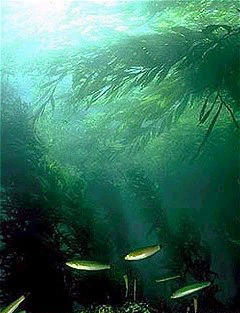
Saccharina
A genus of 24 brown algae species in northern oceans.

Saccharina is a genus of brown algae containing 24 species. These seaweeds grow in the North Atlantic and North Pacific Oceans, typically at depths between 8 and 30 meters. In warmer regions, such as the Mediterranean Sea and off the coast of Brazil, they can be found as deep as 120 meters. One species, Saccharina japonica (formerly known as Laminaria japonica), is commercially important and is farmed to produce kombu, a staple food in Japan. The full list of species includes Saccharina angustata, Saccharina angustissima, Saccharina bongardiana, Saccharina cichorioides, Saccharina coriacea, Saccharina complanata, Saccharina crassifolia, Saccharina dentigera, Saccharina groenlandica, Saccharina gurjanovae, Saccharina gyrata, Saccharina japonica, Saccharina kurilensis, Saccharina lanciformis, Saccharina latissima, Saccharina longicruris, Saccharina longipedales, Saccharina longissima, Saccharina ochotensis, Saccharina religiosa, Saccharina sachalinensis, Saccharina sculpera, Saccharina sessilis, and Saccharina yendoana.
Quick Facts
- Taxon
- Saccharina
Facts from the source article.
Lore & Background
Saccharina is a genus of brown algae comprising 24 species. It occurs in the north Atlantic Ocean and the northern Pacific Ocean, typically at depths from 8 m to 30 m, though exceptionally it can be found at depths up to 120 m in the warmer waters of the Mediterranean Sea and off Brazil. The genus includes the commercially important species Saccharina japonica, also known as Laminaria japonica, which is cultivated as kombu, a popular food in Japan. The species list includes a wide variety of names, many with taxonomic authorities such as C.E. Lane, C. Mayes, Druehl & G.W. Saunders, reflecting modern reclassification.
Reader's Guide
Saccharina is notable as a genus of brown algae with 24 recognized species, distributed across the north Atlantic and northern Pacific Oceans. Its depth range is typically 8 m to 30 m, but it can extend to 120 m in warmer waters such as the Mediterranean Sea and off Brazil. The genus includes Saccharina japonica, which is commercially cultivated as kombu, a staple food in Japan. This species is also referred to by its former name Laminaria japonica. The list of species includes many that have been reclassified by modern phycologists, indicating ongoing taxonomic refinement. The genus does not appear to have any disputed or uncertain elements in the source article, but the depth range includes an exceptional extension noted for specific warmer regions. No dates, persons beyond those listed as taxonomic authorities, or additional places are mentioned in the source.
Did You Know?
- Saccharina is a genus of 24 species of brown algae.
- The typical depth range is 8 m to 30 m, but exceptionally to 120 m in warmer waters.
Culinary Heritage Across Civilizations
Kombu occupies a central place in the food traditions of East Asia, with Japanese consumers standing out as the most devoted eaters of kelp, having woven seaweed into their daily meals for more than fifteen centuries. Chinese and Icelandic cuisines also feature kelp prominently, though on a smaller scale compared to Japan. The term itself is a loanword from Japanese, while Korean speakers call it dasima and Chinese speakers refer to it as haidai. In Japan, the tradition runs deep: Okinawan households consume more kombu per household than any other prefecture, a practice rooted in the Edo period when the island's cuisine became heavily dependent on this ingredient. The versatility of kombu in the kitchen is remarkable—it can be prepared as a dried soup stock base, pickled in vinegar with sweet-and-sour seasoning, shredded into fine strips, or even served fresh as sashimi. This range of preparations has sustained its role as a foundational ingredient across generations.
Taxonomic Complexity and Species Diversity
The family Laminariaceae contains roughly eighteen edible species, most of which carry the kombu label, though not all do. This creates a web of naming confusion that spans both biological taxonomy and fisheries science, where the same species may appear under different Latin names depending on the context. For instance, Saccharina japonica is also known as Laminaria japonica in fisheries literature, and it spawns several varieties—religiosa, diabolica, and ochotensis—each with its own Japanese designation. Other species like Saccharina latissima (Karafuto-kombu) are noted for their mannitol content and sweeter flavor, while Saccharina angustata (Mitsuishi-kombu) is prized specifically for dashi preparation. The variety extends to Saccharina longissima, S. coriacea, S. sculpera, S. longipedalis, S. gyrata, S. cichorioides, and even Arthrothamnus bifidus, each carrying distinct Japanese names that reflect regional usage and culinary application.
Etymology and Ancient Documentation
The word kombu entered English in 1867 through James Curtis Hepburn's Japanese-English dictionary, but its roots stretch far deeper. In Old Japanese, edible seaweed was generically termed "me," a category that also encompassed wakame and arame, and was transcribed with kanji such as gun-fu, ka-so, or wa-fu. The specific seaweed we now call kombu was alternatively known as hirome or ebisume in earlier periods. By the twelfth and thirteenth centuries, the forms konfu and kofu appeared in editions of the Iroha Jiruishō. Two main theories explain the modern name: one traces it to the Sino-Japanese reading of the Chinese term kūnbù, documented as early as the third-century Wupu Bencao; the other notes that ancient Chinese descriptions of kūnbù are so vague and inconsistent—referring to seaweed in the South China Sea with hand-like leaves—that it is impossible to confirm which species was actually meant. Li Shizhen's sixteenth-century Bencao Gangmu further complicated matters by distinguishing kūnbù from haidai, a distinction still maintained in Chinese usage today.
From Ancient Tribute to Scientific Discovery
Archaeological traces of seaweed are rare due to its rapid decomposition, yet plant remains of wakame found in Jōmon-period ruins suggest kombu was already part of the diet by that era. Documentary evidence confirms its early importance: the Shoku Nihongi records that in 797 a representative of the Emishi people reported annually offering kombu as tribute to the Yamato court, and the Engishiki of 927 notes similar tribute from Mutsu. The Muromachi period brought a transformative drying technique that extended kombu's shelf life beyond mere days, turning it into a significant export from the Tōhoku region. By the Edo period, organized shipping from a colonizing Hokkaidō made kombu widely accessible across Japan. The twentieth century saw another leap: a cultivation method was developed that made kombu inexpensive and abundant. In 1908, Kikunae Ikeda's experiments with kombu dashi led him to identify glutamic acid as the source of a distinct taste he named umami. Since the 1960s, dried kombu has been exported globally, moving from specialty Asian shops into mainstream supermarkets and health-food retailers worldwide.
Frequently Asked Questions
What is Saccharina?
Saccharina is a genus of brown macroalgae (kelp) that makes up 24 distinct species. These seaweeds are native to the colder waters of the North Atlantic and North Pacific Oceans.
Where do Saccharina species typically grow?
Most species are found at depths between roughly 8 and 30 meters in northern ocean waters. In warmer areas like the Mediterranean or off Brazil, they can extend down to about 120 meters.
What is Saccharina japonica and why is it famous?
Saccharina japonica, once classified under the name Laminaria japonica, is the species farmed on a large scale to produce kombu. It is a dietary staple in Japan and one of the most commercially significant kelps in the world.
How many species belong to the Saccharina genus?
The genus currently encompasses 24 recognized species, ranging from Saccharina angustata to Saccharina coriacea and others. They are all brown algae found in northern ocean environments.
Why is Saccharina important to humans?
Its most notable contribution is the cultivation of kombu from Saccharina japonica, a key ingredient in Japanese cuisine. Beyond food, the genus is ecologically significant as a foundational kelp in northern marine ecosystems.
More in Brown Macroalgae and Kelp, Part 2 1-24
Spotted an error? Know more?
Reader corrections go straight into our review queue. Suggest an edit · How this site is sourced