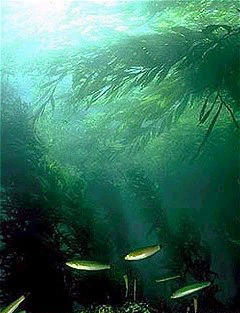
Aquaculture of giant kelp
Cultivation of giant kelp for food, supplements, and potash.

Aquaculture of giant kelp, *Macrocystis pyrifera*, involves growing this seaweed for products like food, dietary supplements, and potash. The kelp itself is rich in iodine, potassium, other minerals, vitamins, and carbohydrates.
In the early 1900s, California’s kelp beds were harvested for potash. Interest grew again in the 1970s and 1980s for alginate production and as a biomass source for animal feed during the energy crisis, but commercial farming of *M. pyrifera* never took off. When the energy crisis ended and alginate prices dropped, research into farming it slowed. During the early 1990s, supply for alginate relied on managing and restoring natural beds. In California, the “Kelp bed project” transplanted adult specimens 3 to 6 meters long to stabilize harbor substrates and boost biodiversity.
In the twenty-first century, research is looking at using the kelp as feed for farmed fish. China and Chile are the top producers of aquatic plants and algae, each making over 300,000 tonnes in 2007, though how much of that is *M. pyrifera* is unclear. Chile’s production is split evenly between brown algae (Phaeophytes) and red algae (Rhodophytes), while China grows a wider variety including green algae (Chlorophytes). Chilean experiments are exploring hybrids of *M. pyrifera* and *M. integrifolia*. Kelp farming is also developing in Oregon and British Columbia, and startups have begun leasing water in Alaska for large-scale cultivation.
Northern California lost 95% of its kelp ecosystems in the 2010s due to marine heatwaves. Recovery efforts focus on removing sea urchins, either by scuba divers or by their natural predator, the sea otter. An invasive brown algae, *Sargassum horneri*, first spotted in 2003, is also a problem. Researchers at UC Davis’s Bodega Marine Laboratory are developing replanting strategies, and volunteers from the Orange County Coastkeeper group are replanting giant kelp. Humboldt State University started cultivating bull kelp at its research farm in 2021. State-level research to prevent kelp forest collapse was announced in July 2020. At the federal level, the KELP Act (H.R. 4458), introduced in July 2021, would create a NOAA grant program for kelp forest restoration. Ocean Rainforest, a Faroe Islands company, received $4.5 million in U.S. government funding to grow giant kelp on an 86-acre farm off Santa Barbara, California.
- Largest producers 2007
- China and Chile, each producing over 300,000 tonnes of aquatic plants and algae
- Chile phaeophyte share
- 50%
- Chile rhodophyte share
- 50%
- Northern california kelp loss 2010s
- 95%
- Oregon british columbia kelp farming
- ongoing
- Ocean rainforest funding
- $4.5 million
- Ocean rainforest farm size
- 86 acres
Lore & Background
At the beginning of the 20th century California kelp beds were harvested for their potash. Commercial interest increased during the 1970s and 1980s due to the production of alginates and biomass for animal feed, but commercial production for M. pyrifera never developed. With the end of the energy crisis and decline in alginate prices, research declined. Supply for alginate production relied on restoration and management of natural beds during the early 1990s. In California, the 'Kelp bed project' transplanted 3-6m adult specimens to increase harbor stability and promote diversity.
In the 21st century, research is investigating its use as feed for other aquaculture species. China and Chile are the largest producers of aquatic plants and algae. Experiments in Chile are exploring hybrids of M. pyrifera and M. integrifolia. Kelp farming development has been ongoing in Oregon and British Columbia, and startups have begun leasing water in Alaska to cultivate M. pyrifera at large scale. In the 2010s, Northern California lost 95% of its kelp ecosystems due to marine heatwaves. Recovery efforts focus on sea urchin removal by scuba divers and sea otters. The invasive Sargassum horneri has also been a concern. Researchers at UC Davis Bodega Marine Laboratory are developing replanting strategies, and volunteers of Orange County Coastkeeper are replanting giant kelp. Humboldt State University began cultivating bull kelp in 2021. Federal legislation H.R. 4458, the KELP Act, was introduced July 29, 2021. Ocean Rainforest secured $4.5 million to grow giant kelp on an 86-acre farm off Santa Barbara.
Reader's Guide
The most common cultivation method, the long line system developed in China in the 1950s, involves producing sporelings in a cooled water greenhouse and planting them on long lines in the ocean. The life cycle alternates between a large sporophyte and a microscopic gametophyte. To induce sporulation, plants are dried up to twelve hours and placed in seawater at 9-10 °C, salinity 30%, pH 7.8-7.9. Zoospores attach to synthetic twine and germinate into gametophytes, which then release sperm and egg cells. Young sporophytes are reared for up to 60 days, then attached to cultivation ropes extending about 60m with buoys. In China, ropes are hung at 50 cm intervals; in Chile, kelp is grown at 2m depth. Harvesting typically occurs after two growth seasons, using a pulley system. In the US, naturally grown M. pyrifera is harvested from the surface canopy several times per year. Applications include fertilizers, bioremediation, and feed for abalone and sea urchins. Carbon sequestration potential is noted: kelp grows 30 times faster than terrestrial plants, and planting across 10% of oceans could offset current emissions. A Maine startup, Running Tide Technologies, seeks to grow kelp for carbon sequestration. A kelp nursery near Catalina Island is exploring biofuel via thermochemical liquefaction. Small-scale cultivation uses kelp as a replacement for kale, and GreenWave connects farmers with buyers.
Did You Know?
- Giant kelp contains iodine, potassium, other minerals, vitamins and carbohydrates.
- The most common cultivation method, the long line system, was developed in China in the 1950s.
- Kelp can grow at 2 feet per day, 30 times faster than terrestrial plants.
Ecological Productivity & Global Significance
Kelp forests, despite covering a mere 0.1 percent of Earth's combined surface alongside coral reefs, punch far above their weight in biological output, contributing roughly 0.9 percent of the planet's total primary productivity. This extraordinary efficiency has earned them a reputation as one of the most productive and dynamically active ecosystems anywhere on the globe. Beyond raw biomass generation, these underwater meadows shape coastal oceanographic patterns and deliver a broad suite of ecosystem services that extend well beyond the immediate kelp canopy. They have served as a focal point for ecological research over the past century, particularly in the field of trophic ecology, and the conceptual frameworks developed through studying them continue to resonate across disciplines far removed from marine biology. Their global reach spans temperate and polar coastal waters, with a surprising 2007 discovery extending their known range into tropical waters off Ecuador, reminding scientists that the boundaries of kelp habitat are still being redrawn.
Biodiversity & Habitat Architecture
Kelp functions as what ecologists call an ecosystem engineer, constructing a three-dimensional physical scaffold that supports an astonishing array of marine life. In the North Pacific, rockfish and a host of invertebrates—including amphipods, shrimp, marine snails, bristle worms, and brittle stars—depend on the forest structure for shelter and foraging grounds. The canopy also draws in larger fauna: seals, sea lions, whales, and sea otters swim through the fronds, while gulls, terns, snowy egrets, great blue herons, cormorants, and various shore birds exploit the productivity from above. Structurally, each kelp thallus is organized into a holdfast that grips the seafloor, a stipe that rises like a stalk, and fronds that serve as the primary sites of photosynthesis and nutrient uptake. Many species also carry pneumatocysts, gas-filled bladders near the base of the fronds, which grant the necessary buoyancy to keep the entire structure upright in the water column. This architectural complexity is what transforms a simple algal growth into a full multidimensional habitat.
Threats, Degradation & Conservation
Human activity has become a dominant force in the decline of kelp forests worldwide. The most pressing mechanism involves overfishing in nearshore waters, which removes the predators that normally keep herbivore populations in check. Freed from this top-down regulation, grazers consume kelp and other algae at unsustainable rates, rapidly converting once-lush forests into barren seascapes where only a handful of species can persist. Compounding this pressure, climate change adds further stress, and the combined effect has already driven kelp forests to near-total disappearance in particularly vulnerable regions, including Tasmania's eastern coastline and the shores of Northern California. One of the most promising management responses is the establishment of marine protected areas, which can curtail fishing impacts and simultaneously buffer the ecosystem against the additive effects of other environmental stressors. These protected zones offer a practical pathway toward restoring the trophic balance that kelp forests require to thrive.
Growth Biology & Tropical Frontiers
Giant kelp of the genus Macrocystis can achieve vertical growth rates of thirty to sixty centimeters per day under ideal conditions, a pace that is almost inconceivable for a plant-like organism. This explosive growth depends on a specific set of environmental prerequisites: a hard substrate such as rock or sand for anchoring, elevated concentrations of nitrogen and phosphorus, and an annual light dose exceeding fifty einsteins per square meter. Areas of strong oceanographic upwelling, where cool nutrient-rich water is drawn from depth into the surface mixed layer, tend to produce the most vigorous forests, while water flow and turbulence help shuttle nutrients across the frond surfaces. The northeastern Pacific, stretching from just north of San Francisco to the Aleutian Islands, harbors the greatest kelp diversity on Earth with more than twenty species. Yet the most recent frontier lies in the tropics: a spatial model predicting subsurface kelp forests to depths of two hundred meters was validated in the Galápagos, where all eight sampled sites confirmed thriving kelp, suggesting these ecosystems may be far more widespread in tropical waters than previously imagined.
Frequently Asked Questions
What is Aquaculture of giant kelp?
It refers to the deliberate cultivation of Macrocystis pyrifera, the giant kelp species, to harvest it for human food, dietary supplements, and industrial potash. The seaweed is notably dense in iodine, potassium, vitamins, and complex carbohydrates, which is what makes it commercially attractive.
What are Aquaculture of giant kelp's main products and roles?
Beyond food and supplements, the kelp has been targeted for alginate extraction and as a biomass feedstock for animal feed. Historically, California's wild kelp beds were stripped specifically for their potash content in the early 1900s, and that same mineral-rich profile still underpins modern interest in the crop.
Why did Aquaculture of giant kelp fail to become a major commercial industry?
A brief wave of investment in the 1970s and 1980s was tied to the energy crisis and high alginate prices, but once both pressures eased, funding for research dried up. As a result, large-scale commercial farming of M. pyrifera never reached a self-sustaining scale.
Where is Aquaculture of giant kelp active today?
Kelp farming continues in Oregon and British Columbia, while China and Chile each reported producing over 300,000 tonnes of aquatic plants and algae by 2007. In Chile, phaeophytes (brown algae like kelp) account for roughly half of that output, with the other half coming from red algae.
Why is Aquaculture of giant kelp important for coastal ecosystems?
Northern California lost approximately 95 percent of its kelp forest cover during the 2010s, underscoring how fragile these habitats are. Initiatives such as the Ocean Rainforest project, backed by around $4.5 million in funding, aim to restore and sustainably farm kelp to rebuild that lost ecosystem while creating a renewable resource.
More in Brown Macroalgae and Kelp, Part 2 1-24
Spotted an error? Know more?
Reader corrections go straight into our review queue. Suggest an edit · How this site is sourced