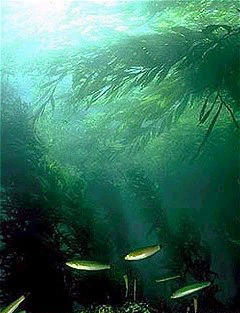
Postelsia
A kelp that lives out of water, neither plant nor animal.

Postelsia palmaeformis—called the sea palm or palm seaweed, but not to be confused with the southern sea palm—is a type of kelp belonging to the brown algae, within the SAR supergroup of eukaryotes. It is the sole species in its genus, Postelsia. This seaweed grows on rocky shores along western North America where waves are constant. It is one of the few multicellular organisms with differentiated tissues that lives most of its life out of water, yet it is not an animal, fungus, or plant, nor closely related to any of them. Although edible, harvesting is discouraged because the species is easily harmed by overharvesting.
Indigenous peoples from Central Coast California to British Columbia knew the sea palm. The Hesquiaht First Nation, Ditidaht People, Nuu-chah-nulth, and Kashia Pomo used it for food, medicine, and games. In the Kashaya language of the Kashia Pomo, it is called qaye. Qaye was prepared three ways: fresh stems chewed raw, cooked in hot ashes, or cut into strips and dried. The first scientific description came from Franz Josef Ruprecht in 1852, based on a specimen collected near Bodega Bay, California, by botanist Ilya Vosnesensky, who worked with Coast Miwok guides. Ruprecht’s paper described one seagrass and five seaweeds, Postelsia among them. Textbooks such as Campbell–Reece Biology have used the sea palm as an example of a multicellular protist and of the class Phaeophyceae.
The genus name Postelsia honors Alexander Philipov Postels, an Estonian-born geologist and artist who collaborated with Ruprecht. The species name palmaeformis refers to the alga’s superficial resemblance to true palms.
Fossils from Monte Bolca, a lagerstätte near Verona, were originally named Zoophycos caput-medusae and thought to be trace fossils. French zoologist Henri Milne-Edwards later recognized them as plants in 1866, giving them the name Algarum. The type specimen, collected by Italian paleobotanist Abramo Bartolommeo Massalongo before 1855, is housed at the Natural History Museum of Verona, preserved in lithographic limestone as upper and lower slabs. In 1926, Italian botanist Achille Forti reinterpreted these fossils as close relatives of Postelsia—brown algae that lived in coastal waters of the Eocene sea. He renamed them Postelsiopsis caput-medusae, noting their extreme similarity to the living sea palm.
Quick Facts
- Genus
- Postelsia
- Species
- palmaeformis
Facts from the source article.
Lore & Background
The sea palm was known by indigenous peoples from Central Coast California to British Columbia, with documented use among the Hesquiaht First Nation, Ditidaht People, Nuu-chah-nulth, and Kashia Pomo. In the Kashaya language it is called qaye, prepared by chewing fresh stems raw, cooking in hot ashes, or cutting into strips and drying. The species was first scientifically described by Franz Josef Ruprecht in 1852 from a specimen collected near Bodega Bay by botanist Ilya Vosnesensky, who worked with Coast Miwok guides. The generic name Postelsia honors Alexander Philipov Postels, an Estonian-born geologist and artist who worked with Ruprecht, while the specific name palmaeformis refers to its superficial similarity to true palms.
Fossils from Monte Bolca near Verona, originally named Zoophycos caput-medusae and thought to be trace fossils, were later reinterpreted by Italian botanist Achille Forti in 1926 as close relatives of Postelsia. Forti renamed them Postelsiopsis caput-medusae, noting extreme similarity to the living sea palm. The fossils show a holdfast, stem-like stipe, and fronds 5–10 cm long, held vertically when submerged and flopping over at low tide, similar to the modern species. Other specimens from the same deposit remain assigned to Zoophycos as trace fossils.
Reader's Guide
Postelsia palmaeformis holds significance as a textbook example of multicellular protists and of the class Phaeophyceae, used in works such as the Campbell–Reece Biology textbook. Its life cycle involves alternation of generations, with a dominant diploid sporophyte stage and a microscopic haploid gametophyte stage. The sporophyte has a stem-like stipe topped with over 100 leaf-like blades and a root-like holdfast; it lacks a vascular system, with the stipe serving only for support. The sea palm is an annual species, with spores released at low tide that fall within a few meters of the parent, leading to dense aggregations. It is found on rocky shores from Vancouver Island to the southern central coast of California, in the middle to upper intertidal zones with constant wave action, which removes competitors like the California mussel. Interestingly, studies show Postelsia grows in greater numbers when mussels are present, as they may protect developing gametophytes or prevent growth of competing algae. The species is edible but sensitive to overharvesting; harvesting is illegal in British Columbia, Washington, and Oregon, while in California recreational harvesting is illegal but regulated commercial harvesting is legal. Epiphytes include the brown algae Ectocarpus commensalis and Pylaiella gardneri (an obligate epiphyte), and the red algae Microcladia borealis and Porphyra gardneri, which are not harmful.
Did You Know?
- Postelsia is one of very few multicellular organisms with differentiated tissues that spends most of its life out of water and is not closely related to animals, fungi, or plants.
- The fossil relative Postelsiopsis caput-medusae was originally misidentified as a trace fossil before being reinterpreted as a brown alga.
- The stipe of Postelsia thickens by cell division in the meristoderm, similar to tree rings, but is flexible to withstand waves.
- Postelsia can regenerate blades cut above the meristem, but removing blades limits its ability to produce spores.
The Smallest of the Kelps
Postelsia palmaeformis, commonly known as the sea palm, occupies the lower extreme of the kelp size spectrum. At a maximum height of roughly 60 centimeters (about 2 feet), it stands in stark contrast to its more famous relative Macrocystis pyrifera, the giant kelp, which stretches beyond 50 meters and holds the title of the largest alga on Earth. Despite this dramatic difference in scale, both belong to the same broad group of brown algae (Phaeophyceae), a class of photoautotrophic, multicellular organisms within the SAR supergroup. The sea palm's modest stature does not diminish its botanical significance; it represents the minimum threshold at which a brown alga qualifies as a kelp. Among the 1,500 to 2,000 known species of brown algae worldwide, Postelsia occupies a unique niche as the smallest member of this particular lineage, reminding us that the kelp family encompasses an extraordinary range of body plans from a half-meter palm to a forest-forming giant.
Built for the Intertidal Zone
One of the most distinctive structural features of Postelsia palmaeformis is the rigidity of its stipe, the stalk-like structure that supports the algal body. While many kelps, such as Macrocystis pyrifera, evolve flexible and elastic stipes to withstand the constant battering of strong underwater currents, the sea palm takes a fundamentally different mechanical approach. Its stipe is notably more rigid, an adaptation directly linked to its exposure to the open atmosphere during low tide. This means the sea palm must endure not just hydrodynamic forces but also desiccation, temperature swings, and the mechanical stress of air exposure—challenges that a flexible, current-adapted stipe would not address. The stipe in structurally differentiated brown algae can be organized into three tissue layers: a central pith, a surrounding cortex, and an outer epidermis, each serving an analog to vascular plant stem tissues. In Postelsia, this internal architecture is tuned for structural integrity in a zone where the alga alternates between submersion and aerial exposure, making it one of the few kelps whose engineering priorities are shaped as much by air as by water.
A Stramenopile, Not a Plant
Despite its palm-like common name and its role in marine ecosystems, Postelsia palmaeformis is not a plant in the botanical sense. It belongs to the class Phaeophyceae within the Stramenopiles, a clade of eukaryotic organisms in the SAR supergroup. This places it far from red algae, green algae, and all green plants, which belong to the archaeplastid lineage. The chloroplasts in brown algae are wrapped in four membranes, a hallmark of secondary endosymbiosis—suggesting an ancient event in which a stramenopile ancestor engulfed a photosynthetic alga, possibly red or green, and retained the organelle. Most brown algae, including Postelsia, carry the pigment fucoxanthin, which imparts the characteristic olive-green to brown coloration that defines the group. What sets brown algae apart among all Stramenopiles is their development into multicellular forms with differentiated tissues, a level of complexity not seen in their single-celled or colonial relatives. Yet they still reproduce through flagellated spores and gametes that closely mirror the cells of other Stramenopiles, preserving a deep evolutionary signature.
Life Among the Rocky Shores
Postelsia palmaeformis belongs to a group of organisms that dominate the cooler waters of the Northern Hemisphere, serving as the principal seaweeds of temperate and polar marine environments. Brown algae like the sea palm commonly colonize rocky seashores, where they anchor themselves to hard substrates and form the structural foundation of coastal ecosystems. Within these habitats, brown algae fulfill two critical ecological roles: they serve as a food source for a wide array of marine organisms, and they provide physical habitat and shelter for countless species. The broader Phaeophyceae class, which includes Postelsia, spans an extraordinary diversity of forms—from microscopic, threadlike tufts just a few centimeters long to the vast floating mats of Sargassum in the Sargasso Sea. Some species, such as Ascophyllum nodosum, have attracted extensive scientific research due to their commercial value, while others like Macrocystis build underwater kelp forests teeming with biodiversity. Postelsia, at the small end of this spectrum, still participates in the same fundamental processes of carbon fixation and ecological support that make brown algae indispensable to marine life.
Frequently Asked Questions
What is Postelsia?
Postelsia palmaeformis, often called the sea palm or palm seaweed, is a brown kelp that is the only species in its genus. It reaches roughly 50–75 cm in height and is found on rocky western North American coastlines.
Where does Postelsia grow?
This kelp colonizes wave-battered rocky shores along the western coast of North America. Its type locality is near Bodega Bay, California, where Franz Josef Ruprecht first described the species in 1852.
Is Postelsia a plant?
No. Although it has differentiated tissues that make it look plant-like, Postelsia is a brown alga within the SAR supergroup of eukaryotes. It is not an animal, fungus, or plant, and is not closely related to any of them.
What makes Postelsia unusual among seaweeds?
It is one of the very few multicellular, tissue-differentiated organisms that spends the majority of its life exposed to air above the waterline. Despite this aerial lifestyle, it remains a marine alga rather than a true land organism.
Can I harvest Postelsia for eating?
The seaweed is technically edible, but harvesting is strongly discouraged because the species is highly vulnerable to disturbance and slow to recover. Fans and foragers are urged to admire it in place rather than remove it from the shore.
More in Brown Macroalgae and Kelp, Part 2 1-24
Spotted an error? Know more?
Reader corrections go straight into our review queue. Suggest an edit · How this site is sourced