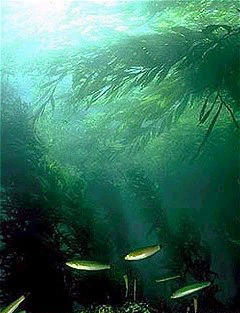
Alaria esculenta
Edible winged kelp of the far north Atlantic coasts.

Alaria esculenta is a brown seaweed people eat, known by names like dabberlocks, badderlocks, winged kelp, and sometimes Atlantic Wakame. Along the far north Atlantic coasts, it has been a traditional food, consumed fresh or cooked in Greenland, Iceland, Scotland, and Ireland. Out of twelve Alaria species, this is the only one found in both Ireland and Great Britain. The whole frond is brown and can reach up to 2 meters long. It has a clear midrib, with wavy, thin, membranous blades up to 7 centimeters wide on each side. The frond is unbranched and narrows toward the tip. At the base, a short stem (stipe) grows from a holdfast made of branching, root-like rhizoids. The stipe can also carry several club-shaped sporophylls, up to 20 centimeters long and 5 centimeters wide, which produce spores. Unlike other large, unbranched brown algae in the British Isles, this one has a long, noticeable midrib running through the frond. Reproduction happens through sporangia that grow on these narrow, leafy sporophylls near the base, attached to the stipe. These sporophylls can reach 20 centimeters long and 5 centimeters wide. In Ireland, where it is called Láir or Láracha, and across the rest of the British Isles except southern and eastern England, this seaweed is well known. It is a perennial species. It thrives on rocky shores with heavy wave exposure, attached to rocks just below the low-water mark in the "Laminaria belt." Its growth rate is fairly high compared to other algae—about 5.5% per day—and it can support a carrying capacity of roughly 2 kilograms wet weight per square meter. It may grow up to about 2.5 meters long. Its distribution overlaps a little with *Fucus serratus* and somewhat more with *Laminaria digitata*. Light limitation occurs at about 5 and 70 watts per square meter for low and high values, respectively. Salinity, wave exposure, temperature, desiccation, and general stress also limit where it grows. These traits are summarized in works by Lewis (1964) and Seip (1980). The leaf-like sporophylls develop from the stipe and release zoospores. To protect against high levels of photosynthetically active and ultraviolet radiation, *A. esculenta* can produce phlorotannins and oxidized lipids. It also serves as a host for the pathogenic fungus *Phycomelaina laminariae*.
Quick Facts
- Genus
- Alaria
- Species
- esculenta
Facts from the source article.
Lore & Background
Alaria esculenta grows to a maximum length of 2 m. The whole frond is brown and consists of a distinct midrib with wavy membranous lamina up to 7 cm wide on either side. The frond is unbranched and tapers towards the end. The base has a short stipe arising from a rhizoidal holdfast. The stipe may bear several sporophylls which are club-shaped and up to 20 cm long and 5 cm broad, bearing the spores. The stipe is continued into the frond forming a long conspicuous midrib; all other large and unbranched brown algae in the British Isles are without a mid-rib. The lamina is thin, membranous with a wavy margin.
Reader's Guide
Alaria esculenta holds significance as a traditional food source in Greenland, Iceland, Scotland, and Ireland, where it is eaten fresh or cooked. Its notable status as the only Alaria species found in both Ireland and Great Britain underscores its ecological distinctiveness within the British Isles. The alga's morphology—particularly its conspicuous midrib, which distinguishes it from all other large unbranched brown algae in the region—makes it a key species for identification in intertidal and subtidal zones. Its high intrinsic growth rate of 5.5% per day and carrying capacity of about 2 kg wet weight per square meter indicate its productivity in wave-exposed environments. The species' distribution across the North Atlantic, from Europe to North America and Asia, reflects its adaptability to cold, turbulent waters. Its production of phlorotannins and oxidized lipids as protective compounds against UV radiation highlights its physiological resilience. The presence of the pathogenic fungus Phycomelaina laminariae on A. esculenta adds a dimension to its ecological interactions. The alga's role as a perennial component of the Laminaria belt on exposed rocky shores contributes to the structural complexity of these marine habitats.
Did You Know?
- Alaria esculenta is the only one of twelve species of Alaria to occur in both Ireland and Great Britain.
- The alga may produce phlorotannins and oxidized lipids as protective functions against high photosynthetically active and UV radiations.
- It is host to the pathogenic fungus Phycomelaina laminariae.
Frequently Asked Questions
What is Alaria esculenta?
Alaria esculenta is an edible brown seaweed commonly called dabberlocks, badderlocks, winged kelp, or occasionally Atlantic Wakame. It is the only one of the twelve Alaria species native to both Ireland and Great Britain.
Where does Alaria esculenta grow?
This kelp is native to the far north Atlantic coasts, with long-standing traditional use in Greenland, Iceland, Scotland, and Ireland. It is the sole Alaria species found in both Irish and British waters.
What does Alaria esculenta look like?
The frond is entirely brown, unbranched, and tapers toward its tip, with a distinct central midrib flanked by thin, wavy, membranous blades up to seven centimeters wide on each side. The whole frond can reach two meters in length.
Is Alaria esculenta edible?
Yes—coastal communities in Greenland, Iceland, Scotland, and Ireland have long eaten it fresh or cooked as a traditional food. The entire frond is consumed, making it a practical staple in those regions.
How does Alaria esculenta grow?
It has an intrinsic growth rate of roughly 5.5 percent per day and can reach a carrying capacity of about two kilograms of wet weight per square meter. Its sporophylls, the reproductive structures, can measure up to twenty centimeters long and five centimeters wide.
More in Brown Macroalgae and Kelp, Part 2 1-24
Spotted an error? Know more?
Reader corrections go straight into our review queue. Suggest an edit · How this site is sourced