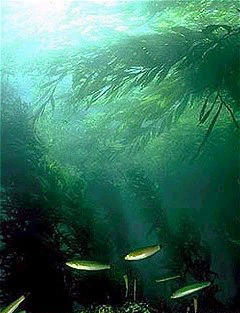
Pleurophycus gardneri
A deciduous kelp overlooked beneath giant kelp forests.

Pleurophycus gardneri is a species of brown alga, a deciduous kelp found primarily in lower, rocky inter-tidal and shallow, rocky sub-tidal locations. It is notable as one of the most abundant kelps within the Pleurophycus Zone, a depth range of roughly 30–45 meters, and forms aggregates of densities up to 10 per square meter. Its beds reside below giant kelp forests, leading to its historical oversight by researchers.
Quick Facts
- Genus
- Pleurophycus
- Species
- gardneri
Facts from the source article.
Lore & Background
Pleurophycus gardneri is a stipitate kelp that forms dense aggregates in the Pleurophycus Zone, typically between 30 and 45 meters depth, and is not commonly present deeper in the ocean than 30m. Its range extends from Central California to British Columbia, Canada, and it has a lifespan of only 3 to 6 years. The family of this kelp was previously believed to be Laminariaceae, but molecular data supports its placement in Alariaceae. It has been referred to as Tender Kelp (1980) or Sea spatula (1985). Interactions with other species include serving as habitat for many amphipod species, particularly those that burrow into the stipe. These burrowing amphipods decrease the kelp's lifespan; breaks in the holdfast up to the stipe kill the plant, while breaks above the abscission zone of the frond may reduce fitness but not kill it. Reproduction follows the typical kelp pattern: diploid sporophytes and a microscopic haploid gametophyte stage. Mature blades have a thick mid-rib containing sori, which produce gametes. The plant is deciduous, losing all foliage by late fall, followed by a roughly two-week dormancy before new blades grow, requiring light. Annual banding in the stipe allows age determination. Premature blade deterioration and breakages result from warmed ocean temperatures, with temperatures around 14–15°C triggering deterioration; such premature blade drop was recorded following an El Niño.
Reader's Guide
Pleurophycus gardneri holds significance as a deciduous kelp that forms dense beds in the Pleurophycus Zone, a depth range often overshadowed by giant kelp forests, leading to its historical neglect by researchers. Its presence from Central California to British Columbia marks it as a key component of lower inter-tidal and shallow sub-tidal ecosystems. The species' interactions with stipe-burrowing amphipods highlight a critical ecological relationship: these amphipods reduce the kelp's lifespan, with breaks in the holdfast or stipe being lethal, while frond damage above the abscission zone only reduces fitness. This dynamic underscores the kelp's vulnerability to biotic stressors. The kelp's deciduous nature, with annual blade loss and regrowth triggered by light after a two-week dormancy, and its sensitivity to temperature—with blade deterioration at 14–15°C and premature drop following El Niño events—demonstrate its responsiveness to environmental conditions. The use of annual banding in the stipe for age determination provides a tool for studying its life history. The taxonomic revision from Laminariaceae to Alariaceae based on molecular data reflects ongoing refinement in kelp classification. Its common names, Tender Kelp and Sea spatula, offer historical vernacular references. Overall, P. gardneri serves as a model for understanding understory kelp ecology, amphipod interactions, and climate sensitivity.
Did You Know?
- Pleurophycus gardneri is a deciduous kelp that loses all foliage by late fall and regrows new blades after a two-week dormancy.
- Temperatures around 14–15°C trigger blade deterioration, and premature blade drop was recorded following an El Niño.
Frequently Asked Questions
What is Pleurophycus gardneri?
It is a deciduous species of brown kelp in the family Alariaceae, though it was once misclassified under Laminariaceae. The plant grows on rocky substrates in inter-tidal and shallow sub-tidal zones along the Pacific coast, from Central California up to British Columbia.
Where exactly does Pleurophycus gardneri grow?
This kelp inhabits the Pleurophycus Zone, a depth band spanning roughly 30 to 45 meters, on rocky inter-tidal and shallow sub-tidal habitats. Its range stretches from Central California northward to British Columbia, Canada.
How large do Pleurophycus gardneri colonies get?
Individual blades reach approximately 150 centimeters in length, and the species can form dense patches of up to 10 plants per square meter. These thick aggregations make it one of the most numerically dominant kelps in its depth zone.
How long does a Pleurophycus gardneri plant live?
Each individual kelp has a lifespan of about three to six years before it senesces. As a deciduous species, it sheds its blades seasonally rather than retaining them year-round.
Why did researchers overlook Pleurophycus gardneri for so long?
Because its beds sit directly beneath the towering canopies of giant kelp forests, early surveys tended to focus on the more visually striking upper layers. This position below the giant kelp canopy meant the Pleurophycus Zone received far less attention until its abundance was properly documented.
More in Brown Macroalgae and Kelp, Part 2 1-24
Spotted an error? Know more?
Reader corrections go straight into our review queue. Suggest an edit · How this site is sourced