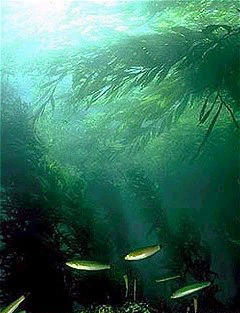
Laminaria agardhii
A brown kelp with finger-like blades and a strong holdfast.

Laminaria agardhii is a brown kelp distinguished by a sturdy holdfast and blade segments that resemble fingers. This species is primarily located in the northeastern Atlantic Ocean, with a range extending from Massachusetts in the United States northward to Baffin Bay in the Canadian Arctic. It grows in the sublittoral zone, adapted to tidal rocks at depths between 0.5 and 3 meters. A strong stem, up to 0.5 meters long, anchors the plant to these rocks via a tough, fibrous holdfast. The blade is narrow and long, significantly longer than the stem, reaching about 30 centimeters in width and 3 meters in length. Reproduction occurs between September and April, peaking in January, through sporangia on the blade surface. These sporangia release flagellated zoospores that disperse widely. The resulting gametophytes form a chain-like series of cells that develop into a new organism. Medicinally, Laminaria agardhii is valued for its high iodine content, which supports thyroid function. Members of the Laminariaceae family are also used to induce labor: a piece of laminaria placed in the cervix absorbs water, expands, and gently dilates the opening.
Quick Facts
- Genus
- Laminaria
- Species
- agardhii
Facts from the source article.
Lore & Background
Laminaria agardhii grows in the sublittoral zone, adapted to tidal rocks at depths between 0.5 and 3 meters. Its morphology includes a strong stem that can reach 0.5 meters in length, attached to a strong, fibrous holdfast. The blade is narrow and long, substantially longer than the stem, growing to approximately 30 cm in width and 3 meters in length.
Reproduction occurs typically between September and April, peaking in January. The kelp reproduces via sporangia that grow on the surface of blades, releasing zoospores with flagella for wider dispersal. Gametophytes consist of a chain-like series of cells that grow into a new organism.
Medicinally, Laminaria agardhii is high in iodine, a nutrient crucial for proper thyroid function. Members of the family Laminariaceae can also be used to induce and aid in labor: pieces of laminaria placed in the cervix absorb water and enlarge, making the opening of the cervix larger.
Reader's Guide
Laminaria agardhii is notable for its strong holdfast and finger-like blades, which anchor it in the sublittoral zone among tidal rocks. Its distribution spans the northeastern Atlantic Ocean from Massachusetts to Baffin Bay, indicating a tolerance for cold, northern waters. The species' morphology—a stem up to 0.5 meters and a blade up to 3 meters—reflects adaptation to shallow, rocky environments. Its reproductive strategy, using sporangia and flagellated zoospores from September to April, maximizes dispersal in these habitats. Medicinally, the kelp's high iodine content supports thyroid health, and its use in inducing labor by absorbing water and enlarging in the cervix demonstrates a practical application in traditional medicine. These characteristics underscore its ecological and cultural significance within the Laminariaceae family.
Did You Know?
- Laminaria agardhii has a blade that can grow up to 3 meters in length.
- It reproduces via sporangia that release flagellated zoospores.
- The kelp is high in iodine, important for thyroid function.
- Pieces of laminaria can be used to aid in labor by absorbing water and enlarging the cervix.
Frequently Asked Questions
What is Laminaria agardhii?
It is a brown kelp species recognized for its finger-like blade segments and a tough, fibrous holdfast that grips rocky substrates. It belongs to the broader group of brown macroalgae found in cold northern waters.
Where can Laminaria agardhii be found?
This kelp inhabits the sublittoral zone on tidal rocks at depths of roughly 0.5 to 3 meters. Its geographic range spans the northeastern Atlantic, stretching from Massachusetts northward all the way to Baffin Bay in the Canadian Arctic.
What does Laminaria agardhii look like?
It features a sturdy stem up to 0.5 meters long, anchored by a robust holdfast, and a long narrow blade measuring about 30 cm wide and 3 m in length. The blade's segmented, finger-like shape is the species' most distinctive visual trait.
When does Laminaria agardhii reproduce?
Its reproductive window runs from September through April, with the peak of activity occurring in January. This long season aligns with the colder months of its northeastern Atlantic and Arctic range.
Why is Laminaria agardhii notable among brown kelps?
Its combination of a particularly strong holdfast and uniquely finger-shaped blade segments sets it apart from many other Laminaria species. It is also a key indicator of cold, rocky sublittoral habitats across the northeastern Atlantic.
More in Brown Macroalgae and Kelp, Part 2 1-24
Spotted an error? Know more?
Reader corrections go straight into our review queue. Suggest an edit · How this site is sourced