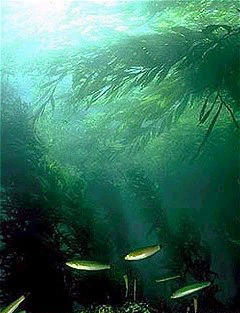
Laminaria abyssalis
A Brazilian brown kelp tied to rhodolith beds.

Laminaria abyssalis is a species of brown kelp native to the Atlantic Ocean off the coast of Brazil. It is notable for its connection to rhodolith beds, which serve as its primary substrate.
Quick Facts
- Taxon
- Laminaria abyssalis
Facts from the source article.
Lore & Background
Laminaria abyssalis was first discovered in 1967 by A. B. Joly and E. C. Oliveira along the Brazilian coastline. A later expedition by Quége N in 1988 determined many locations where the kelp grows along Brazil. The kelp resides in a habitat spanning over 33,000 km2 from upper Espírito Santo to Mid Rio de Janeiro, thriving in waters of the continental shelf and intertidal zone at depths of 40 to 120 m. The majority of these kelp take root in rhodolith beds, substrates formed by nodules of calcareous algae. Morphologically, the stipe averages 14.3 cm in length and 0.7 cm in width, supporting an undivided blade averaging 241 cm long, 68 cm wide, and 0.65 cm thick. The holdfast has an average of 4 root-like extensions, each averaging 13.5 cm in length.
Reader's Guide
Laminaria abyssalis holds significance as a brown kelp species uniquely associated with rhodolith beds along the Brazilian coastline. Its discovery in 1967 by A. B. Joly and E. C. Oliveira marked the first documentation of this species, with later surveys by Quége N in 1988 expanding knowledge of its distribution. The kelp's habitat spans over 33,000 km2 from upper Espírito Santo to Mid Rio de Janeiro, at depths of 40 to 120 m. Its reliance on rhodolith beds—substrates formed by calcareous algae—makes it ecologically distinct. However, sand trawling in Brazilian waters has disrupted these beds, leading to a semi-endangered state for the kelp. In response, the RESTORESEAS project has begun collecting data and conducting experiments to preserve the lives of these kelps. The legacy of Laminaria abyssalis thus lies in its ecological specificity and the conservation efforts it has inspired.
Did You Know?
- The kelp's holdfast averages 4 root-like extensions, each about 13.5 cm long.
- Sand trawling has disrupted the rhodolith beds, causing the kelp to slightly die out.
Frequently Asked Questions
What is Laminaria abyssalis?
Laminaria abyssalis is a species of brown kelp found in the Atlantic waters off Brazil's coast. It is distinguished by its strong ecological tie to rhodolith beds, which act as its main anchoring substrate.
Who first described Laminaria abyssalis and when?
The species was identified by A. B. Joly and E. C. Oliveira back in 1967. Their work formalized what had previously been an unclassified kelp population in Brazilian deep-water habitats.
Where does Laminaria abyssalis grow and how widespread is it?
It inhabits depths between roughly 40 and 120 metres along the Brazilian Atlantic shelf. Its known range covers more than 33,000 square kilometres of rhodolith-bed terrain.
How big is Laminaria abyssalis compared to other kelps?
The stipe (stem) averages about 14.3 centimetres, while the blade stretches to roughly 241 centimetres on average. That gives it a long, ribbon-like profile typical of deep-water laminarians.
Why do ecologists care about Laminaria abyssalis?
Because it is anchored to rhodolith beds, it is a key indicator of the health of those carbonate structures. Understanding its distribution helps researchers monitor the broader deep-water ecosystem off Brazil.
More in Brown Macroalgae and Kelp, Part 2 1-24
Spotted an error? Know more?
Reader corrections go straight into our review queue. Suggest an edit · How this site is sourced