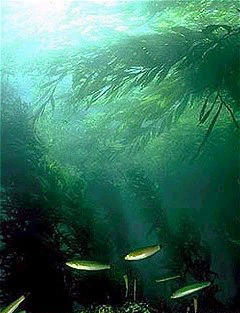
Undaria pinnatifida
Edible kelp native to the northwest Pacific, now a widespread invasive species.

Undaria pinnatifida, commonly known as wakame, is a species of kelp native to cold, temperate coasts of the northwest Pacific Ocean. It is notable as an edible seaweed with a subtly sweet, distinctive flavor and satiny texture, most often served in soups and salads. As of 2018, the Invasive Species Specialist Group listed it among the 100 worst globally invasive species, as it has established itself in temperate regions worldwide.
Quick Facts
- Genus
- Undaria
- Species
- pinnatifida
Facts from the source article.
Lore & Background
Wakame has long been collected for food in East Asia, and sea farmers in Japan have cultivated it since the eighth century (Nara period). The primary common name derives from the Japanese name wakame. In Old Japanese, 'me' stood for edible seaweeds in general, and wakame was likely most often eaten, so 'me' especially meant wakame. The word wakame is derived from waka + me, meaning 'young seaweed'. In the Man'yōshū, it appears as 和可米 and 稚海藻, and also as nigime (soft wakame).
In the West, the earliest appearance is probably in the Portuguese Nippo Jisho (1603) as Vacame. In 1867, the word appeared in an English-language publication by James C. Hepburn. Starting in the 1960s, the word wakame began to be used widely in the United States, and the dried product became available at natural food stores and Asian-American grocery stores due to the macrobiotic movement, and in the 1970s with the growing number of Japanese restaurants and sushi bars.
Wakame fronds are green and have a subtly sweet flavor and satiny texture. In Japan and Europe, it is distributed either dried or salted, used in soups (particularly miso soup) and salads. In Korea, it is used to make miyeok-guk, a seaweed soup. Goma wakame, or seaweed salad, is a popular side dish at American and European sushi restaurants.
Reader's Guide
Undaria pinnatifida holds dual significance as both a valued food source and a problematic invasive species. Cultivated in Japan since the eighth century, it remains a staple in East Asian cuisine, with Japanese and Korean sea-farmers as leading producers and consumers. It has been cultivated in France since 1983, and wild-grown wakame is harvested in Tasmania, Australia, and sustainably hand-harvested from Foveaux Strait in New Zealand.
However, its spread beyond its native range has caused ecological and economic concerns. It has established itself in temperate regions including New Zealand, the United States, Belgium, France, Great Britain, Spain, Italy, Argentina, Australia, and Mexico. Listed among the 100 worst invasive species, Undaria can alter native community composition, reduce understory algal diversity, out-compete native macroalgae, and affect associated fauna. Its dense growth on hard surfaces damages aquaculture apparatus, clogs underwater equipment, and fouls boat hulls.
In New Zealand, it was declared an unwanted organism in 2000. First discovered in Wellington Harbour in 1987, it has since spread throughout much of the country. Eradication efforts involve manual removal of reproductive parts by divers and regular cleaning of underwater equipment. Despite its invasive status, farming of wakame is permitted in heavily infested areas of New Zealand as part of a control program established since 2010, with permission from Biosecurity New Zealand.
Did You Know?
- Wakame has been cultivated in Japan since the eighth century (Nara period).
- It was listed among the 100 worst globally invasive species as of 2018.
- In Korea, miyeok-guk soup is traditionally eaten by women after giving birth and on birthdays.
- A compound in wakame called fucoxanthin was found in a Hokkaido University study to help burn fatty tissue in mice and rats.
Frequently Asked Questions
What is Undaria pinnatifida?
Undaria pinnatifida, widely known as wakame, is an edible brown kelp species that naturally grows along the cold, temperate shores of the northwest Pacific. It is prized in kitchens for its gently sweet taste and silky, satiny mouthfeel, most commonly appearing in miso soups and seaweed salads.
Where is Undaria pinnatifida native to?
This kelp is indigenous to the chilly coastal waters surrounding Japan, Korea, China, and Russia. Its cultivation history stretches back to at least the eighth century in Japan during the Nara period, making it one of the longest-domesticated seaweeds on record.
How is Undaria pinnatifida used in cooking?
Wakame is best known as a soup and salad ingredient, valued for its subtle sweetness and smooth, satiny texture. It has been a staple of East Asian cuisine for over a millennium, and its earliest Western culinary record appears in the Portuguese Nippo Jisho lexicon of 1603, where it was written as Vacame.
Why is Undaria pinnatifida considered a globally invasive species?
In 2018, the Invasive Species Specialist Group named it one of the 100 worst invasive species on Earth because it has colonized temperate coastlines far outside its native Pacific range. New Zealand formally declared it an unwanted organism under its Biosecurity Act in 2000, and it has since established footholds in regions like France, where cultivation began in 1983.
When did Undaria pinnatifida first appear in English-language records?
The earliest known English publication to reference this kelp was James C. Hepburn's A Japanese and English Dictionary, printed in 1867. Prior to that, Western awareness of the species was limited to early-1600s Portuguese trade documents and other European maritime records.
More in Brown Macroalgae and Kelp, Part 2 1-24
Spotted an error? Know more?
Reader corrections go straight into our review queue. Suggest an edit · How this site is sourced