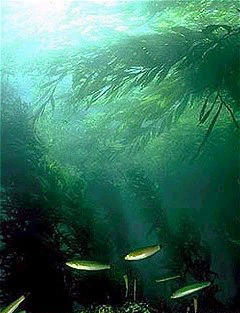
Pterygophora californica
A dominant understory kelp with a woody stipe and annual rings.

Pterygophora californica, also called stalked kelp, woody-stemmed kelp, walking kelp, or winged kelp, is a large brown seaweed and the sole member of its genus. It lives in shallow waters along the Pacific coast of North America, where it contributes to the biodiversity of kelp forests.
This perennial algae can reach about three meters tall and live for up to twenty-five years. It anchors to rocky surfaces with a holdfast and has a single, tough, woody stipe, or stem, that can grow two meters long and two centimeters wide. Annual growth rings in the stipe allow scientists to estimate its age within a couple of years. Smooth blades called sporophylls line both sides of the upper stipe; these bear sporangia that produce spores. A larger, linear terminal blade with a midrib can grow up to ninety centimeters long.
The species ranges from Vancouver Island, British Columbia, south to Bahía Rosario in Baja California, Mexico, living in the sublittoral zone down to about ten meters deep.
Reproduction involves alternating generations. Microscopic zoospores form in the sporangia, settle on the seafloor, and develop into haploid gametophytes. These produce male and female gametes; after fertilization, a zygote grows into a diploid sporophyte—the familiar stipe and blades.
In underwater kelp forests, *P. californica* is a dominant understory species, forming a sub-surface canopy alongside annual bull kelp (*Nereocystis luetkeana*) and perennial giant kelp (*Macrocystis pyrifera*). As photosynthetic organisms, these seaweeds are limited mainly by light availability, and *P. californica* can be shaded by the canopies of bull and giant kelp. Various algae, including red algae, bull kelp, and sea belt (*Saccharina latissima*), attach themselves to *P. californica* as epiphytes to get a head start above the seafloor. Storms are the most common cause of death, tearing the kelp from rocks—a risk increased by the drag from epiphyte loads. To reduce this burden, *P. californica* and other Laminariales periodically shed surface layers and produce antifouling compounds like phenols. Washed-up woody stipes degrade slowly and have been used by bald eagles as nest material.
At Race Rocks near Vancouver Island, winter leaves only the bare stipes of *P. californica* standing, while annual seaweeds break down and disperse. By midsummer, fast-growing *N.
Quick Facts
- Genus
- Pterygophora
- Species
- californica
Facts from the source article.
Lore & Background
Pterygophora californica is a large brown seaweed attached to rocky substrate by its holdfast, with a single, tough, woody stipe up to two metres long and 2 cm in diameter. It is a long-lived perennial alga that may survive for twenty-five years, and annual growth rings can be seen in the stipe, allowing age estimation within about two years. A number of smooth blades, called sporophylls, are arranged on either side of the top half of the stipe and bear reproductive organs called sporangia. The terminal blade is linear, has a midrib, and is larger than the others, growing up to 90 cm long.
Reproduction involves an alternation of generations: microscopic zoospores produced in the sporangia settle on the sea bed and develop into haploid gametophytes, which produce male and female gametes. Fertilization results in zygote formation and growth of the diploid sporophytes. The stalked kelp grows in underwater kelp forests with other brown algae including the annual bull kelp (Nereocystis luetkeana) and the perennial giant kelp (Macrocystis pyrifera). It is a dominant understory kelp species and creates a sub-surface canopy. Its growth can be restricted by shading from bull and giant kelp canopies.
Various algae attach themselves epiphytically to P. californica well above the ocean floor, including red algae, bull kelp, and sea belt (Saccharina latissima). The most common cause of death is being torn from rocks during storms, made more likely by drag from the epiphyte burden. The kelp attempts to reduce epiphytic load by periodically sloughing off surface layers and producing antifouling substances such as phenols. Washed-up woody stipes degrade slowly on shore and have been used by bald eagles as nest material.
Reader's Guide
Pterygophora californica is notable as the sole species in its genus and as a dominant understory kelp in Pacific North American kelp forests. Its woody stipe, which can live up to twenty-five years and display annual growth rings, allows researchers to estimate its age, similar to terrestrial trees. The species plays a key ecological role by creating a sub-surface canopy and providing a substrate for epiphytic algae such as bull kelp and sea belt. Its growth is limited by light availability and shading from canopy-forming kelps. The most common cause of death is storm-induced detachment, exacerbated by epiphyte drag. The kelp employs antifouling strategies including surface sloughing and phenolic compounds. Herbivory by sea urchins, particularly Strongylocentrotus purpuratus and Strongylocentrotus droebachiensis, can lead to barren grounds if urchin populations become too large. At Race Rocks, seasonal observations showed that only the bare stipes of P. californica remain in winter, while by summer it forms a middle storey layer with Saccharina latissima, with much bull kelp growing epiphytically on its upper parts. The lower stipe regions are thought to be free of epiphytes due to grazing by benthic macrofauna such as sea urchins.
Did You Know?
- Pterygophora californica is the only species in its genus Pterygophora.
- Its age can be estimated within about two years by counting annual rings in its woody stipe.
Frequently Asked Questions
What is Pterygophora californica?
It is a large brown seaweed found in shallow Pacific waters off the North American coast, often nicknamed stalked kelp, walking kelp, or winged kelp. As the sole species in its genus, it stands alone in its classification within the kelp family.
How tall does Pterygophora californica get?
This perennial kelp can grow to roughly three metres in overall height, with a single woody stipe reaching up to two metres long and about two centimetres in diameter. Its terminal blade can extend to around ninety centimetres.
How long can Pterygophora californica live?
Individuals of this species can survive for as long as twenty-five years in the wild. Researchers estimate an individual's age by counting the annual growth rings that form in its tough stipe.
What makes Pterygophora californica different from other kelps?
Rather than a soft, flexible stipe, it grows a single rigid, woody stem that gives it a tree-like silhouette unlike most other kelp species. It also functions as a dominant understory kelp, anchoring itself to rocky substrates with a holdfast and helping structure the surrounding kelp forest.
Where can you find Pterygophora californica?
It inhabits shallow coastal waters along the Pacific coast of North America, typically at depths down to about ten metres. In those habitats it plays a meaningful role in supporting the overall biodiversity of kelp forest ecosystems.
More in Brown Macroalgae and Kelp, Part 2 1-24
Spotted an error? Know more?
Reader corrections go straight into our review queue. Suggest an edit · How this site is sourced