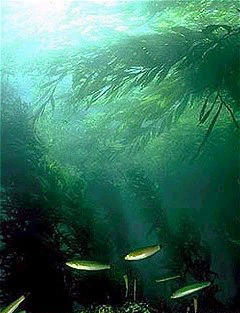
Nereocystis
A monotypic kelp forming subtidal beds and important in kelp forests.

Nereocystis, from the Greek for "mermaid's bladder huki kelp," is a monotypic genus of subtidal kelp, with the sole species being *Nereocystis luetkeana*. It goes by several English names—edible kelp, bull kelp, bullwhip kelp, ribbon kelp, and their variants. The common name "bull kelp" can cause confusion with southern bull kelps, which inhabit the Southern Hemisphere. This species forms dense beds on subtidal rocks and is a key component of kelp forests. The species was originally named *Fucus luetkeanus* by Mertens, honoring the German-Russian explorer Fyodor Petrovich Litke (also spelled Lütke). It was later reclassified under the name *Nereocystis luetkeana* in a description by Postels and Ruprecht. A brown macroalgae that gets its chemical energy through photosynthesis, *Nereocystis* is easily identified by a single large pneumatocyst—a gas bladder—located between the hollow stipe and the blades, a trait it shares with *Pelagophycus porra*. Individuals can reach up to 36 meters (118 feet) in length. The holdfast can be about 40 centimeters (16 inches) across, topped by a single stipe and then the pneumatocyst, which contains some carbon monoxide (with no known current function for the organism). From this bladder sprout 30 to 64 blades, each up to 4 meters (13 feet) long and 15 centimeters (5.9 inches) wide. The plant is usually annual, though it can persist up to 18 months. Uniquely among kelps, *Nereocystis* drops spore patches so that spores land near the parent's holdfast. The thallus has a richly branched holdfast (haptera) and a cylindrical stipe 10–36 meters (33–118 feet) long. Blade growth can reach 15 centimeters (5.9 inches) per day, and each blade can grow up to 10 meters (33 feet) long. It often grows in areas where *Pterygophora californica* lives, with 10 to 20 individual *Nereocystis* sometimes attaching to a single *Pterygophora* stipe. Reproduction involves an alternation of generations. The diploid generation is the recognizable macroscopic sporophyte. During sexual reproduction, reproductive patches (sori) develop on the blades and drop to the seafloor when mature. These sori release haploid spores, which become microscopic gametophytes. The gametophytes produce gametes, and after fertilization, a new sporophyte can develop and grow up from the seafloor.
Quick Facts
- Genus
- Nereocystis
- Species
- luetkeana
Facts from the source article.
Lore & Background
The species Nereocystis luetkeana was named (as Fucus luetkeanus) after the German-Russian explorer Fyodor Petrovich Litke (also spelled Lütke) by Mertens, and was renamed in a description by Postels and Ruprecht. Nereocystis is a brown macroalgae that derives chemical energy from photosynthesis. It can be identified by a single large pneumatocyst (gas bladder) between the end of its hollow stipe and the blades. The pneumatocyst contains some carbon monoxide, for which there is no known present-day function for the organism. The thallus has a richly branched holdfast (haptera) and a cylindrical stipe 10–36 m (33–118 ft) long. The stipe terminates in a single, gas-filled pneumatocyst from which many blades grow. Each blade can grow up to 10 m (33 ft) long, and blade growth can reach 15 cm (5.9 in) per day. Nereocystis is the only kelp which will drop spore patches, so that the right concentration of spores lands near the parent's holdfast. It often grows in areas where Pterygophora californica inhabits, with up anywhere from 10 to 20 individuals of Nereocystis attaching to a single Pterygophora stipe.
Reader's Guide
Nereocystis is common along the Pacific Coast of North America, from Southern California to the Aleutian Islands, Alaska, with drift individuals dispersing further south into northwest Baja California, Mexico. It grows on rock from the low intertidal to subtidal zones, preferring semi-exposed habitats or high-current areas, and does not grow in areas with breaking waves or swells. Its distribution is limited by light requirements and preference for high water movement to prevent sediment coverage of the microscopic gametophyte stage. Factors such as salinity, turbidity, and water temperature affect its distribution; it thrives in temperatures from 5 to 20 degrees Celsius and is rarely found in high turbidity or low salinity. Nereocystis plays a crucial role in maintaining biologically diverse kelp forests, providing habitat for fish, invertebrates, and foraging grounds. Kelp crabs are important grazers that control the ecosystem by feeding on large canopy kelps such as Nereocystis. Human extraction for abalone mariculture and consumption has increased notably, removing the top two meters of the forest and destroying reproductive organs, rendering the kelp unable to reproduce. Kelp harvesters are legally mandated to record harvest details, and the kelp is processed into liquid fertilizer and food for abalones, as well as pickled for human consumption.
Did You Know?
- Nereocystis is the only kelp that drops spore patches so spores land near the parent's holdfast.
- Its pneumatocyst contains carbon monoxide with no known present-day function for the organism.
- Up to 10 to 20 individuals of Nereocystis can attach to a single stipe of Pterygophora californica.
- The microbial communities on Nereocystis are composed mostly of Proteobacteria, Bacteroidetes, Verrucomicrobia, and Planctomycetes, with Verrucomicrobia making up about 10%.
Architecture of a Giant
Nereocystis luetkeana is a brown macroalgae whose most striking feature is a single, gas-filled pneumatocyst positioned at the junction between its long cylindrical stipe and a crown of blades. This bladder-like structure, which contains some carbon monoxide of no currently understood purpose, anchors the organism's orientation in subtidal waters. The stipe itself can stretch from 10 to 36 meters, rising from a richly branched holdfast (haptera) that grips rock and can measure up to 40 centimeters across. From the pneumatocyst, roughly 30 to 64 blades radiate outward, each capable of reaching 4 to 10 meters in length and 15 centimeters in width. Remarkably, blade tissue can extend at a rate of up to 15 centimeters per day, allowing the kelp to grow rapidly in favorable conditions. Although typically an annual organism, some individuals persist for as long as eighteen months. The genus is monotypic, meaning Nereocystis luetkeana is its sole representative, and it shares its distinctive single-pneumatocyst morphology only with the related Pelagophycus porra.
Reproduction and the Annual Cycle
Nereocystis luetkeana reproduces through a classic alternation of generations, cycling between a large diploid sporophyte and a microscopic haploid gametophyte. The sporophyte is the towering, visible form that colonizes subtidal rock. As the organism matures, reproductive patches called sori develop along the blades. In a behavior unique among kelps, these sori detach and fall to the seafloor, ensuring that the haploid spores they release settle in the immediate vicinity of the parent's holdfast. Those spores germinate into tiny gametophytes that produce gametes; once fertilization is complete, a new sporophyte begins its ascent from the ocean floor. Because the kelp is typically annual and reproduces only once per year, this single reproductive window is critical. The microscopic gametophyte stage is particularly vulnerable to sediment burial, which is why Nereocystis favors high-current, semi-exposed habitats where water movement keeps the seafloor clear. The species was originally described as Fucus luetkeanus by Mertens, honoring the German-Russian explorer Fyodor Petrovich Litke, before Postels and Ruprecht reclassified it into its own genus.
Range and Environmental Niche
Nereocystis luetkeana is most abundant along the Pacific coastline of North America, stretching from Southern California northward to the Aleutian Islands of Alaska. Drift individuals can be carried by ocean currents as far south as northwest Baja California, Mexico. The kelp establishes thick beds on subtidal rock in the low intertidal to subtidal zones, favoring semi-exposed or high-current environments while avoiding areas subject to breaking waves and swells. Its distribution is constrained by several environmental factors: adequate light for photosynthesis, water temperatures between 5 and 20 degrees Celsius, and sufficient salinity. The species struggles in brackish estuarine waters where reduced salinity and elevated turbidity both limit its growth. It is rarely found in highly turbid or low-salinity settings. Nereocystis often co-occurs with other canopy kelps such as Eualaria and Macrocystis, typically occupying deeper water than those species. In some habitats it grows directly on the stipes of Pterygophora californica, with ten to twenty Nereocystis individuals attaching to a single Pterygophora stipe. Disease, competition, and herbivory also shape where the kelp can successfully establish.
Ecological Importance and Human Harvest
As a canopy-forming kelp, Nereocystis luetkeana is a keystone of temperate kelp forests, providing structural habitat for fish, invertebrates, and foraging species. Kelp crabs serve as important grazers that help regulate the ecosystem by feeding on the large canopy. At a microscopic level, the kelp hosts diverse bacterial communities dominated by Proteobacteria, Bacteroidetes, Verrucomicrobia, and Planctomycetes; notably, Verrucomicrobia make up roughly ten percent of the microbial population, a proportion that distinguishes Nereocystis from other kelps. These microbacteria in turn produce growth-promoting substances that benefit the seaweed. Human interaction with Nereocystis intensified in the 1980s when the Abalone International company began commercial harvest to support abalone mariculture. Hand-harvesters remove the top two meters of the forest, which contain the pneumatocysts and reproductive organs, effectively sterilizing the kelp and destroying dependent ecosystems. The harvested tissue is processed into liquid fertilizer and abalone feed. Harvest now occurs along the coasts of California, Oregon, Washington, British Columbia, and Alaska, with legal requirements mandating detailed recording of quantity, species, and location.
Frequently Asked Questions
What is Nereocystis?
Nereocystis is a monotypic genus of brown kelp whose sole species, Nereocystis luetkeana, is one of the most recognizable subtidal macroalgae of the North Pacific. The genus name comes from Greek words meaning roughly 'mermaid's bladder,' a nod to the gas-filled pneumatocyst that lifts the kelp toward the surface. It is commonly called bull kelp, ribbon kelp, or bullwhip kelp.
How big can Nereocystis luetkeana get?
Individual blades can stretch up to about 10 meters (33 feet) in length. The kelp anchors its holdfast to subtidal rock and then extends upward, relying on its pneumatocyst to keep the blade suspended near the photic zone.
Where does Nereocystis live?
It forms dense beds on subtidal rocky substrates along the cool-temperate coasts of the North Pacific, from Alaska down through British Columbia, Washington, Oregon, and into northern California. It is a foundational species in those regions' kelp-forest ecosystems.
Why is Nereocystis important to its ecosystem?
As a structural keystone of kelp forests, it creates three-dimensional habitat that shelters a wide range of fish, invertebrates, and marine mammals. Its dense canopy also modulates light and nutrient flow, shaping the productivity of the surrounding water column.
Why is the common name 'bull kelp' confusing?
The same name is applied to several unrelated kelps in the Southern Hemisphere, often grouped as 'southern bull kelps.' Because those species belong to entirely different genera, using 'bull kelp' in conversation can lead to misidentification, so the binomial Nereocystis luetkeana is the safest reference.
More in Brown Macroalgae and Kelp, Part 2 1-24
Spotted an error? Know more?
Reader corrections go straight into our review queue. Suggest an edit · How this site is sourced