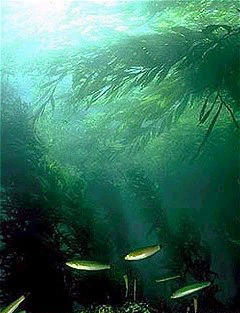
Pterygophora
A long-lived kelp with a woody stipe and annual growth rings.

Pterygophora is a genus of large brown macroalgae in the family Laminariaceae, containing the single species Pterygophora californica, commonly known as stalked kelp, woody-stemmed kelp, walking kelp, or winged kelp. It is notable for its long-lived, woody stipe that can survive up to twenty-five years and for forming a dominant understory canopy in Pacific coast kelp forests.
Quick Facts
- Genus
- Pterygophora
- Species
- californica
Facts from the source article.
Lore & Background
Pterygophora californica is a large brown seaweed that grows attached to rocky substrates by a holdfast, with a single tough, woody stipe up to two metres long and 2 cm in diameter. It is a perennial alga that may survive for twenty-five years, and annual growth rings can be seen in the stipe, allowing age estimation to within ±2 years. The upper half of the stipe bears smooth blades called sporophylls, which contain reproductive sporangia; the terminal blade is linear with a midrib and grows up to 90 cm long.
Reproduction involves an alternation of generations: microscopic zoospores released from sporangia settle and develop into haploid gametophytes, which produce gametes; fertilization yields zygotes that grow into diploid sporophytes. Ecologically, P. californica is a dominant understory species in kelp forests, often growing alongside bull kelp (Nereocystis luetkeana) and giant kelp (Macrocystis pyrifera). It creates a sub-surface canopy and can be shaded by the canopies of these larger kelps.
The most common cause of death is being torn from rocks during storms, a risk increased by the drag of epiphytic algae such as red algae, bull kelp, and sea belt (Saccharina latissima). P. californica reduces epiphytic loads by sloughing surface layers and producing antifouling phenols. Washed-up stipes degrade slowly and have been used by bald eagles as nest material. At Race Rocks, winter leaves only bare stipes, while by summer N. luetkeana forms the canopy and P. californica and S. latissima form a middle storey. Herbivores such as sea urchins (Strongylocentrotus purpuratus and Strongylocentrotus droebachiensis) graze on it, and overpopulation can create barren grounds.
Reader's Guide
Pterygophora californica holds significance as the sole species in its genus and as a key structural component of Pacific kelp forests. Its woody stipe, which can live for twenty-five years and display annual growth rings, provides a rare example of a perennial, tree-like growth form among brown algae. As a dominant understory species, it creates a sub-surface canopy that shapes the vertical structure of kelp forests, offering habitat and substrate for epiphytic algae including bull kelp and sea belt. The species' interactions with grazers like sea urchins illustrate the delicate balance of kelp forest ecosystems, where overgrazing can lead to persistent barren grounds. Its ability to slough surface layers and produce antifouling phenols demonstrates adaptive strategies against epiphytic burden. The use of its durable stipes by bald eagles for nest material highlights its role in coastal food webs beyond the marine environment. The species' distribution from British Columbia to Baja California and its depth range down to about ten metres define its ecological niche in the sublittoral zone.
Did You Know?
- Pterygophora californica is the only species in its genus Pterygophora, established by Ruprecht in 1852.
- Its age can be estimated to within ±2 years by counting annual growth rings in the woody stipe.
- Washed-up stipes have been found being used by bald eagles as nest material.
Frequently Asked Questions
What are Pterygophora's powers or ecological role?
Pterygophora serves as a dominant understory canopy in Pacific coast kelp forests, providing a persistent structural layer beneath the taller canopy species. Its woody stipe stretches up to two metres long and about two centimetres in diameter, while the whole plant can reach roughly three metres in height.
How long can Pterygophora live?
A single stipe of Pterygophora californica can persist for as long as twenty-five years, making it one of the longest-lived kelps in its habitat. Each year it lays down a new growth ring in its woody stem, much like a tree trunk.
Why is Pterygophora important to kelp-forest fans?
Because it forms a long-lasting understory layer, Pterygophora offers stable habitat and structural complexity for a wide range of marine organisms throughout the year. Its woody, ring-marked stipe sets it apart from the shorter-lived kelps around it and makes it a keystone component of Pacific coast kelp-forest ecology.
More in Brown Macroalgae and Kelp, Part 2 1-24
Spotted an error? Know more?
Reader corrections go straight into our review queue. Suggest an edit · How this site is sourced